
Question 112 marksAsked 2020Easy
Give one example of each when:
(i) Chemical energy changes into electrical energy.
(ii) Electrical energy changes into sound energy.
Confirming your payment
Sign up now and get 250 free tokens.
Previous Year Questions · Question 11 of 34
Give one example of each when:
(i) Chemical energy changes into electrical energy.
(ii) Electrical energy changes into sound energy.
Solution:
Concept: Every device or process takes in energy in one form and gives it out in another. To name the change, first name the form of energy that is supplied, then the useful form that comes out. An example is a device whose input is the first form and whose output is the second.
Step 1 — Part (i): chemical energy into electrical energy.
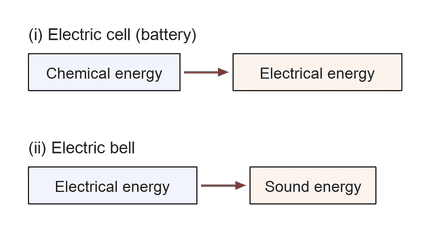
An electric cell (battery), such as the cell in a torch, does this. The chemical reaction between its electrodes and the electrolyte releases energy, which drives a current round the circuit.
Step 2 — Part (ii): electrical energy into sound energy.
An electric bell (or a loudspeaker) does this. The current makes the hammer of the bell strike the gong again and again (or makes the cone of the loudspeaker vibrate), and the vibrations produce sound.
Watch out: Keep the order of the change: a microphone changes sound into electrical energy, which is the reverse of part (ii).
Therefore, (i) an electric cell (battery), as in a torch; (ii) an electric bell (or a loudspeaker).