
Question 102 marksAsked 2020Easy
A satellite revolves around a planet in a circular orbit. What is the work done by the satellite at any instant? Give a reason.
Confirming your payment
Sign up now and get 250 free tokens.
Previous Year Questions · Question 10 of 34
A satellite revolves around a planet in a circular orbit. What is the work done by the satellite at any instant? Give a reason.
Solution:
Concept: Work is done when a force moves a body. If the force F makes an angle θ with the displacement S, only the part F cos θ acts along the displacement, so W = F S cos θ. Its S.I. unit is the joule: 1 joule is the work done when a force of 1 N moves a body through 1 m in its own direction. If the force is at 90° to the displacement, cos 90° = 0 and no work is done.
Step 1 — Find the force on the satellite.
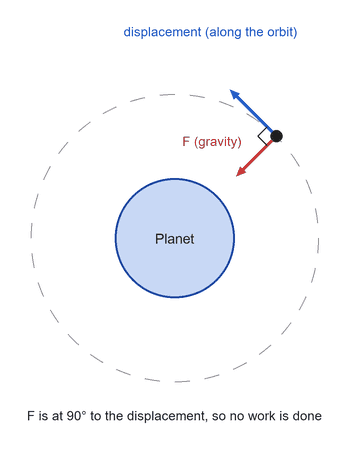
The only force on the satellite is the gravitational pull of the planet. It acts along the radius of the orbit, towards the centre of the planet.
Step 2 — Find the direction of the displacement.
At every instant the satellite moves along the tangent to its circular orbit.
Step 3 — Find the angle between them.
A tangent to a circle is perpendicular to the radius at that point, so the force and the displacement are at θ = 90° at every instant.
Step 4 — Find the work.
We put θ = 90° into the formula for the work. Since cos 90° is zero, the work is zero:
This is why the satellite keeps going round at a constant speed: no work is done, so its kinetic energy does not change.
Watch out: The satellite covers a large distance, but distance alone does not give work; the displacement must have a part along the force.
Therefore, the work done is zero, because the planet's pull (towards the centre) is at 90° to the satellite's displacement (along the tangent) at every instant.