Solution:
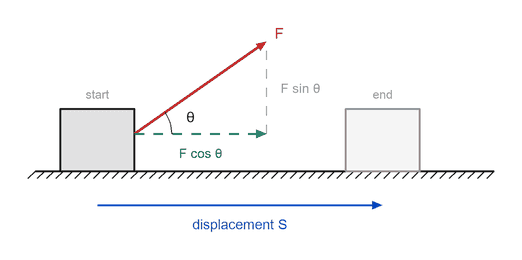
Concept: Work is done when a force moves a body. If the force F makes an angle θ with the displacement S, only the part F cos θ acts along the displacement, so W = F S cos θ. Its S.I. unit is the joule: 1 joule is the work done when a force of 1 N moves a body through 1 m in its own direction. The C.G.S. unit of work is the erg (1 dyne × 1 cm).
Step 1 — Part (i): write the two units.
The S.I. unit of work is the joule and the C.G.S. unit is the erg:
1 J=1 N×1 m
1 erg=1 dyne×1 cm
Step 2 — Part (i): change newton and metre into C.G.S. units.
Since 1 kg = 1000 g and 1 m = 100 cm, a newton (1 kg m s⁻²) is:
1 N=1000 g×100 cm s−2=105 dyne
and 1 m = 10² cm.
Step 3 — Part (i): substitute.
We put both into 1 J = 1 N × 1 m:
1 J=105 dyne×102 cm=107 dyne cm=107 erg
Step 4 — Part (ii): write the work at an angle.
When the force F makes an angle θ with the displacement S, only its part F cos θ acts along the displacement, so:
W=FScosθ
Step 5 — Part (ii): make the work greatest.
For a given F and S, W is greatest when cos θ is greatest. The largest value of cos θ is 1, at θ = 0°:
Wmax=FScos0∘
Wmax=FS
So the body must move in the direction of the force.
Watch out: Θ = 90° gives zero work and θ = 180° gives negative work; the maximum positive work is at θ = 0°.
Therefore, (i) 1 J = 10⁷ erg; (ii) θ = 0°, that is, the body moves in the direction of the force, and then W = F S.
