
Question 394 marksEasy
State the condition when the work done by a force is (a) positive, (b) negative. Explain with the help of examples.
Confirming your payment
Sign up now and get 250 free tokens.
Work, Energy and Power · Question 39 of 146
State the condition when the work done by a force is (a) positive, (b) negative. Explain with the help of examples.
Solution:
Concept: Since W = FS cos θ, the sign of the work depends on θ: W is positive for θ < 90° (the force helps the motion), zero for θ = 90°, and negative for θ > 90° (the force opposes the motion).
(a)
Step 1 — Condition for positive work.
Work is positive when the displacement is in the direction of the force, or at an angle less than 90° to it (cos θ > 0). The force helps the motion.
Step 2 — Examples of positive work.
A body falling freely: gravity (down) and the displacement (down) are in the same direction, so gravity does positive work. A horse pulling a cart forward: the pull and the motion are in the same direction.
(b)
Step 3 — Condition for negative work.
Work is negative when the displacement is opposite to the force, or at an angle greater than 90° to it (cos θ < 0). The force opposes the motion.
Step 4 — Examples of negative work.
A ball thrown up: gravity acts down while the ball moves up, so gravity does negative work. Friction on a sliding body acts opposite to its motion, so friction does negative work. A fielder stopping a ball does negative work on it.

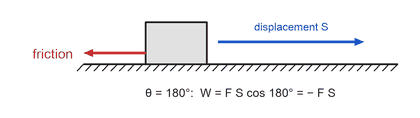
Watch out: The same force (gravity) does positive work on a falling ball and negative work on a rising one.
Therefore, work is positive when θ < 90° (e.g. gravity on a falling body), and negative when θ > 90° (e.g. gravity on a ball thrown up, or friction on a sliding body).