
Question 601 markMCQEasy
According to work energy theorem, the increase in the kinetic energy of a moving body is equal to ................ by a force acting in the direction of the moving body.
Confirming your payment
Sign up now and get 250 free tokens.
Work, Energy and Power · Question 60 of 146
According to work energy theorem, the increase in the kinetic energy of a moving body is equal to ................ by a force acting in the direction of the moving body.
(A) displacement
(B) velocity
(C) acceleration
(D) work done
Answer: (D) work done
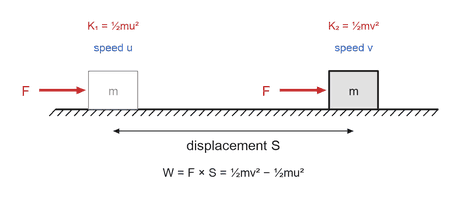
Concept: Work–energy theorem: the work done by a force on a body equals the change in its kinetic energy, W = ½mv² − ½mu², where u and v are the initial and final speeds.
Step 1 — Set up the situation.
A force F acts along the motion of a body of mass m over a displacement S, and its speed rises from u to v.
Step 2 — Apply the theorem.
The work done by the force equals the gain in kinetic energy.
Step 3 — Fill the blank.
So the increase in kinetic energy is equal to the WORK DONE by the force.
Watch out: An increase in energy can only equal another energy-type quantity (in joule).
Why the other options are wrong:
Therefore, the increase in kinetic energy equals the work done by the force, option (D).