Solution:
Concept: Falling water loses potential energy mgh. Efficiency = useful power (output) ÷ power input. A machine that is less than 100% efficient must take in MORE power than it gives out usefully; the rest is wasted, mostly as heat. So first find the INPUT power needed for 1 MW of output, then the mass of water that must fall each second to supply it.
Given: h = 50 m, efficiency = 40%, output power = 1 MW, g = 10 m s⁻².
Step 1 — Input power needed.
Since efficiency = output ÷ input, the input is the output divided by 0·40.
Pin=0.40106=2.5×10⁶ W
Step 2 — Energy from the water each second.
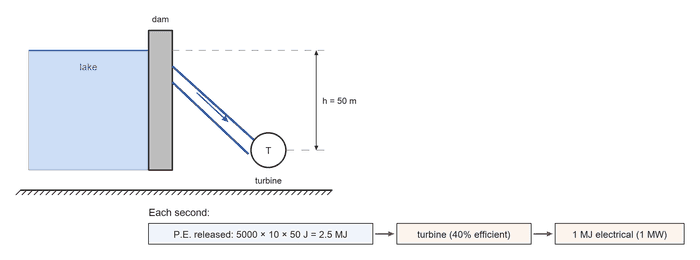
If a mass m falls through 50 m each second, the P.E. it releases each second is mgh, which must equal 2·5 × 10⁶ J.
m×10×50=2.5×10⁶
Step 3 — Solve for m.
Divide by 500.
m=5002.5×106=5000 kg
Step 4 — Say what it means.
That is about 5 cubic metres of water every second (1 m³ of water has a mass of 1000 kg).
Watch out: Use the input power (2·5 MW), not the output (1 MW), to find the water needed.
Therefore, 5000 kg (5 × 10³ kg) of water must flow through the turbine each second.
