Solution:
Concept: Going down the slope, the skier loses potential energy mg × (drop in height); only the vertical drop matters, not the shape of the track. Part of this lost P.E. becomes his kinetic energy at B.
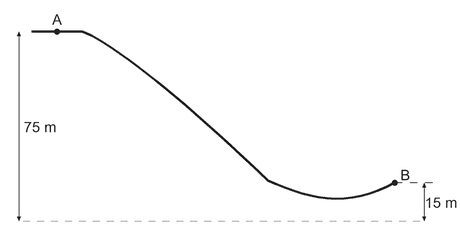
Given: weight 60 kgf (mass 60 kg); height of A = 75 m, of B = 15 m (figure); g = 10 m s⁻².
Step 1 — Weight and mass.
With g = 10 m s⁻², 60 kgf is 600 N, and his mass is 60 kg.
Step 2 — Drop in height.
From the figure, A is at 75 m and B at 15 m.
Δh=75−15=60 m
(a)
Step 3 — Change in potential energy.
Multiply the weight by the drop.
ΔU=600×60=36000 J
It is a decrease of 3·6 × 10⁴ J.
(b)
Step 4 — Kinetic energy at B.
75% of the lost P.E. becomes K.E.
K=10075×36000=27000 J
Step 5 — Speed at B.
Use K = ½mv², with m = 60 kg.
21×60×v2=27000
v2v=900=30 m s−1

Step 6 — Account for the rest.
The other 25% (9000 J) is used up against friction and air resistance, mostly as heat.
Watch out: Use the drop in height (60 m), not the height of A (75 m).
Therefore, (a) the gravitational potential energy decreases by 3·6 × 10⁴ J, and (b) the skier arrives at B at 30 m s⁻¹.