Solution:
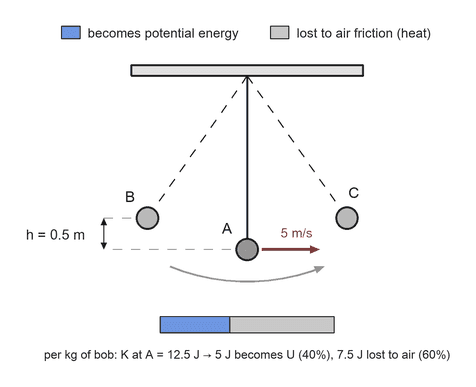
Concept: At the mean position the bob has only kinetic energy. Only the part NOT lost to air friction becomes potential energy at the extreme position. The mass m is not given, but it cancels.
Given: speed at the mean position v = 5 m s⁻¹, energy lost = 60%, g = 10 m s⁻².
Step 1 — Kinetic energy at the mean position.
Use K = ½mv², with v = 5 m s⁻¹.
K=21×m×52=12.5m J
Step 2 — Energy left for potential energy.
60% is lost, so 40% remains.
U=10040×12.5m=5m J
Step 3 — Find the height.
Put U = mgh, cancel m, and use g = 10 m s⁻².
mgh=5m
10h=5
h=105=0.5 m
Step 4 — Compare with no loss.
With no loss the bob would rise v² ÷ 2g, that is 25 ÷ 20 = 1·25 m; air friction cuts this to 0·5 m.
Watch out: Only 40% of the energy (not 60%) goes into height.
Therefore, the bob rises to a maximum vertical height of 0·5 m.
