Solution:
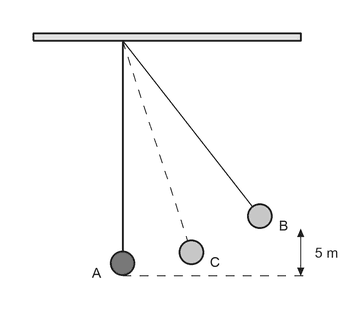
Concept: At the extreme position B the bob is at rest, so all its energy is potential energy. Conservation of mechanical energy: when friction and air resistance are negligible, potential energy and kinetic energy change into each other, but their sum U + K stays constant. So this same total is shared between U and K at C and is all kinetic at A.
Given: m = 200 g, height of B above A h = 5 m, g = 10 m s⁻².
(a)
Step 1 — Potential energy at B.
200 g is 0·2 kg; use U = mgh, with h = 5 m.
U=0.2×10×5=10 J
(b)
Step 2 — Total mechanical energy at C.
At C the bob has some P.E. and some K.E., but their sum equals the total it started with, 10 J.
(c)
Step 3 — Speed at A.
At A, U = 0, so all 10 J is kinetic energy.
21×0.2×v2=10
v2v=100=10 m s−1
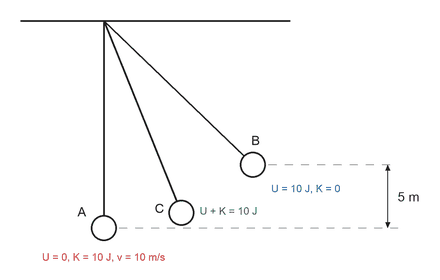
Therefore, (a) the potential energy at B is 10 J, (b) the total mechanical energy at C is 10 J, and (c) the speed of the bob at A is 10 m s⁻¹.