
Question 873 marksEasy
A body of mass is moving with a uniform velocity . A force is applied on the body due to which its velocity increases from to . How much work is being done by the force ?
Confirming your payment
Sign up now and get 250 free tokens.
Work, Energy and Power · Question 87 of 146
A body of mass is moving with a uniform velocity . A force is applied on the body due to which its velocity increases from to . How much work is being done by the force ?
Solution:
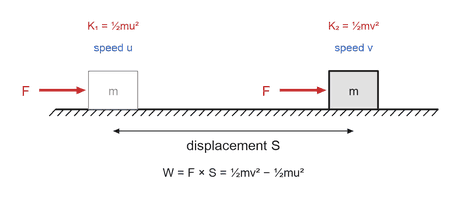
Concept: Work–energy theorem: the work done by a force on a body equals the change in its kinetic energy, W = ½mv² − ½mu², where u and v are the initial and final speeds. For a constant force it follows from F = ma and v² − u² = 2aS.
Given: mass m; velocity rises from u to v (the force acts along the motion).
Step 1 — Write the two kinetic energies.
The initial kinetic energy is ½mu² and the final kinetic energy is ½mv².
Step 2 — Find S from the equation of motion.
Let the force F give an acceleration a over a distance S. From v² − u² = 2aS,
Step 3 — Work out the work.
Work = force × displacement, with F = ma.
Step 4 — Interpret it.
This is the final kinetic energy minus the initial one: the increase in kinetic energy.
Therefore, the work done by the force is ½m(v² − u²), the increase in the kinetic energy of the body.