Solution:
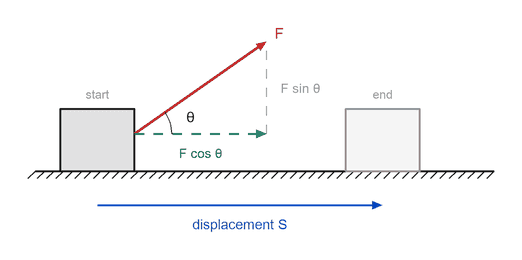
Concept: Work is done when a force moves a body. If a force F displaces a body through a distance S, and θ is the angle between the force and the displacement, the work done is W = FS cos θ. Work is a scalar, and its S.I. unit is the joule (1 J = 1 N × 1 m).
(a)
Step 1 — Write the expression for work.
Only the part of the force along the displacement, F cos θ, does work, so the work is that part multiplied by the displacement.
W=F×Scosθ
(b)(i)
Step 2 — Find the angle for zero work.
W is zero when cos θ = 0, that is when θ = 90°: the force is perpendicular to the displacement (for example, gravity on a coolie walking on a level road).
(b)(ii)
Step 3 — Find the angle for maximum work.
W is largest when cos θ = 1, that is when θ = 0°: the body moves in the direction of the force, and then W = FS.
Watch out: Zero work comes at 90°, not at 0°; at 0° the work is the greatest.
Therefore, (a) W = FS cos θ; (b) (i) θ = 90° for zero work, (ii) θ = 0° for maximum work.
