Solution:
Concept: Work is done when a force moves a body. If a force F displaces a body through a distance S, and θ is the angle between the force and the displacement, the work done is W = FS cos θ. Work is a scalar, and its S.I. unit is the joule (1 J = 1 N × 1 m). A force of 1 kgf is the weight of 1 kg, that is 1 kg × g.
Given: F = 20 kgf, S = 1 m, g = 10 N kg⁻¹.
Step 1 — Change the force into newton.
With g = 10 N kg⁻¹, 1 kgf = 10 N.
F=20×10 N=200 N
(i)
Step 2 — Displacement along the force.
Here θ = 0° and cos 0° = 1.
W=200×1×1=200 J
(ii)
Step 3 — Displacement at 60° to the force.
Here θ = 60° and cos 60° = 0·5.
W=200×1×0.5=100 J
(iii)
Step 4 — Displacement normal to the force.
Here θ = 90° and cos 90° = 0.
W=200×1×0=0
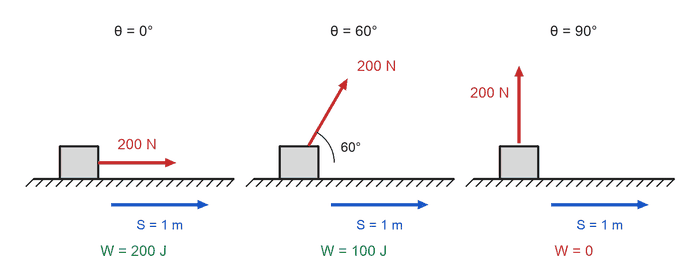
Step 5 — Notice the pattern.
As the angle grows from 0° to 90°, less of the force acts along the motion, so less work is done.
Watch out: Change kgf into newton before multiplying; 20 kgf × 1 m is not 20 J.
Therefore, the work done is (i) 200 J, (ii) 100 J and (iii) zero.
