
Question 1153 marksEasy
A body of mass 10 kg is moving with a velocity of 20 m s. If the mass of the body is doubled and its velocity is halved, find : (i) the initial kinetic energy, and (ii) the final kinetic energy.
Confirming your payment
Sign up now and get 250 free tokens.
Work, Energy and Power · Question 115 of 146
A body of mass 10 kg is moving with a velocity of 20 m s. If the mass of the body is doubled and its velocity is halved, find : (i) the initial kinetic energy, and (ii) the final kinetic energy.
Solution:
Concept: Kinetic energy is the energy of a body due to its motion. A body of mass m moving with speed v has K = ½mv². For a fixed mass, K is proportional to v² (double the speed, four times the energy). Doubling m doubles K, but halving v makes K one-fourth, so overall K becomes half.
Given: m = 10 kg, v = 20 m s⁻¹; then mass doubled, velocity halved.
(i)
Step 1 — Initial kinetic energy.
Use m = 10 kg and v = 20 m s⁻¹.
(ii)
Step 2 — Final kinetic energy.
Now m = 20 kg and v = 10 m s⁻¹.
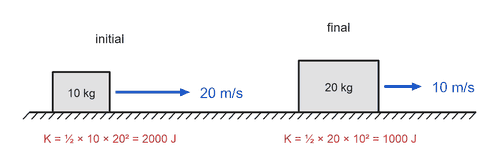
Therefore, (i) the initial kinetic energy is 2000 J, and (ii) the final kinetic energy is 1000 J (half of it).