Solution:
Concept: The work done in lifting the water is the useful work. Efficiency = useful power (output) ÷ power input. A machine that is less than 100% efficient must take in MORE power than it gives out usefully; the rest is wasted, mostly as heat.
Given: m = 600 kg, depth h = 75 m, t = 10 s, efficiency = 40%, g = 10 m s⁻².
(a)
Step 1 — Work done by the pump.
The pump lifts 600 kg of water through 75 m.
W=mgh=600×10×75=4.5×10⁵ J
(b)
Step 2 — Power at which the pump works.
Divide the useful work by the time.
P=104.5×105=4.5×10⁴ W=45 kW
(c)
Step 3 — Power rating.
The power rating is the power input. Since efficiency = useful power ÷ power input, the power input is the useful power divided by the efficiency (40% = 0·40).
power input=0.4045 kW=112.5 kW
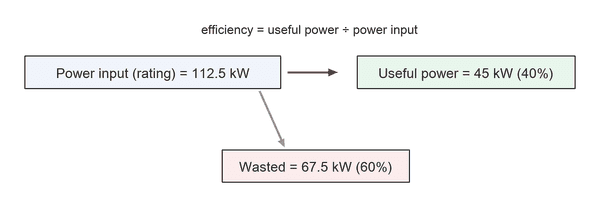
Step 4 — Check the waste.
Of the 112·5 kW taken in, only 45 kW lifts the water; the remaining 67·5 kW is wasted, mostly as heat.
Watch out: The rating must be LARGER than the useful power; dividing by 0·40, not multiplying, gives it.
Therefore, (a) the work done is 4·5 × 10⁵ J, (b) the pump works at 45 kW, and (c) its power rating is 112·5 kW.
