
Question 41 markMCQEasy
When a ball of mass is thrown upwards to a height , the work done by the force of gravity is :
Confirming your payment
Sign up now and get 250 free tokens.
Work, Energy and Power · Question 4 of 146
When a ball of mass is thrown upwards to a height , the work done by the force of gravity is :
(A)
(B)
(C)
(D)
Answer: (B)
Concept: Since W = FS cos θ, the sign of the work depends on θ: W is positive for θ < 90° (the force helps the motion), zero for θ = 90°, and negative for θ > 90° (the force opposes the motion).
Step 1 — Find the force and its direction.
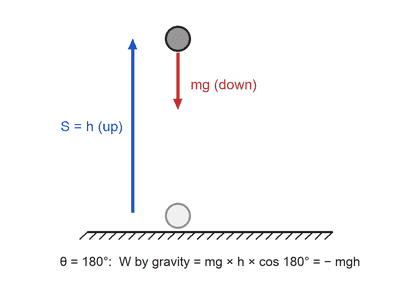
The force of gravity on the ball is its weight mg, acting vertically downward.
Step 2 — Find the displacement and the angle.
The ball moves vertically upward through h, opposite to the weight, so θ = 180° and cos 180° = −1.
Step 3 — Work out the work done by gravity.
Put F = mg, S = h and θ = 180° into the formula for work.
Step 4 — Interpret the sign.
The minus sign means gravity opposes the motion. The thrower does +mgh of work AGAINST gravity, while gravity itself does −mgh.
Watch out: The question asks for the work done BY gravity, not the work done against it.
Why the other options are wrong:
Therefore, the work done by the force of gravity is −mgh, option (B).