
Opening your dashboard
Class 10 Physics Chapter 2 Work, Energy and Power: Competency-Based Questions (CBQ)
40 questions on Chapter 2, each worked through on its own page with the AI tutor. Class 10 Physics, ICSE 2026-27.
40 questions
1–5 marks · Mixed difficulty
- 11 mark
Question 1
Competency: Analysis
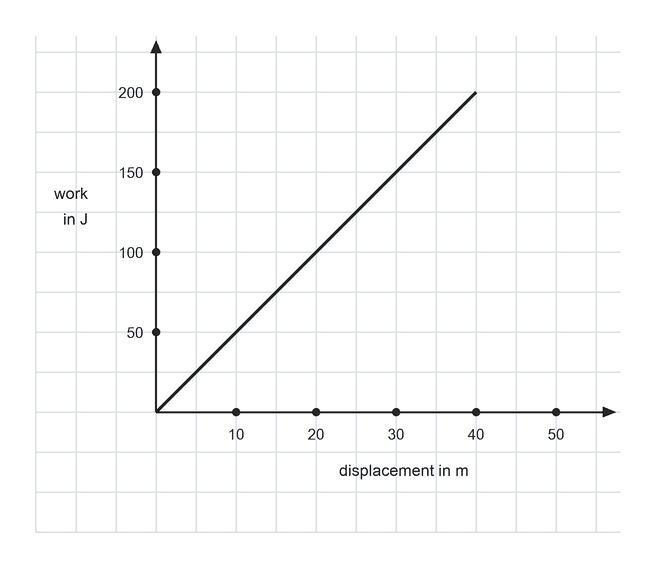
The given figure depicts the graph of work done vs. displacement under a constant force of 10 N. Which of the following statements is true?
- 21 mark
Question 2
Competency: Understanding
Assertion (A): When the displacement is zero, then the work is zero. So, if the work done is zero, then it necessarily means the displacement is zero.
Reason (R): Work done is calculated by the relation
- 32 marks
Question 3
Competency: Analysis
Regenerative braking involves harnessing the energy that is typically lost when a car decelerates and brakes and instead using it to recharge the car's batteries. Unlike traditional braking systems that simply dissipate energy, regenerative braking allows some of that energy to be recycled.
(a) What is the energy conversion process that results in the wastage of energy in a normal car during braking?
(b) How does regenerative braking differ from normal braking in terms of energy conversion?
- 43 marks
Question 4
Competency: Analysis
The mass of the block P is 5 kg. It is to be moved along an inclined plane AC of length 8 m, which makes an angle of 30° with the horizontal. A force of 50 N is applied on the block to move it through the inclined plane AC, as shown in the diagram.

(a) What is the work done by the force along the inclined plane?
(b) Find the gain in potential energy of block P if it is directly lifted to C from the ground. ()
(c) We know that potential energy is gained due to the work done on the body against gravity. Then, in this case, why is the work done on the block and the increase in the potential energy of the block different?
- 53 marks
Question 5
Competency: Analysis & Evaluation
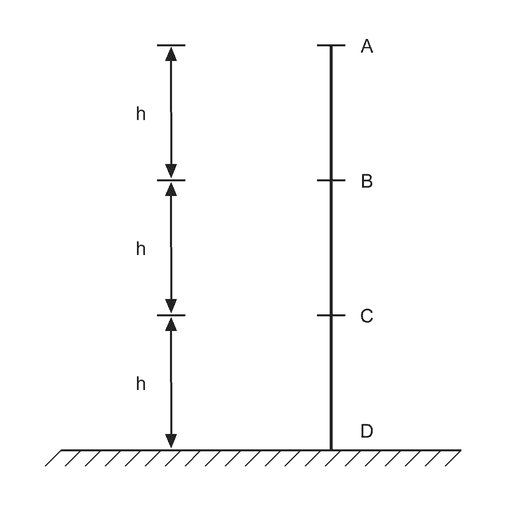
A ball of mass is dropped freely from point A. It is given that AB = BC = CD = . If the acceleration due to gravity at the given place is , then what will be its
(a) potential energy at point A?
(b) kinetic energy at point C?
- 63 marks
Question 6
Competency: Analysis & Evaluation
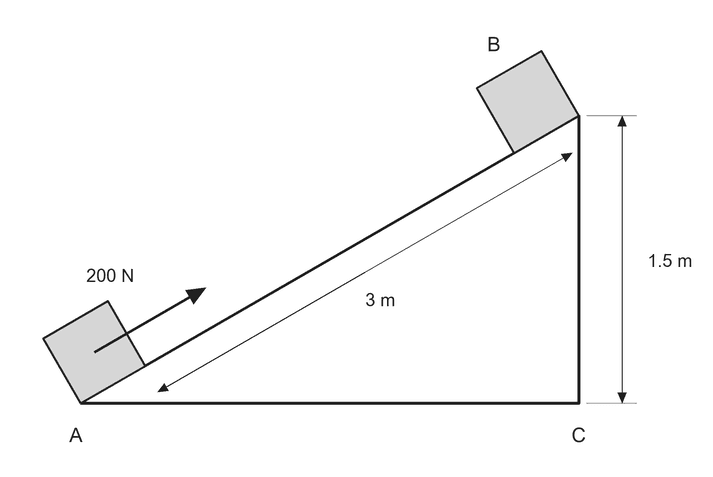
A block of mass 30 kg is pulled up a slope (diagram below) with a constant speed by applying a force of 200 N parallel to the slope. A and B are the initial and final positions of the block. Calculate the force of friction offered by the surface AB.
- 74 marks
Question 7
Competency: Evaluation
Shan is utilising a dynamometer to measure the force, expressed in newtons, on a bowstring. He records both the force and displacement of the bowstring and plots the data on a graph that shows the relationship between force in newtons and displacement in centimetres. Shan is interested in determining the highest point that the arrow reaches. He knows he can calculate the work done by finding the area under the graph.
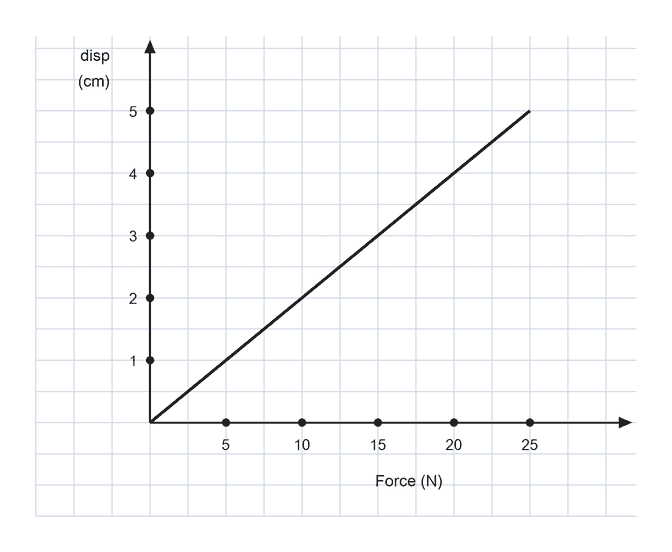
(a) What is the potential energy stored in the bow string, when the force is 25 N?
(b) If the mass of the arrow is 31.25 g, calculate the maximum velocity attained by the arrow.
(c) Calculate the maximum height reached by the arrow.
- 84 marks
Question 8
Competency: Analysis & Evaluation
Two students are conducting experiments with identical 100 g mass simple pendulums, each raising the bob 5 m above the mean position. The graph depicting the relationship between distance from the mean position and velocities is presented in the diagram.
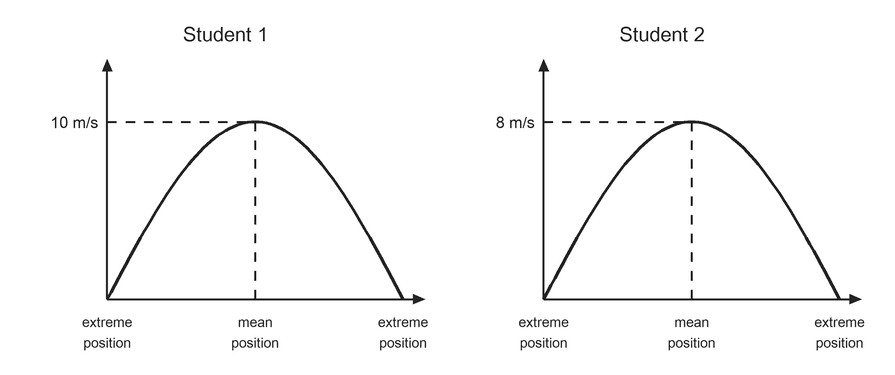
(a) Demonstrate, using mathematical calculations, that the path followed by student 1 is devoid of friction.
(b) Does the situation involving student 2 exhibit a breach of the law of conservation of energy?
- 94 marks
Question 9
Competency: Analysis & Creation
In a hydraulic power station, water is first stored in a dam at a higher altitude.
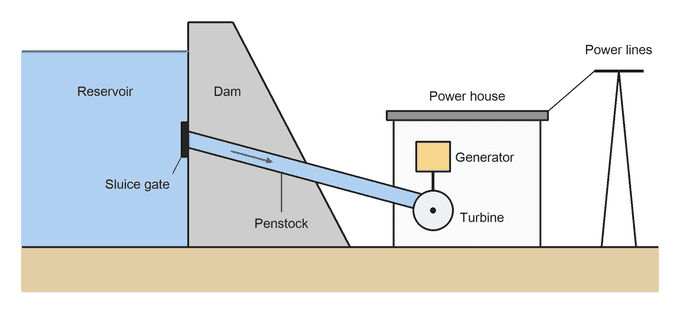
(a) What is the purpose of being stored at higher altitudes?
(b) When the water is allowed to fall on a turbine, what change of energy takes place for the water?
(c) Why is this turbine connected to the armature of a generator?
(d) Which basic law of physics is followed by the whole mechanism?
- 101 mark
Question 10
Competency: Application
The display of an electric scooter shows that its motor is delivering a steady 500 W to the wheels while the scooter runs along a level road at a constant speed of 36 km h. How much work does the motor do against friction and air resistance while the scooter covers 2 km?
- 111 mark
Question 11
Competency: Analysis
A delivery drone of mass 2 kg rises vertically from the ground to a height of 30 m at a steady speed of 3 m s. Which statement about the drone during this climb is correct? (Take .)
- 121 mark
Question 12
Competency: Understanding
Assertion (A): Two sisters of the same mass go up the same flight of stairs, one running and the other walking. Both do the same amount of work against the force of gravity.
Reason (R): The sister who runs up the stairs develops more power than the sister who walks up.
- 134 marks
Question 13
Competency: Analysis & Evaluation
Case study: A housing society wants to buy a pump to fill its overhead tanks. The dealer runs two pumps, X and Y, on trial at two different buildings. The record of the trials is given below.
Pump Mass of water lifted Height through which it is lifted Time taken X 600 kg 12 m 5 min Y 450 kg 20 m 6 min Take .
(a) Calculate the work done against gravity by each pump during its trial.
(b) Calculate the power developed by each pump in lifting the water.
(c) The dealer says, "Pump X is clearly the more powerful one. It lifted more water and it took less time." Judge his statement. Also find the time pump Y would take to do the job that pump X did in its trial.
- 144 marks
Question 14
Competency: Application & Analysis
Case study: A carpenter drives identical nails into a block of hard wood, first with a light hammer P and then with a heavy hammer Q. A sensor records the speed of the head of each hammer just before it strikes the nail.
Hammer Mass of the head Speed just before striking P 0.25 kg 8 m s Q 0.5 kg 4 m s Assume that in each blow the whole kinetic energy of the hammer head is used in doing work against the resistance of the wood, which is a constant force of 800 N on the nail.
(a) Calculate the kinetic energy and the momentum of each hammer head just before it strikes.
(b) Find how far each hammer drives the nail into the wood in one blow.
(c) The carpenter's apprentice says, "Both hammers hit with the same momentum, so they must drive the nail in equally." Use the relation between kinetic energy and momentum to judge his statement. Then find the speed at which hammer Q must strike to drive the nail as far as P does in one blow.
- 154 marks
Question 15
Competency: Application & Evaluation
Case study: A family fixes a solar panel of area 2 m on the roof of its house. Around noon, sunlight delivers 1000 J of energy every second on each square metre of the panel. The panel converts one-fifth of the light energy falling on it into electrical energy. Over a whole day the panel produces as much electrical energy as it would in 5 hours of noon sunshine.
(a) State the energy conversion that takes place in the panel, and find its electrical power output at noon.
(b) Find the electrical energy produced by the panel in a day, in kWh and in joule.
(c) The father says, "This panel alone will run our 1.5 kW water heater for 2 hours every day." Judge his claim by calculation, and state what happens to the remaining four-fifths of the light energy that falls on the panel.
- 164 marks
Question 16
Competency: Analysis & Creation
Riya reads that a stretched rubber band has elastic potential energy. She guesses that the more the band is stretched, the more energy it stores. To test this she fixes a thick rubber band between two nails at one end of a long wooden board, like a catapult. She also has a small wooden block, a metre rule and a piece of chalk.
(a) When the block is pressed against the band, pulled back and released, it shoots forward and then slides to rest on the board. State the energy changes that take place, and explain why the distance the block slides can be used to compare the energy that was stored in the band.
(b) Design an experiment, using only these things, to test Riya's guess. Give the steps and show how the readings should be recorded.
(c) State the result that would support her guess, and give two precautions that make the test fair and reliable.
- 171 mark
Question 17
Competency: Analysis
A ball of mass 0.2 kg is thrown vertically upward from the ground with a speed of 10 . Neglect air resistance. Take . Four students draw bar charts of the potential energy (PE) and the kinetic energy (KE) of the ball at the instant when it is 3 m above the ground.

Which chart is correct?
- 181 mark
Question 18
Competency: Application
In a storeroom, four objects P, Q, R and S rest on the shelves of a rack, as shown. The ruler on the right gives the height of each shelf above the floor. Treat each object as if its mass were at the height of its shelf, take the floor as the level of zero potential energy, and take .
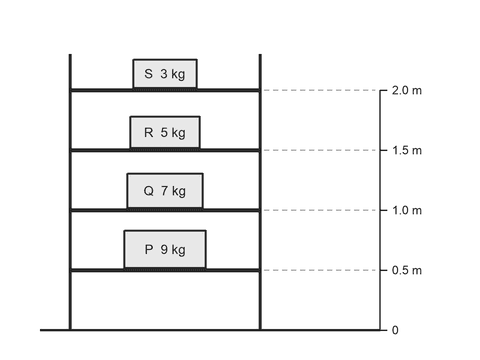
Which object has the greatest gravitational potential energy?
- 191 mark
Question 19
Competency: Understanding
Assertion (A): When a battery-driven toy car runs along a level floor, its potential energy does not change.
Reason (R): In the toy car, the chemical energy of the cells changes, through electrical energy, into kinetic energy and heat.
- 201 mark
Question 20
Competency: Analysis
A small ball is released from rest at A on a smooth track (no friction), as shown. The heights are measured from the level of the valley floors, where B is: A is 2.0 m, the hill top C is 1.5 m and the hill top D is 2.5 m high. Take .
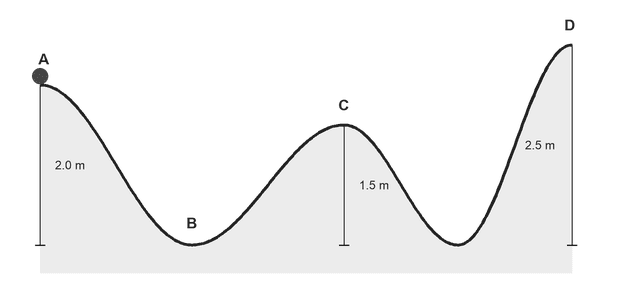
Which statement about the motion of the ball is correct?
- 211 mark
Question 21
Competency: Evaluation
At a metro station, an escalator carries people up at a steady vertical speed of 0.25 . At rush hour 40 passengers of average mass 60 kg stand on it at the same time. The engineer says that a motor with an output power of 5 kW is enough to carry them. Neglect friction in the machinery. (Hypothetical data.) Take . Which of the following judgements is correct?
- 221 mark
Question 22
Competency: Understanding
Assertion (A): A body of larger mass always has greater kinetic energy than a body of smaller mass.
Reason (R): The kinetic energy of a body depends on its mass and also on the square of its speed.
- 231 mark
Question 23
Competency: Application
Four quantities of energy are given in different units.
Use 1 H.P. = 746 W, 1 kWh = J and 1 J = erg.
Which of the following is the greatest quantity of energy?
- 241 mark
Question 24
Competency: Analysis
In a school laboratory a toy car of mass 0.5 kg is released from rest on a smooth ramp from three different heights. A sensor records its speed at the foot of the ramp. (Hypothetical data.) Take .
Release height (m) 0.10 0.20 0.40 Speed at the foot () 1.4 2.0 2.8 Which statement agrees with these readings?
- 251 mark
Question 25
Competency: Analysis
The graph shows the work done by two electric motors, A and B, with time. Each motor works at a steady rate.
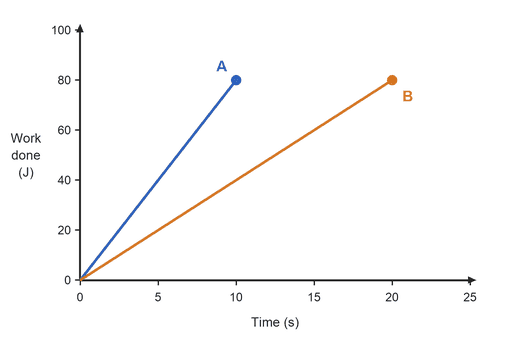
Which statement is correct?
- 261 mark
Question 26
Competency: Application
On a steep hill road, a straight uphill ramp is built beside the road for trucks whose brakes have failed. A runaway truck of mass 8000 kg enters the ramp at a speed of 20 . Treat the ramp as smooth, so the truck is stopped only because it rises. (Hypothetical data.) Take .
What is the least vertical height through which the ramp must rise to stop the truck?
- 272 marks
Question 27
Competency: Understanding
A hand-cranked emergency radio has no battery. When its handle is turned, a small generator inside produces the electricity that makes the loudspeaker play.
(a) Write, in order, the chain of energy changes from the food eaten by the person to the sound from the loudspeaker.
(b) The person must keep turning the handle to keep the radio playing, and the handle feels warm after a long time. Explain why this does not go against the principle of conservation of energy.
- 282 marks
Question 28
Competency: Application
A girl carries a 5 kg pot of water to a terrace 6 m above the ground. On Monday she climbs a vertical ladder. On Tuesday she goes up a long spiral staircase, 24 m in length, to reach the same terrace. Both days she lifts the pot at a steady pace and finds Tuesday more tiring. (Hypothetical data.) Take .
(a) Find the work done against gravity on the pot on Monday.
(b) State the work done against gravity on the pot on Tuesday, and give one reason why Tuesday still feels more tiring.
- 292 marks
Question 29
Competency: Analysis
A cyclist can keep up a steady power output of 240 W at the pedals. On a level road the total force opposing him (friction and air resistance) is 40 N. On a steep uphill road the force he must supply to move at a steady speed, taking the resistance and gravity together, is 120 N. (Hypothetical data.)
(a) Find his steady speed on the level road.
(b) Find his steady speed on the uphill road. Explain, using the relation between power, force and speed, why the speed falls.
- 302 marks
Question 30
Competency: Application
The label on a 50 g chocolate bar says 'Energy: 250 kcal'. Use 1 kcal = 1000 cal and 1 cal = 4.2 J. (Hypothetical data.) A student of mass 50 kg imagines using all of this energy to lift herself up a hill. Take .
(a) Convert the energy of the bar to joule.
(b) Find the height through which this energy could lift her, and give one reason why she cannot really climb that high on this chocolate.
- 312 marks
Question 31
Competency: Analysis
A simple pendulum of length 1.0 m is released from rest at A, which is 0.36 m above its lowest point B. A thin peg P is fixed on the vertical line through the pivot O, 0.6 m below O. When the bob moves from B towards the right, the string catches on the peg, and the bob then swings on a smaller circle about P. Neglect friction and air resistance. Take .
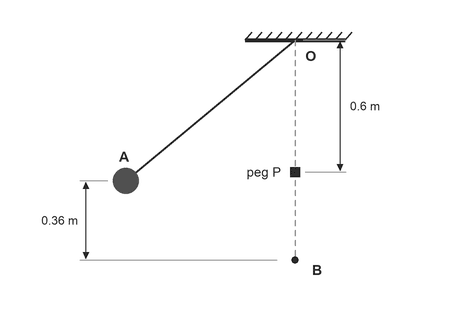
(a) Predict how the height reached by the bob on the right-hand side, measured from B, compares with the height of A above B.
(b) Use energy to explain your answer, although the string on the right-hand side is shorter.
- 322 marks
Question 32
Competency: Analysis
A coconut of unknown mass drops from a branch of a palm tree, 5 m above the ground, and falls freely. A sensor records its kinetic energy against the distance it has fallen from the branch, and the readings are plotted on the graph shown. (Hypothetical data.) Take .

(a) Use the graph to find the mass of the coconut.
(b) Find the speed with which the coconut reaches the ground.
- 333 marks
Question 33
Competency: Evaluation
From the top of a cliff 20 m high, three identical stones are thrown with the same speed of 10 : stone 1 vertically upward, stone 2 horizontally and stone 3 vertically downward. Neglect air resistance. Take . Arun says, "Stone 3 will hit the ground with the greatest speed and stone 1 with the least."
(a) Using energy, find the speed of stone 2 when it reaches the ground.
(b) Find the speeds of stones 1 and 3 when they reach the ground.
(c) Judge Arun's statement, and say what is different about the three stones.
- 343 marks
Question 34
Competency: Creativity
Harpreet has a smooth curved metal channel shaped like a bowl cut in half, a steel marble, a metre rule and a few books. She wants to test whether the marble regains its starting height on the opposite side of the channel.
(a) Describe how she should set up and carry out the test, and what she should measure.
(b) State what she should expect to find, and explain, using energy changes, any difference from the ideal result.
(c) Suggest one change to the experiment that would make the marble rise closer to its starting height, and say why it works.
- 353 marks
Question 35
Competency: Analysis
A weightlifter lifts a 100 kg barbell from the floor to a height of 2.0 m in 1.6 s, holds it steady overhead for 3.0 s, and then lowers it slowly. (Hypothetical data.) Take .
(a) Find the work done by him on the barbell during the lift.
(b) Find his average power during the lift.
(c) Find his average power over the 4.6 s from the start of the lift to the end of the hold, and explain why it is less than the answer to (b).
- 363 marks
Question 36
Competency: Application
A scooter engine changes 25 % of the chemical energy of its petrol into useful work and the rest is wasted as heat. One litre of petrol releases J of energy on burning. At a steady speed on a level road the scooter has to work against a total resistance of 170 N. (Hypothetical data.)
(a) State the energy changes that take place in the engine.
(b) Find the useful work done by the engine for each litre of petrol.
(c) Find the distance the scooter can travel on one litre of petrol.
- 373 marks
Question 37
Competency: Analysis
In a coal-fired power station, the energy passed on at each stage for every 100 MJ of chemical energy in the coal burnt is given in the table. (Hypothetical data.)
Stage Energy passed on to the next stage (MJ) Boiler makes steam (heat energy) 80 Turbine is turned by the steam 36 Generator produces electrical energy 34 (a) Name the form of energy that enters the turbine and the form of energy that leaves it.
(b) Find the energy wasted at each stage, and name the stage that wastes the most.
(c) Say where the wasted energy goes, and whether this goes against the principle of conservation of energy.
- 384 marks
Question 38
Competency: Evaluation
Case study: The Mehta family wants to reduce its electricity bill. The table shows the appliances in its flat, the power of each one and the number of hours it is used in a day. The electricity company charges ₹6 for every unit (1 kWh) of energy used. Take a month as 30 days. Their neighbour says, "The geyser has the highest power rating, so it must be using the most energy in your flat." (Hypothetical data.)
Appliance Number Power of each (W) Hours of use per day LED lamp 6 10 6 Ceiling fan 3 60 10 Refrigerator 1 150 8 Geyser 1 2000 0.5 Television 1 100 4 (a) Find the energy used in a day by each kind of appliance, in kWh, and the total for the day.
(b) Find the energy used in a month and the electricity bill for the month.
(c) Judge the neighbour's statement, using your answer to (a).
- 395 marks
Question 39
Competency: Evaluation
Case study: A skydiver of total mass 80 kg jumps from an aeroplane at a height of 4000 m and falls for a while with the parachute still closed. A tracking device records her speed at different heights, as given in the table. Take the ground as the level of zero potential energy, and note that the air pushes upward on her as she falls. Her friend Ritu looks at the readings and says, "Near the end her speed hardly changes, so no energy is being lost there." (Hypothetical data.) Take .
Height (m) 4000 3800 3000 2500 Speed () 0 45 53 54 (a) Find the loss of potential energy and the gain of kinetic energy between 4000 m and 3800 m.
(b) Find the energy transferred to the air in this stretch, and say in what form it appears.
(c) Find the loss of potential energy and the gain of kinetic energy between 3000 m and 2500 m, and judge Ritu's statement.
- 404 marks
Question 40
Competency: Creativity
Case study: For a science fair, a class builds a lamp that needs no battery. A bag of sand of mass 12 kg is lifted by hand to a height of 1.8 m. As the bag sinks very slowly, a string turns a small generator which lights an LED of power 0.1 W. Because of losses in the generator, only half of the energy lost by the falling bag reaches the LED as electrical energy. (Hypothetical data.) Take .
(a) Find the gain in the potential energy of the bag when it is lifted.
(b) For how long does the lamp stay lit on one lifting of the bag?
(c) The class wants the lamp to stay lit for at least one hour with the same LED. Propose a change to the design, and show by calculation that it works.