
Question 621 markMCQEasy
The wheel of a moving vehicle possesses :
Confirming your payment
Sign up now and get 250 free tokens.
Work, Energy and Power · Question 62 of 146
The wheel of a moving vehicle possesses :
(A) rotational kinetic energy
(B) translational kinetic energy
(C) vibrational kinetic energy
(D) both rotational and translational kinetic energy
Answer: (D) both rotational and translational kinetic energy
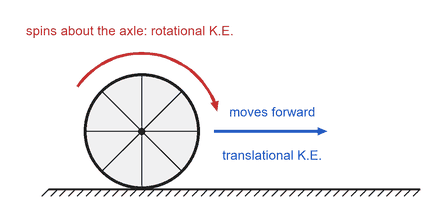
Concept: Kinetic energy has three forms: translational (the body moves from place to place), rotational (it spins about an axis) and vibrational (it moves to and fro about a mean position). A body can have more than one form at the same time.
Step 1 — Look at the spinning.
The wheel spins about its axle, so it has rotational kinetic energy.
Step 2 — Look at the forward motion.
At the same time the axle, and with it the whole wheel, moves forward along the road with the vehicle, so the wheel also has translational kinetic energy.
Why the other options are wrong:
Therefore, the wheel of a moving vehicle has both rotational and translational kinetic energy, option (D).