
Opening your dashboard
Class 10 Chemistry Chapter 6 Electrolysis: Previous Year Questions
60 questions on Chapter 6, each solved step by step. Class 10 Chemistry, ICSE 2026-27.
60 questions with solutions
1–5 marks · Mixed difficulty
- 11 mark
Question 1
The particles present in strong electrolytes are:
Solve with AIAnswer
(A) only molecules
- Correct
(B) mainly ions
(C) ions and molecules
(D) only atoms.
Answer: (B) mainly ions
Concept: Electrolytes conduct because they contain mobile ions. A strong electrolyte is almost completely dissociated, so it contains (almost) only ions; a weak electrolyte is only partly dissociated, so it contains ions together with many un-ionised molecules; a non-electrolyte forms no ions and contains only molecules.
Step 1 — Recall what a strong electrolyte is.
A strong electrolyte, such as sodium chloride, sodium hydroxide or hydrochloric acid, breaks up almost completely into ions when it is melted or dissolved in water.
Step 2 — Name the particles.
Since almost every unit has split into ions, the particles of the electrolyte are mainly ions; practically no undissociated molecules are left. These many mobile ions are why a strong electrolyte conducts well.
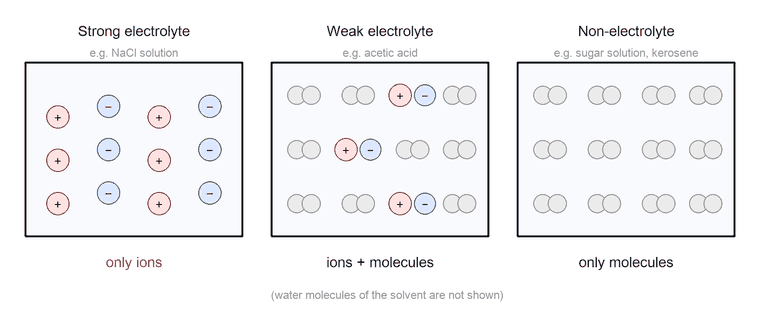
Watch out: The water molecules of a solution are the solvent, not particles of the electrolyte; do not let them push you to 'ions and molecules', which describes a weak electrolyte.
Why the other options are wrong:
- (A) only molecules: Only molecules (no ions) is the case of a non-electrolyte such as sugar solution, which does not conduct.
- (C) ions and molecules: Ions together with many un-ionised molecules describe a weak electrolyte such as acetic acid.
- (D) only atoms: Electrolytes conduct by ions, not by neutral atoms; free atoms are not the particles of any electrolyte.
Therefore, the particles present in strong electrolytes are mainly ions, option (B).
- 24 marks
Question 2
Write equations for the reactions taking place at the two electrodes (mentioning clearly the name of the electrode) during the electrolysis of:
(i) Acidified copper sulphate solution with copper electrodes.
(ii) Molten lead bromide with inert electrodes.
Solve with AIWritten solution
Solution:
Concept: In an electrolytic cell the anode is the electrode joined to the positive (+) terminal of the battery and the cathode is the electrode joined to the negative (−) terminal. Cations (+) move to the cathode and gain electrons there (reduction); anions (−) move to the anode and lose electrons there (oxidation). An inert electrode (platinum, graphite) only passes electrons and takes no part in the reaction. An active electrode (copper, nickel, silver) takes part: as an anode, its own atoms lose electrons and go into the solution as ions, so the anode dissolves.
(i) Acidified copper sulphate solution, copper electrodes
Step 1 — List the ions.
The solution contains and ions from copper sulphate, ions from the acid and a few and ions from water.
Step 2 — Reaction at the cathode (copper).
Both and move to the cathode. is lower than in the electrochemical series, so it is discharged and copper is deposited:
Step 3 — Reaction at the anode (copper).
The anions and move to the anode, but neither is discharged, because the copper anode is an active electrode. Its own atoms lose electrons more easily and go into the solution as copper ions, so the anode dissolves:
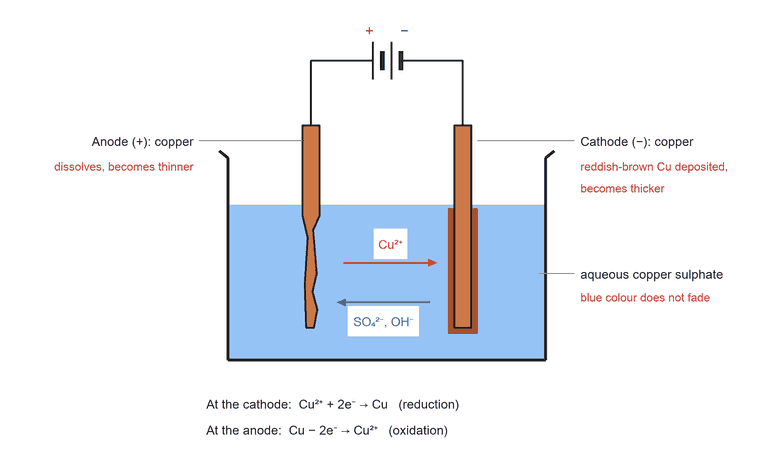
(ii) Molten lead bromide, inert electrodes
Step 4 — List the ions.
Molten lead bromide contains only and ions, now free to move.
Step 5 — Reaction at the cathode (graphite).
The ions move to the cathode and each gains two electrons, forming lead metal:
Step 6 — Reaction at the anode (graphite).
The ions move to the anode and each loses one electron. The bromine atoms formed then join in pairs to give bromine molecules:
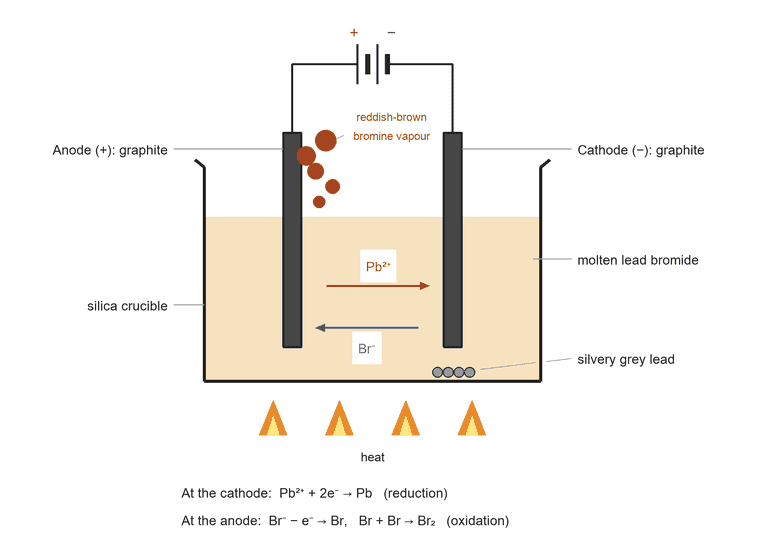
Watch out: With copper electrodes the anode reaction is the copper anode dissolving, not the discharge of OH⁻ ions (that happens only with an inert anode).
Therefore, (i) cathode: Cu²⁺ + 2e⁻ → Cu and anode: Cu − 2e⁻ → Cu²⁺; (ii) cathode: Pb²⁺ + 2e⁻ → Pb and anode: Br⁻ − e⁻ → Br, Br + Br → Br₂.
- 32 marks
Question 3
(i) Name the product formed at the anode during the electrolysis of acidified water using platinum electrodes.
(ii) Name the metallic ions that should be present in the electrolyte when an article made of copper is to be electroplated with silver.
Solve with AIWritten solution
Solution:
Concept: When two or more ions of the same sign reach an electrode, the ion lower in the electrochemical series is discharged in preference (selective discharge). The cation series is K⁺, Ca²⁺, Na⁺, Mg²⁺, Al³⁺, Zn²⁺, Fe²⁺, Ni²⁺, Sn²⁺, Pb²⁺, H⁺, Cu²⁺, Hg²⁺, Ag⁺, Au³⁺ and the anion series is SO₄²⁻, NO₃⁻, Cl⁻, Br⁻, I⁻, OH⁻; in both lists the ease of discharge increases downwards. In electroplating, the electrolyte must contain ions of the metal that is to be deposited.
(i) Product at the anode
Step 1 — Find the anions at the anode.
Acidified water contains ions from the sulphuric acid and ions from water. Both move to the platinum anode.
Step 2 — Choose the ion discharged.
The ion is lower than in the anion series, so ions lose electrons:
The OH groups then combine to give water and oxygen gas:
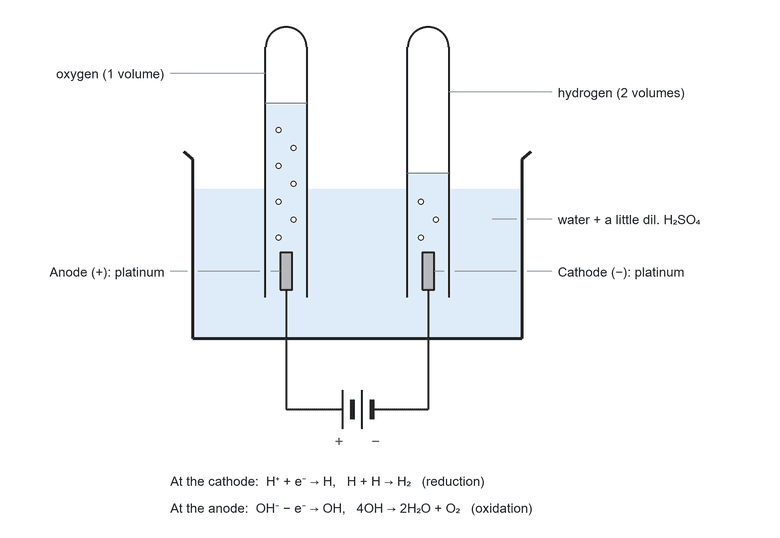
(ii) Metallic ions in the electrolyte
Step 3 — Match the ion to the coat.
The copper article is made the cathode and must receive a coat of silver, so the electrolyte must supply silver ions, . In practice a solution of sodium argentocyanide, , is used, which gives the silver ions slowly.
At the article each silver ion gains one electron:

Watch out: The anode product is a GAS, oxygen; hydrogen is the cathode product.
Therefore, (i) oxygen gas is formed at the anode, and (ii) silver ions (Ag⁺) must be present in the electrolyte.
- 43 marks
Question 4
Give reasons why:
(i) Sodium Chloride will conduct electricity only in fused or aqueous solution state.
(ii) In the electroplating of an article with silver, the electrolyte sodium argento-cyanide solution is preferred over silver nitrate solution.
(iii) Although copper is a good conductor of electricity, it is a non-electrolyte.
Solve with AIWritten solution
Solution:
Concept: An electrolyte conducts by mobile ions and is decomposed by the current; a metal conducts by free electrons and is not decomposed.
(i) Sodium chloride conducts only when fused or dissolved
Step 1 — Look at the solid.
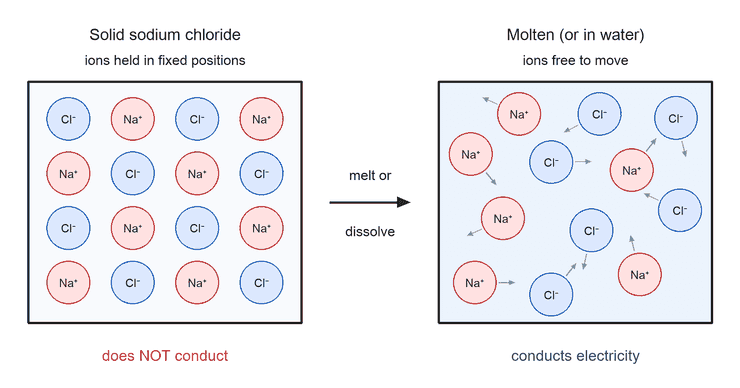
In solid sodium chloride the and ions are held in fixed positions in the crystal by strong electrostatic forces of attraction. They cannot move, so they cannot carry a current.
Step 2 — Look at the melt or the solution.
On fusion (melting) or on dissolving in water these forces are overcome and the ions become free to move. Mobile ions carry the current, so fused or aqueous sodium chloride conducts.
(ii) Sodium argentocyanide is preferred to silver nitrate
Step 3 — Compare the two electrolytes.
Sodium argentocyanide, , is a complex salt that gives ions slowly, so silver is deposited slowly and evenly, giving a smooth, firm and lasting coat. With silver nitrate solution the silver is deposited very fast, so the coat is rough and uneven and does not stick well.
(iii) Copper is a non-electrolyte
Step 4 — See how copper conducts.
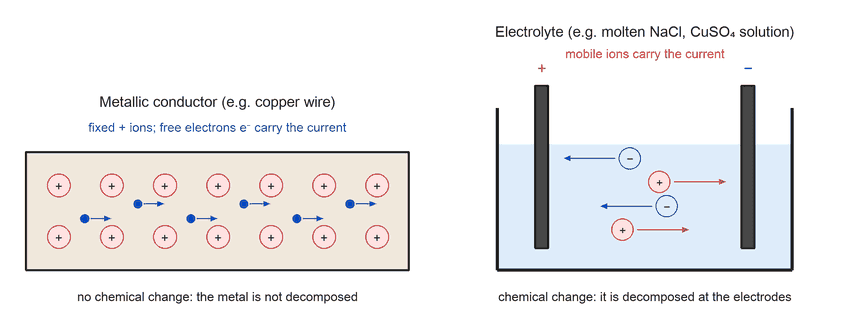
Copper conducts by the movement of free electrons, and it undergoes no chemical change when the current passes.
Step 5 — Compare with the definition.
An electrolyte must conduct by ions and be decomposed by the current. Copper does neither, so although it is a good conductor it is a non-electrolyte (a metallic conductor).
Watch out: 'Good conductor' and 'electrolyte' are not the same thing: an electrolyte must be chemically decomposed by the current.
Therefore, (i) its ions are free to move only when fused or dissolved; (ii) sodium argentocyanide releases Ag⁺ ions slowly, giving a smooth, even, firm coat (silver nitrate deposits silver too fast); (iii) copper conducts by electrons and is not decomposed, so it is not an electrolyte.
- 51 mark
Question 5
Identify the substance underlined, in each of the following cases:
The electrolyte used for electroplating an article with silver.
Solve with AIWritten solution
Solution:
Concept: In electroplating the article to be plated is made the cathode, a block of the pure plating metal is made the anode, and the electrolyte is a solution of a salt of the plating metal. The metal ions are discharged on the article; the anode dissolves and replaces them. For silver the electrolyte must give silver ions slowly and steadily.
Step 1 — Decide what the electrolyte must supply.
To plate an article with silver, the electrolyte must contain silver ions, and it must give them up slowly so that the coat is smooth and even.
Step 2 — Name the electrolyte.
Sodium argentocyanide, , does this. It dissociates to give ions slowly:
(Potassium argentocyanide, , is also used.)
Watch out: Silver nitrate also contains Ag⁺ ions, but it deposits silver too fast and gives an uneven coat, so it is not the electrolyte used.
Therefore, the electrolyte is sodium argentocyanide, Na[Ag(CN)₂].
- 61 mark
Question 6
Identify the substance underlined, in each of the following cases:
The particles present in a liquid such as kerosene, that is a non electrolyte.
Solve with AIWritten solution
Solution:
Concept: Electrolytes conduct because they contain mobile ions. A strong electrolyte is almost completely dissociated, so it contains (almost) only ions; a weak electrolyte is only partly dissociated, so it contains ions together with many un-ionised molecules; a non-electrolyte forms no ions and contains only molecules.
Step 1 — Classify kerosene.
Kerosene is a mixture of covalent hydrocarbons. It forms no ions at all, so it does not conduct electricity; it is a non-electrolyte.
Step 2 — Name its particles.
A substance with no ions is made up only of molecules, so the particles in kerosene are molecules.
Watch out: A non-electrolyte has no ions at all, not even a few.
Therefore, the particles present in kerosene are molecules.
- 74 marks
Question 7
State the observations at the anode and at the cathode during the electrolysis of :
(i) fused lead bromide using graphite electrodes.
(ii) copper sulphate solution using copper electrodes.
Solve with AIWritten solution
Solution:
Concept: What is seen at each electrode depends on the ions present and on whether the electrode is inert (graphite) or active (copper). In an electrolytic cell the anode is the electrode joined to the positive (+) terminal of the battery and the cathode is the electrode joined to the negative (−) terminal. Cations (+) move to the cathode and gain electrons there (reduction); anions (−) move to the anode and lose electrons there (oxidation).
(i) Fused lead bromide, graphite electrodes
Step 1 — Observation at the anode.
The ions lose electrons at the anode and bromine is formed; it is seen as dark reddish-brown fumes of bromine vapour:
Step 2 — Observation at the cathode.
The ions gain electrons at the cathode and silvery grey lead metal is formed (it collects below the cathode as molten lead):
(ii) Copper sulphate solution, copper electrodes
Step 3 — Observation at the anode.
The copper anode is an active electrode; its atoms lose electrons and go into the solution, so the anode dissolves and gradually becomes thinner. No gas is given off:
Step 4 — Observation at the cathode.
The ions gain electrons at the cathode, so a reddish-brown (pink) layer of copper is deposited and the cathode becomes thicker:
For every ion removed at the cathode the anode adds one, so the blue colour of the solution does not fade.
Watch out: With copper electrodes NO oxygen is given off at the anode; the anode itself dissolves.
Therefore, (i) anode: reddish-brown fumes of bromine; cathode: silvery grey lead; (ii) anode: the copper anode dissolves and becomes thinner; cathode: reddish-brown copper is deposited and the cathode becomes thicker.
- 82 marks
Question 8
Select the ion in each case, that would get selectively discharged from the aqueous mixture of the ions listed below:
(i) , and ;
(ii) , and .
Solve with AIWritten solution
Solution:
Concept: When two or more ions of the same sign reach an electrode, the ion lower in the electrochemical series is discharged in preference (selective discharge). The cation series is K⁺, Ca²⁺, Na⁺, Mg²⁺, Al³⁺, Zn²⁺, Fe²⁺, Ni²⁺, Sn²⁺, Pb²⁺, H⁺, Cu²⁺, Hg²⁺, Ag⁺, Au³⁺ and the anion series is SO₄²⁻, NO₃⁻, Cl⁻, Br⁻, I⁻, OH⁻; in both lists the ease of discharge increases downwards.
(i) Anions SO₄²⁻, NO₃⁻ and OH⁻
Step 1 — Place the anions in the series.
In the anion series comes first, then , and is last, the lowest of the three.
Step 2 — Choose the ion discharged.
The lowest anion is discharged first, so is discharged at the anode:
(ii) Cations Pb²⁺, Ag⁺ and Cu²⁺
Step 3 — Place the cations in the series.
In the cation series lies above hydrogen, while and then lie below it; is the lowest of the three.
Step 4 — Choose the ion discharged.
The lowest cation is discharged first, so is discharged at the cathode:
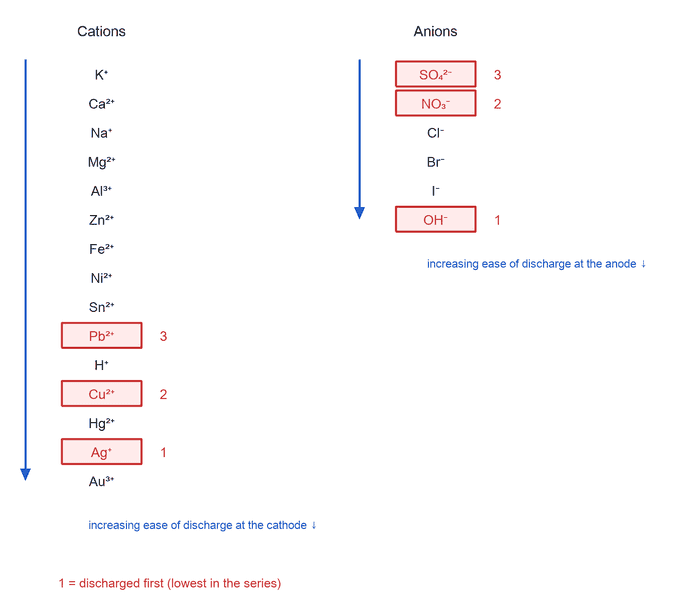
Watch out: The ion LOWER in the series is discharged first; the order of preference here is Ag⁺, then Cu²⁺, then Pb²⁺.
Therefore, (i) OH⁻ ions and (ii) Ag⁺ ions are selectively discharged.
- 91 mark
Question 9
The electrolysis of acidified water is an example of:
Solve with AIAnswer
(A) Reduction
(B) Oxidation
- Correct
(C) Redox reaction
(D) Synthesis
Answer: (C) Redox reaction
Concept: Oxidation is the loss of electrons and reduction is the gain of electrons. In electrolysis oxidation always happens at the anode and reduction at the cathode, at the same time.
Step 1 — Look at the cathode.
At the cathode ions gain electrons, which is reduction:
Step 2 — Look at the anode.
At the anode ions lose electrons, which is oxidation:
Step 3 — Put the two together.
Reduction and oxidation happen at the same time in the same cell, so the electrolysis of acidified water as a whole is a redox reaction.
Watch out: Do not choose just one half; every electrolysis has both an oxidation (anode) and a reduction (cathode).
Why the other options are wrong:
- (A) Reduction: Reduction is only the cathode half; oxidation takes place at the anode at the same time.
- (B) Oxidation: Oxidation is only the anode half; reduction takes place at the cathode at the same time.
- (D) Synthesis: Water is broken down into hydrogen and oxygen, which is decomposition, not synthesis (combination).
Therefore, the electrolysis of acidified water is a redox reaction, option (C).
- 101 mark
Question 10
Give one word or a phrase for the following statements:
Process of formation of ions from molecules which are not in ionic state.
Solve with AIWritten solution
Solution:
Concept: Some polar covalent compounds contain no ions of their own, but form ions when they dissolve in water. Ionic compounds already contain ions, which only separate on melting or dissolving.
Step 1 — Read the statement.
The statement describes ions being FORMED from molecules that were not ionic to begin with.
Step 2 — Name the process.
This process is called ionisation. For example, hydrogen chloride gas is made of molecules, and in water it forms ions:
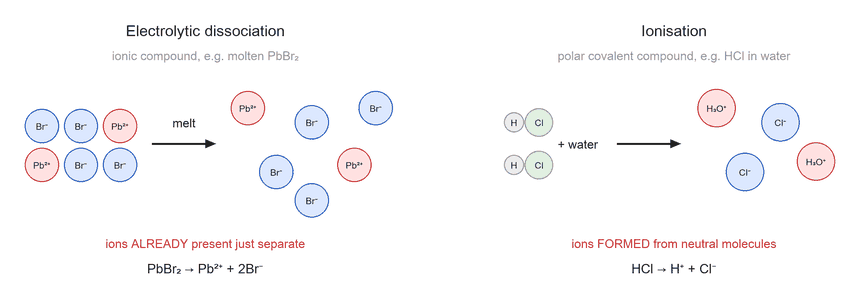
Watch out: The separation of ions that ALREADY exist (as in NaCl) is electrolytic dissociation, not ionisation.
Therefore, the process is ionisation.
- 111 mark
Question 11
State one relevant observation for each of the following:
At the anode, when molten lead bromide is electrolyzed using graphite electrodes.
Solve with AIWritten solution
Solution:
Concept: Solid lead bromide does not conduct, because its Pb²⁺ and Br⁻ ions are held in fixed positions. On melting, the ions become free to move: Pb²⁺ ions go to the cathode and are reduced to lead, and Br⁻ ions go to the anode and are oxidised to bromine.
Step 1 — Find the ions at the anode.
The negative ions of the melt move to the anode.
Step 2 — Describe the change.
Each bromide ion loses one electron there, and the bromine atoms join in pairs to form bromine:
At the temperature of the melt the bromine comes off as a vapour, seen as dark reddish-brown fumes.
Watch out: Silvery grey lead is the observation at the CATHODE, not the anode.
Therefore, dark reddish-brown fumes of bromine are seen at the anode.
- 121 mark
Question 12
Name the gas that is produced in each of the following cases:
At the anode during the electrolysis of acidified water.
Solve with AIWritten solution
Solution:
Concept: Pure water has very few ions, so it hardly conducts. A little dilute sulphuric acid supplies many mobile ions, and the acidified water is then electrolysed with platinum electrodes: hydrogen is given off at the cathode and oxygen at the anode, in the ratio 2 : 1 by volume.
Step 1 — Find the anions at the anode.
The anions present are (from the acid) and (from water). is lower in the series, so it is discharged.
Step 2 — Write the change.
Four ions lose four electrons, and the OH groups formed give water and oxygen:
Watch out: Hydrogen is the gas at the CATHODE; the anode gives oxygen.
Therefore, oxygen gas is produced at the anode.
- 131 mark
Question 13
Fill up the blanks with the correct choice given in brackets.
Electrolysis of aqueous sodium chloride solution will form ............... at the cathode. (hydrogen gas / sodium metal)
Solve with AIWritten solution
Solution:
Concept: When two or more ions of the same sign reach an electrode, the ion lower in the electrochemical series is discharged in preference (selective discharge). The cation series is K⁺, Ca²⁺, Na⁺, Mg²⁺, Al³⁺, Zn²⁺, Fe²⁺, Ni²⁺, Sn²⁺, Pb²⁺, H⁺, Cu²⁺, Hg²⁺, Ag⁺, Au³⁺ and the anion series is SO₄²⁻, NO₃⁻, Cl⁻, Br⁻, I⁻, OH⁻; in both lists the ease of discharge increases downwards.
Step 1 — Find the cations at the cathode.
Aqueous sodium chloride contains ions from the salt and ions from water. Both move to the cathode.
Step 2 — Choose the ion discharged.
The ion is much lower than in the series, so ions gain electrons and hydrogen gas is formed:
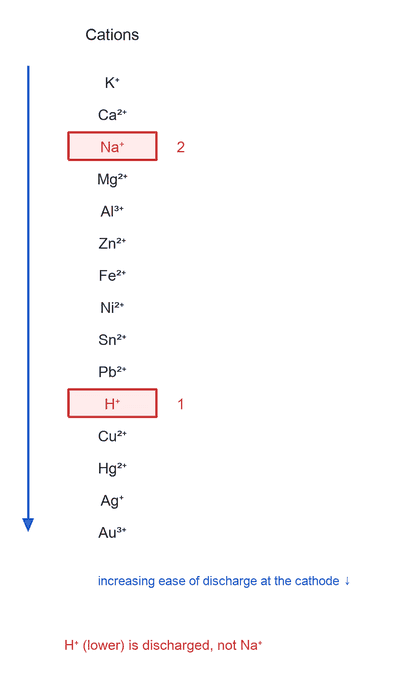
Step 3 — Why not sodium.
Sodium is near the top of the series. Even if any sodium were formed it would react at once with the water, so sodium metal is obtained only from MOLTEN sodium chloride.
Watch out: In aqueous solutions of salts of very reactive metals (K, Na, Ca, Mg, Al), the cathode always gives hydrogen.
Therefore, electrolysis of aqueous sodium chloride solution will form hydrogen gas at the cathode.
- 144 marks
Question 14
Copy and complete the following table which refers to the conversion of ions to neutral particles.
Conversion Ionic equation Oxidation/Reduction Chloride ion to chlorine molecule Lead [II] ion to lead Solve with AIWritten solution
Solution:
Concept: Oxidation is the loss of electrons and reduction is the gain of electrons. In electrolysis oxidation always happens at the anode and reduction at the cathode, at the same time.
Step 1 — Chloride ion to chlorine molecule.
Each ion loses one electron, and two chlorine atoms join to form a molecule. Loss of electrons is oxidation:
Step 2 — Lead (II) ion to lead.
Each ion gains two electrons and becomes a lead atom. Gain of electrons is reduction:
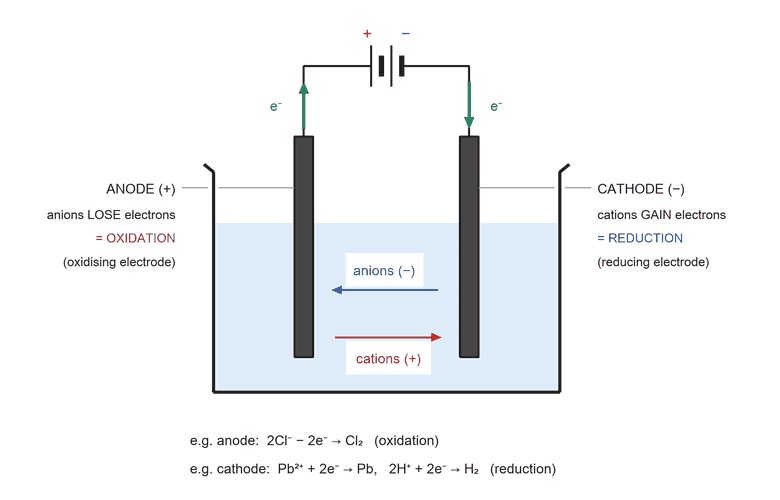
Step 3 — Complete the table.
Putting both results in the table:
Conversion Ionic equation Oxidation/Reduction Chloride ion to chlorine molecule Oxidation Lead [II] ion to lead Reduction Watch out: Check the electrons: two Cl⁻ ions give ONE Cl₂ molecule and lose 2 electrons in all; Pb²⁺ needs 2 electrons.
Therefore, Cl⁻ → Cl₂ (2Cl⁻ − 2e⁻ → Cl₂) is oxidation and Pb²⁺ → Pb (Pb²⁺ + 2e⁻ → Pb) is reduction.
- 152 marks
Question 15
For the electro-refining of copper:
(i) What is the cathode made up of?
(ii) Write the reaction that takes place at the anode.
Solve with AIWritten solution
Solution:
Concept: In electro-refining a thick block of the impure metal is the anode, a thin sheet of the pure metal is the cathode, and the electrolyte is a solution of a salt of that metal. The anode dissolves, pure metal is deposited on the cathode, and insoluble impurities fall below the anode as anode mud.
(i) The cathode
Step 1 — Name the cathode.
Pure copper is to be collected on the cathode, so the cathode is made of thin strips (sheets) of pure copper.
(ii) Reaction at the anode
Step 2 — Write the anode reaction.
The anode is a thick block of impure copper. Its copper atoms lose electrons and pass into the solution as copper ions, so the anode dissolves:
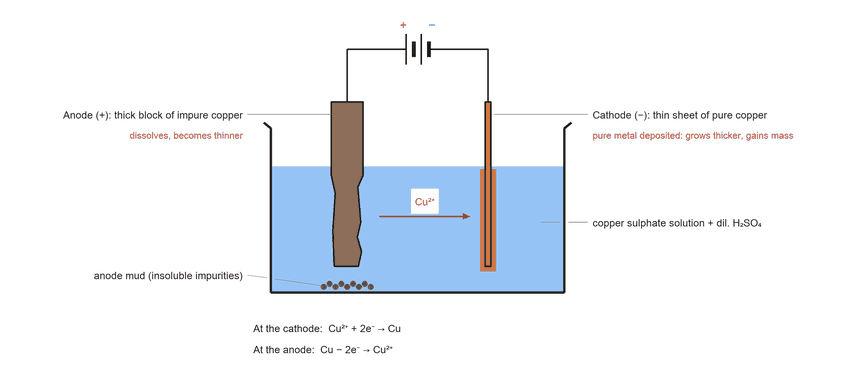
Impurities that do not dissolve collect below the anode as anode mud.
Watch out: The IMPURE copper is the anode; putting it at the cathode would only coat it with more copper.
Therefore, (i) the cathode is made of thin sheets of pure copper, and (ii) the anode reaction is Cu − 2e⁻ → Cu²⁺.
- 161 mark
Question 16
An electrolyte which completely dissociates into ions is:
Solve with AIAnswer
(A) Alcohol
(B) Carbonic acid
(C) Sucrose
- Correct
(D) Sodium hydroxide
Answer: (D) Sodium hydroxide
Concept: Electrolytes conduct because they contain mobile ions. A strong electrolyte is almost completely dissociated, so it contains (almost) only ions; a weak electrolyte is only partly dissociated, so it contains ions together with many un-ionised molecules; a non-electrolyte forms no ions and contains only molecules. Strong acids and strong bases such as sodium hydroxide are strong electrolytes.
Step 1 — Look at sodium hydroxide.
Sodium hydroxide is an ionic compound and a strong base; in water it is practically completely dissociated into ions:
Step 2 — Compare with the others.
Alcohol and sucrose are covalent and form no ions, and carbonic acid is a weak acid that ionises only partly. So sodium hydroxide is the one that dissociates completely.
Watch out: 'Completely dissociates' means a STRONG electrolyte; any acid is not enough, it must be a strong one.
Why the other options are wrong:
- (A) Alcohol: Alcohol is a covalent compound that forms no ions in water, so it is a non-electrolyte.
- (B) Carbonic acid: Carbonic acid is a weak acid; it is only partly dissociated, so it is a weak electrolyte.
- (C) Sucrose: Sucrose (cane sugar) forms no ions in water, so it is a non-electrolyte.
Therefore, the electrolyte which completely dissociates into ions is sodium hydroxide, option (D).
- 171 mark
Question 17
State one observation for each of the following:
Copper sulphate solution is electrolysed using copper electrodes.
Solve with AIWritten solution
Solution:
Concept: When copper sulphate solution is electrolysed with copper electrodes, Cu²⁺ ions are discharged on the cathode as copper, and the copper anode (an active electrode) dissolves, putting the same number of Cu²⁺ ions back into the solution.
Step 1 — Look at the cathode.
The ions gain electrons at the cathode, so a reddish-brown (pink) deposit of copper forms on it and it becomes thicker:
Step 2 — Look at the anode and the solution.
The copper anode dissolves and becomes thinner, and since it puts back one ion for each one removed, the blue colour of the solution does not fade.
Watch out: With copper electrodes the blue colour stays; it fades only with inert (platinum) electrodes.
Therefore, a reddish-brown deposit of copper forms on the cathode (the anode becomes thinner and the blue colour does not fade; any one observation is enough).
- 181 mark
Question 18
Arrange the following according to the instructions given in brackets:
, , , (In the order of preferential discharge at the cathode)
Solve with AIWritten solution
Solution:
Concept: When two or more ions of the same sign reach an electrode, the ion lower in the electrochemical series is discharged in preference (selective discharge). The cation series is K⁺, Ca²⁺, Na⁺, Mg²⁺, Al³⁺, Zn²⁺, Fe²⁺, Ni²⁺, Sn²⁺, Pb²⁺, H⁺, Cu²⁺, Hg²⁺, Ag⁺, Au³⁺ and the anion series is SO₄²⁻, NO₃⁻, Cl⁻, Br⁻, I⁻, OH⁻; in both lists the ease of discharge increases downwards.
Step 1 — Place the ions in the series.
In the cation series the four ions come in this order from the top: , then , then , then .
Step 2 — Reverse for the order of discharge.
The lowest ion is discharged first, so the order of preferential discharge is the reverse: first, then , then , and last.
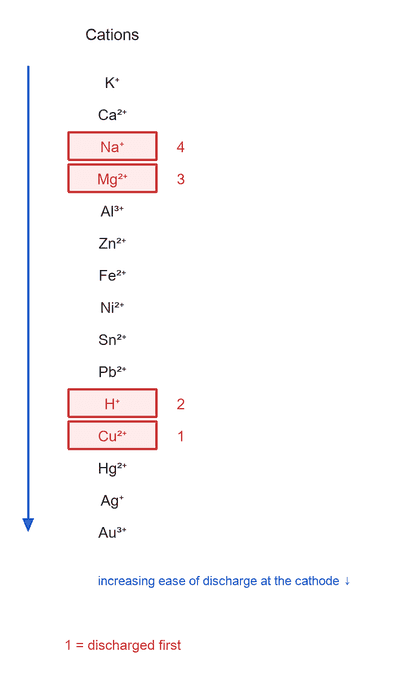
Watch out: Na⁺ lies ABOVE Mg²⁺ in the series, so Na⁺ is the hardest of all four to discharge.
Therefore, the order of preferential discharge at the cathode is Cu²⁺ > H¹⁺ > Mg²⁺ > Na¹⁺.
- 193 marks
Question 19
Name the particles present in:
(i) Strong electrolyte
(ii) Non- electrolyte
(iii) Weak electrolyte
Solve with AIWritten solution
Solution:
Concept: Electrolytes conduct because they contain mobile ions. A strong electrolyte is almost completely dissociated, so it contains (almost) only ions; a weak electrolyte is only partly dissociated, so it contains ions together with many un-ionised molecules; a non-electrolyte forms no ions and contains only molecules.
(i) Strong electrolyte
Step 1 — Particles in a strong electrolyte.
A strong electrolyte is almost completely dissociated, so it contains only ions, for example sodium chloride solution.
(ii) Non-electrolyte
Step 2 — Particles in a non-electrolyte.
A non-electrolyte forms no ions at all, so it contains only molecules, for example sugar solution or kerosene.
(iii) Weak electrolyte
Step 3 — Particles in a weak electrolyte.
A weak electrolyte is only partly dissociated, so it contains ions as well as molecules, for example acetic acid.
Watch out: The water of a solution is the solvent; the question asks about the particles of the electrolyte itself.
Therefore, (i) a strong electrolyte has only ions, (ii) a non-electrolyte has only molecules, and (iii) a weak electrolyte has ions and molecules.
- 201 mark
Question 20
The inert electrode used in the electrolysis of acidified water, is:
Solve with AIAnswer
(A) Nickel
- Correct
(B) Platinum
(C) Copper
(D) Silver
Answer: (B) Platinum
Concept: An inert electrode (platinum, graphite) only passes electrons and takes no part in the reaction. An active electrode (copper, nickel, silver) takes part: as an anode, its own atoms lose electrons and go into the solution as ions, so the anode dissolves. Platinum foils are used as the electrodes for the electrolysis of acidified water.
Step 1 — See what the electrode must do.
The electrodes must only carry the current, so that water alone is decomposed into hydrogen and oxygen. An anode that reacted or dissolved would spoil this.
Step 2 — Choose the inert metal.
Platinum is not attacked by the oxygen formed at the anode and does not dissolve, so it is the inert electrode used.
Watch out: Nickel, copper and silver are all ACTIVE electrodes; as anodes they dissolve.
Why the other options are wrong:
- (A) Nickel: Nickel is an active electrode; as an anode it would dissolve as ions.
- (C) Copper: Copper is an active electrode; as an anode it would dissolve as ions instead of giving oxygen.
- (D) Silver: Silver is an active electrode; as an anode it would dissolve as ions.
Therefore, the inert electrode used in the electrolysis of acidified water is platinum, option (B).
- 211 mark
Question 21
State one relevant reason for each of the following:
(i) Graphite anode is preferred to platinum in the electrolysis of molten lead bromide.
Solve with AIWritten solution
Solution:
Concept: Solid lead bromide does not conduct, because its Pb²⁺ and Br⁻ ions are held in fixed positions. On melting, the ions become free to move: Pb²⁺ ions go to the cathode and are reduced to lead, and Br⁻ ions go to the anode and are oxidised to bromine. The anode must stand up to the hot, reactive bromine given off on it.
Step 1 — See what forms at the anode.
Bromine is given off at the anode as a hot, very reactive vapour:
Step 2 — Give the reason.
Graphite is inert and is not affected by the reactive bromine vapour. Platinum can be attacked by hot bromine and is also very costly, so graphite is preferred.
Watch out: The reason must be about the bromine at the ANODE; the lead at the cathode does not harm either electrode.
Therefore, graphite is preferred because it is inert and unaffected by the reactive bromine vapour formed at the anode (and it is cheap).
- 221 mark
Question 22
Give one word or a phrase for the following statements:
(ii) Electrode used as cathode in electrorefining of impure copper.
Solve with AIWritten solution
Solution:
Concept: In electro-refining a thick block of the impure metal is the anode, a thin sheet of the pure metal is the cathode, and the electrolyte is a solution of a salt of that metal. The anode dissolves, pure metal is deposited on the cathode, and insoluble impurities fall below the anode as anode mud.
Step 1 — Decide what collects on the cathode.
In electro-refining, pure copper is deposited on the cathode, so the cathode must itself be pure copper.
Step 2 — Name the electrode.
It is a thin strip (sheet) of pure copper. ions from the copper sulphate solution are deposited on it:
Watch out: The thick block of IMPURE copper is the anode, not the cathode.
Therefore, the cathode is a thin strip (sheet) of pure copper.
- 234 marks
Question 23
Choose the correct word which refers to the process of electrolysis from A to E, to match the description (i) to (iv):
A: Oxidation B: Cathode C: Anode D: An electrolyte E: Reduction
(i) Conducts electricity in aqueous or in molten state.
(ii) Loss of electron takes place at anode.
(iii) A reducing electrode.
(iv) Electrode connected to the positive end or terminal of the battery.
Solve with AIWritten solution
Solution:
Concept: In an electrolytic cell the anode is the electrode joined to the positive (+) terminal of the battery and the cathode is the electrode joined to the negative (−) terminal. Cations (+) move to the cathode and gain electrons there (reduction); anions (−) move to the anode and lose electrons there (oxidation).
Step 1 — Match (i).
A substance that conducts electricity in the aqueous or molten state (and is decomposed) is an electrolyte, so (i) is D.
Step 2 — Match (ii).
Loss of electrons is oxidation, and it takes place at the anode, so (ii) is A.
Step 3 — Match (iii).
At the cathode, cations gain electrons, that is, they are reduced. So the cathode is the reducing electrode, and (iii) is B.
Step 4 — Match (iv).
The electrode joined to the positive terminal of the battery is the anode, so (iv) is C. Word E (reduction) is not needed.
Watch out: The cathode is the REDUCING electrode because reduction happens there, and the anode is the oxidising electrode.
Therefore, (i) D: an electrolyte, (ii) A: oxidation, (iii) B: cathode, (iv) C: anode.
- 241 mark
Question 24
Differentiate between the following pairs based on the information given in the brackets.
(i) Conductor and electrolyte (conducting particles)
Solve with AIWritten solution
Solution:
Concept: A conductor and an electrolyte both let a current pass, but the particles that carry the current are different.
Step 1 — Conductor (metallic).
In a metallic conductor the current is carried by free (mobile) electrons. The conductor undergoes no chemical change.
Step 2 — Electrolyte.
In an electrolyte the current is carried by mobile ions, the cations moving to the cathode and the anions to the anode. The electrolyte is decomposed at the electrodes.
Watch out: An electrolyte has no free electrons; its current is carried by ions.
Therefore, a conductor conducts by free electrons, while an electrolyte conducts by mobile ions.
- 251 mark
Question 25
Identify the substance underlined in each of the following:
(i) The electrode that increases in mass during the electro-refining of silver.
Solve with AIWritten solution
Solution:
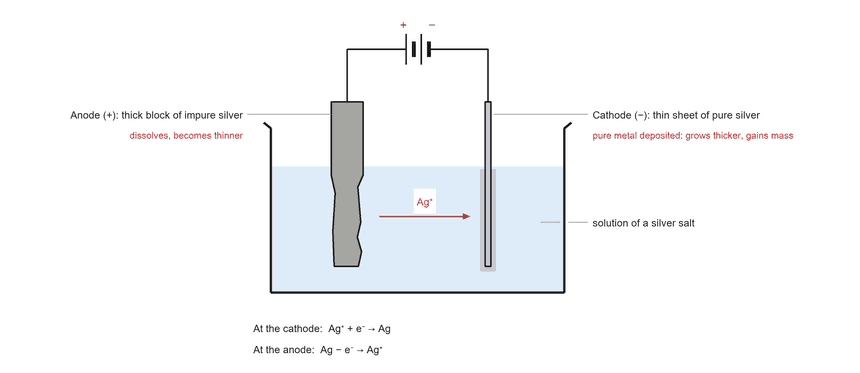
Concept: In electro-refining a thick block of the impure metal is the anode, a thin sheet of the pure metal is the cathode, and the electrolyte is a solution of a salt of that metal. The anode dissolves, pure metal is deposited on the cathode, and insoluble impurities fall below the anode as anode mud.
Step 1 — Decide which electrode receives metal.
In the electro-refining of silver the impure silver anode dissolves and loses mass, while pure silver is deposited on the cathode.
Step 2 — Name the electrode.
The electrode that increases in mass is the cathode, a thin strip of pure silver. ions are deposited on it:
Watch out: The anode LOSES mass in refining; only the cathode gains.
Therefore, the electrode that increases in mass is the cathode (a thin strip of pure silver).
- 264 marks
Question 26
An aqueous solution of nickel (II) sulphate was electrolyzed using nickel electrodes. Observe the diagram and answer the questions that follow:
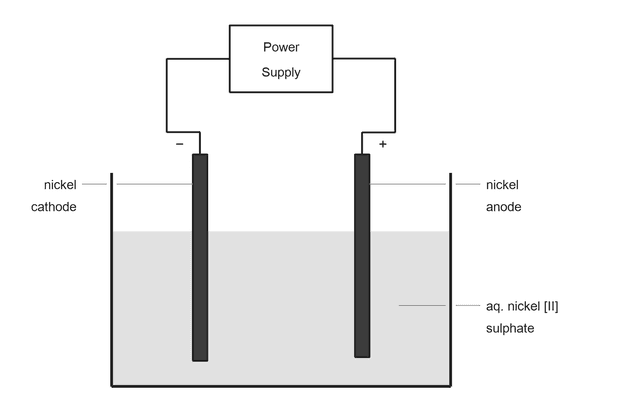
(i) What do you observe at the cathode and anode respectively?
(ii) Name the cation that remains as a spectator ion in the solution.
(iii) Which equation for the reaction at the anode is correct?
Solve with AIWritten solution
Solution:
Concept: An inert electrode (platinum, graphite) only passes electrons and takes no part in the reaction. An active electrode (copper, nickel, silver) takes part: as an anode, its own atoms lose electrons and go into the solution as ions, so the anode dissolves. Nickel electrodes are active: the nickel anode dissolves to give Ni²⁺ ions, and Ni²⁺ ions are deposited on the cathode. This is the set-up used for nickel plating.
(i) Observations at the cathode and the anode
Step 1 — At the cathode.
In the diagram the left electrode is joined to the − end of the supply, so it is the cathode. ions gain electrons there, so a grey layer of nickel is deposited and the cathode becomes thicker:
Step 2 — At the anode.
The right electrode, joined to +, is the nickel anode. Its atoms lose electrons and go into the solution, so the anode dissolves and becomes thinner:
The green colour of the solution stays the same, because the anode replaces the ions removed.

(ii) The spectator cation
Step 3 — Find the cation that is not discharged.
Both (from the salt) and (from water) reach the cathode. In this solution is discharged (it is present in a much higher concentration), so takes no part in the electrode reactions and stays in the solution as a spectator ion.
(iii) The correct anode equation
Step 4 — Test each equation.
The anode reaction is an oxidation: each nickel atom LOSES two electrons. Equation 1, , shows exactly this, and it balances in atoms and in charge.
Equation 2, , does not balance in charge (2− on the left, 2+ on the right). Equation 3, , does not balance in charge either. Equation 4, , is correct but it is the cathode reaction (a gain of electrons).
Watch out: The spectator is the cation that is NOT discharged; Ni²⁺ is discharged at the cathode, so it is not the answer.
Note: The electrochemical series puts Ni²⁺ above H⁺, yet nickel is deposited from nickel sulphate solution. This is because Ni²⁺ ions are present in a far higher concentration than H⁺ ions; concentration also affects which ion is discharged.
Therefore, (i) nickel is deposited on the cathode (it becomes thicker) and the nickel anode dissolves (it becomes thinner); (ii) the spectator cation is H⁺; (iii) equation 1, Ni → Ni²⁺ + 2e⁻, is correct.
-
- 271 mark
Question 27
Which of the following reactions takes place at the anode during the electroplating of an article with silver?
Solve with AIAnswer
- Correct
(A)
(B)
(C)
(D) None of the above
Answer: (A)
Concept: In electroplating the article to be plated is made the cathode, a block of the pure plating metal is made the anode, and the electrolyte is a solution of a salt of the plating metal. The metal ions are discharged on the article; the anode dissolves and replaces them. For silver plating the anode is a block of pure silver.
Step 1 — Write the anode reaction.
At the anode the silver atoms lose one electron each and go into the solution as silver ions (oxidation):
This is option (A), written with 1e⁻ and the charge as 1+.
Step 2 — Compare with the cathode.
At the spoon (cathode) the reverse change takes place, the silver ions gaining electrons:
Watch out: The anode LOSES electrons; any equation in which an atom gains electrons at the anode is wrong.
Why the other options are wrong:
- (B) : A metal atom does not gain an electron to form a negative ion here; a gain of electrons would be reduction, which happens at the cathode.
- (C) : It does not balance in charge: an atom that loses an electron must become a positive ion, not stay a neutral atom.
- (D) None of the above: Option (A) is the correct anode reaction, so 'None of the above' is wrong.
Therefore, the anode reaction is Ag − 1e⁻ → Ag¹⁺, option (A).
- 282 marks
Question 28
Fill in the blanks by choosing the correct answer from the brackets:
(a) During electrolysis, the compound ............... in its molten state liberates reddish brown fumes at the anode. [NaCl / ]
(b) The ion which could be discharged most readily during electrolysis is ............... [ / ]
Solve with AIWritten solution
Solution:
Concept: Bromine is a reddish-brown substance, and of two cations the one lower in the electrochemical series is discharged more readily. When two or more ions of the same sign reach an electrode, the ion lower in the electrochemical series is discharged in preference (selective discharge). The cation series is K⁺, Ca²⁺, Na⁺, Mg²⁺, Al³⁺, Zn²⁺, Fe²⁺, Ni²⁺, Sn²⁺, Pb²⁺, H⁺, Cu²⁺, Hg²⁺, Ag⁺, Au³⁺ and the anion series is SO₄²⁻, NO₃⁻, Cl⁻, Br⁻, I⁻, OH⁻; in both lists the ease of discharge increases downwards.
(a) Reddish-brown fumes at the anode
Step 1 — Find which melt gives a coloured vapour.
Molten lead bromide gives bromine at the anode, which is seen as reddish-brown fumes. Molten sodium chloride would give chlorine, a greenish-yellow gas:
(b) Ion discharged most readily
Step 2 — Place the two ions in the series.
In the series lies above hydrogen and lies below it. is lower, so it accepts electrons more easily:
Watch out: Reddish-brown means bromine, which comes only from a bromide.
Therefore, (a) PbBr₂ and (b) Cu²⁺.
- 293 marks
Question 29
Answer the following questions with reference to electrorefining of copper:
(a) What is the anode made of?
(b) What do you observe at the cathode?
(c) Write the reaction taking place at the cathode.
Solve with AIWritten solution
Solution:
Concept: In electro-refining a thick block of the impure metal is the anode, a thin sheet of the pure metal is the cathode, and the electrolyte is a solution of a salt of that metal. The anode dissolves, pure metal is deposited on the cathode, and insoluble impurities fall below the anode as anode mud. For copper the electrolyte is copper sulphate solution with a little dilute sulphuric acid.
(a) The anode
Step 1 — Name the anode.
The copper to be purified is the anode, so it is made of thick blocks (slabs) of impure copper.
(b) Observation at the cathode
Step 2 — Describe the cathode.
Pure copper is deposited on the thin cathode strips, so a reddish-brown (pink) layer of copper grows and the cathode becomes thicker.
(c) Reaction at the cathode
Step 3 — Write the cathode reaction.
The ions gain two electrons each at the cathode:
The copper deposited is very pure, about 99.9 % or better.
Watch out: The cathode GAINS copper and becomes thicker; it is the anode that dissolves.
Therefore, (a) the anode is made of impure copper, (b) reddish-brown pure copper is deposited on the cathode, which becomes thicker, and (c) Cu²⁺ + 2e⁻ → Cu.
- 301 mark
Question 30
Arrange the following according to the instructions given in brackets:
(b) , , , (The order of Preferential discharge at the cathode)
Solve with AIWritten solution
Solution:
Concept: When two or more ions of the same sign reach an electrode, the ion lower in the electrochemical series is discharged in preference (selective discharge). The cation series is K⁺, Ca²⁺, Na⁺, Mg²⁺, Al³⁺, Zn²⁺, Fe²⁺, Ni²⁺, Sn²⁺, Pb²⁺, H⁺, Cu²⁺, Hg²⁺, Ag⁺, Au³⁺ and the anion series is SO₄²⁻, NO₃⁻, Cl⁻, Br⁻, I⁻, OH⁻; in both lists the ease of discharge increases downwards.
Step 1 — Place the ions in the series.
From the top of the cation series the four ions come in the order , , , .
Step 2 — Reverse for the order of discharge.
The lowest ion is discharged first, so the order of preferential discharge is first, then , then , and last.
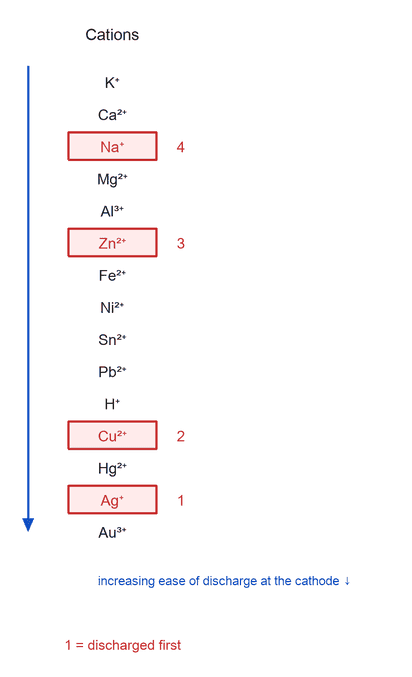
Watch out: The order of DISCHARGE is the reverse of the order in which the ions are listed in the series.
Therefore, the order of preferential discharge at the cathode is Ag⁺ > Cu²⁺ > Zn²⁺ > Na⁺.
- 311 mark
Question 31
Choose the answer from the list which fits in the description:
[, PbO, NaCl, CuO, ]
(c) A compound which is a non-electrolyte.
Solve with AIWritten solution
Solution:
Concept: Electrolytes conduct because they contain mobile ions. A strong electrolyte is almost completely dissociated, so it contains (almost) only ions; a weak electrolyte is only partly dissociated, so it contains ions together with many un-ionised molecules; a non-electrolyte forms no ions and contains only molecules. Ionic compounds are electrolytes; a covalent compound that forms no ions is a non-electrolyte.
Step 1 — Sort the list.
NaCl, PbO, CuO and NH₄Cl are ionic compounds, so they are electrolytes (sodium chloride and ammonium chloride conduct in solution, and lead oxide conducts when fused).
Step 2 — Pick the covalent one.
Carbon tetrachloride, , is a covalent liquid made only of molecules. It has no ions, so it does not conduct electricity even as a liquid; it is a non-electrolyte.
Watch out: Being a liquid is not enough to conduct; the liquid must contain ions.
Therefore, the non-electrolyte is CCl₄ (carbon tetrachloride).
- 325 marks
Question 32
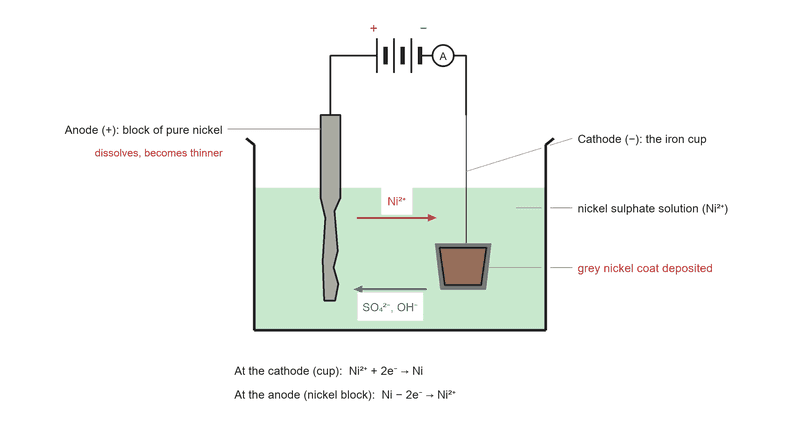
The following sketch represents the electroplating of an Iron cup with Nickel metal. Study the diagram and answer the following questions:
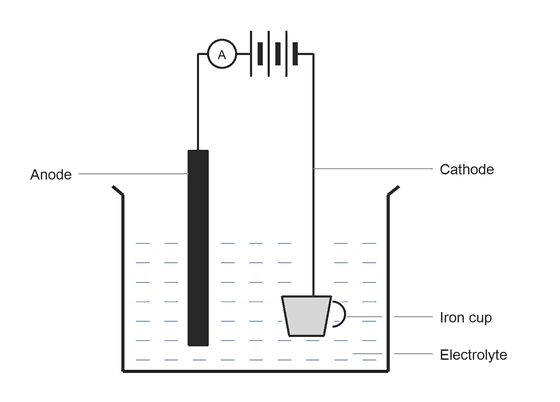
(a) During electroplating the iron cup is placed at the cathode. Why?
(b) Name the ion that must be present in the electrolyte.
(c) State one condition that is necessary to ensure that the deposit is smooth, firm and even.
(d) Write the reaction taking place at the cathode.
(e) What change would you observe at the anode?
Solve with AIWritten solution
Solution:
Concept: In electroplating the article to be plated is made the cathode, a block of the pure plating metal is made the anode, and the electrolyte is a solution of a salt of the plating metal. The metal ions are discharged on the article; the anode dissolves and replaces them. In an electrolytic cell the anode is the electrode joined to the positive (+) terminal of the battery and the cathode is the electrode joined to the negative (−) terminal. Cations (+) move to the cathode and gain electrons there (reduction); anions (−) move to the anode and lose electrons there (oxidation).
(a) Why the iron cup is placed at the cathode
Step 1 — Follow the nickel ions.
The nickel ions, , are positive, so they move to the cathode. There they gain electrons and are deposited as nickel metal. The cup must therefore be the cathode to receive the nickel coat.
(b) Ion in the electrolyte
Step 2 — Name the ion.
The electrolyte must contain the ions of the plating metal, nickel ions , for example from nickel sulphate solution, .
(c) Condition for a smooth, firm, even deposit
Step 3 — Give the condition.
A low current should be passed for a longer time, so that nickel is deposited slowly and evenly. (The cup must also be cleaned thoroughly before plating.)
(d) Reaction at the cathode
Step 4 — Write the cathode reaction.
Each ion gains two electrons on the cup:
(e) Change at the anode
Step 5 — Describe the anode.
The anode is a block of pure nickel. Its atoms lose electrons and go into the solution, so the anode dissolves and becomes thinner:
This keeps the concentration of the electrolyte steady.
Watch out: A large current gives a quick but rough, loosely held coat; low current for a long time gives a good one.
Therefore, (a) Ni²⁺ ions go to the cathode and are deposited there, so the cup is the cathode; (b) Ni²⁺; (c) a low current for a longer time; (d) Ni²⁺ + 2e⁻ → Ni; (e) the nickel anode dissolves and becomes thinner.
- 331 mark
Question 33
Complete the following sentences by choosing the correct answer from the brackets:
(d) During the electrolysis of copper sulphate solution, if ............... is used as electrodes, the colour of the electrolyte does not fade. [copper / platinum]
Solve with AIWritten solution
Solution:
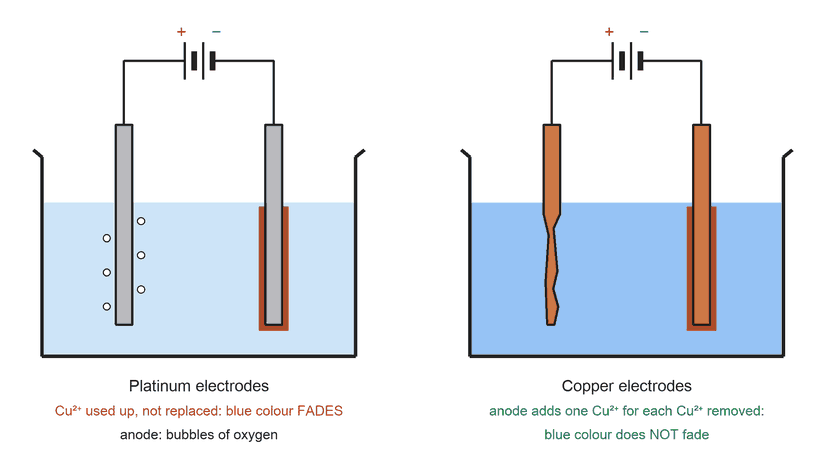
Concept: When copper sulphate solution is electrolysed with copper electrodes, Cu²⁺ ions are discharged on the cathode as copper, and the copper anode (an active electrode) dissolves, putting the same number of Cu²⁺ ions back into the solution.
Step 1 — Follow the copper ions with copper electrodes.
At the cathode ions are removed as copper, and at the copper anode the same number of ions is put back:
So the number of ions stays the same and the blue colour does not fade.
Step 2 — Compare with platinum electrodes.
A platinum anode does not dissolve; oxygen is given off at it instead, so the ions used up at the cathode are not replaced and the blue colour fades.
Watch out: The blue colour comes from Cu²⁺ ions; it fades only when they are used up and not replaced.
Therefore, if copper is used as electrodes, the colour of the electrolyte does not fade.
- 341 mark
Question 34
State the terms for the following:
(b) Two metal plates or wires through which the current enters and leaves the electrolytic cell.
Solve with AIWritten solution
Solution:
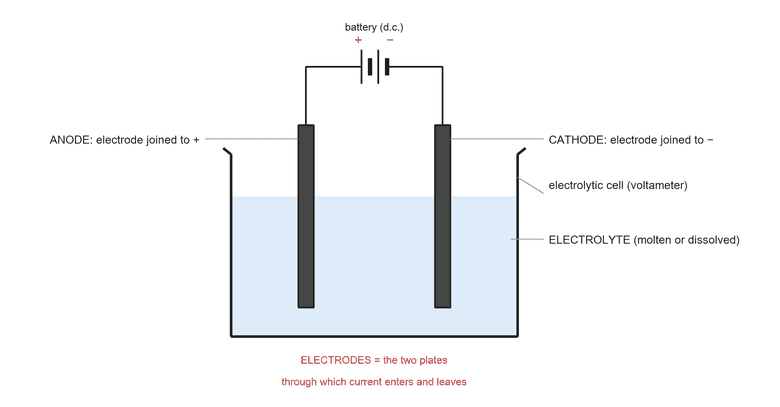
Concept: In an electrolytic cell the anode is the electrode joined to the positive (+) terminal of the battery and the cathode is the electrode joined to the negative (−) terminal. Cations (+) move to the cathode and gain electrons there (reduction); anions (−) move to the anode and lose electrons there (oxidation).
Step 1 — Read the description.
The current needs two conductors dipped in the electrolyte: one through which it enters and one through which it leaves.
Step 2 — Name the term.
These metal plates or wires are called electrodes. The one joined to the positive terminal is the anode and the one joined to the negative terminal is the cathode.
Watch out: The electrolyte is the liquid between them; the electrodes are the plates or wires.
Therefore, the term is electrodes.
- 352 marks
Question 35
X - (in solution state)
Y - (in molten state)
From the above reactions X or Y, identify the reaction which exhibits:
(a) electrolytic dissociation
(b) ionization
Solve with AIWritten solution
Solution:
Concept: Electrolytic dissociation is the separation of ions that are ALREADY present in an ionic (electrovalent) compound when it is melted or dissolved. Ionisation is the FORMATION of ions from a polar covalent compound, made of molecules, when it dissolves in water.
(a) Electrolytic dissociation
Step 1 — Look at reaction Y.
Lead bromide is an ionic compound. Its and ions already exist in the solid and only become free to move on melting, so Y shows electrolytic dissociation.
(b) Ionisation
Step 2 — Look at reaction X.
Hydrogen chloride is a polar covalent compound made of molecules. Its ions are formed only when it dissolves in water, so X shows ionisation.
Watch out: Ask whether the ions existed BEFORE: yes means dissociation, no means ionisation.
Therefore, (a) electrolytic dissociation is Y and (b) ionisation is X.
- 361 mark
Question 36
Fill in the blanks by choosing the correct answer from the bracket:
(b) During electrolysis of acidulated water, the gas liberated at the anode is ............... [oxygen / hydrogen]
Solve with AIWritten solution
Solution:
Concept: Pure water has very few ions, so it hardly conducts. A little dilute sulphuric acid supplies many mobile ions, and the acidified water is then electrolysed with platinum electrodes: hydrogen is given off at the cathode and oxygen at the anode, in the ratio 2 : 1 by volume.
Step 1 — Find the ion discharged at the anode.
At the anode ions are discharged in preference to ions, because is lower in the series.
Step 2 — Name the gas.
The OH groups formed combine to give water and oxygen:
Hydrogen is given off at the cathode, twice the volume of the oxygen.
Watch out: Hydrogen is the cathode gas; the anode gives oxygen.
Therefore, the gas liberated at the anode is oxygen.
- 371 mark
Question 37
Aqueous copper (II) sulphate is electrolysed using copper electrodes. Which statement about the electrolysis is not correct?
Solve with AIAnswer
(A) An oxidation reaction occurs at the positive electrode.
(B) The current is carried through the electrolyte by ions.
(C) The positive electrode loses mass.
- Correct
(D) The number of copper (II) ions in the electrolyte decreases.
Answer: (D) The number of copper (II) ions in the electrolyte decreases.
Concept: When copper sulphate solution is electrolysed with copper electrodes, Cu²⁺ ions are discharged on the cathode as copper, and the copper anode (an active electrode) dissolves, putting the same number of Cu²⁺ ions back into the solution.
Step 1 — Reaction at the negative electrode (cathode).
At the cathode ions gain electrons and copper is deposited:
Step 2 — Reaction at the positive electrode (anode).
At the anode copper atoms lose electrons and go into the solution:
Step 3 — Count the copper ions.
One ion is removed at the cathode for each one added at the anode, so their number stays the same and the blue colour does not fade. Statement (D) says the number decreases, so it is the statement that is not correct.
Watch out: This question asks for the statement that is NOT correct; the three true statements are the wrong choices.
Why the other options are wrong:
- (A) An oxidation reaction occurs at the positive electrode: This statement is correct: copper atoms lose electrons at the positive electrode, which is oxidation.
- (B) The current is carried through the electrolyte by ions: This statement is correct: the current passes through the electrolyte by the movement of ions.
- (C) The positive electrode loses mass: This statement is correct: the positive electrode (anode) dissolves and loses mass.
Therefore, the statement that is not correct is (D), the number of copper (II) ions in the electrolyte decreases.
- 381 mark
Question 38
Complete the following sentences by choosing the correct word(s) from the brackets:
............... conducts electricity by the movement of ions. [Molten iron / Molten sodium chloride]
Solve with AIWritten solution
Solution:
Concept: Metals, solid or molten, conduct by free electrons; molten ionic compounds conduct by mobile ions.
Step 1 — Look at molten iron.
Molten iron is a metal. It conducts by free electrons and is not decomposed.
Step 2 — Look at molten sodium chloride.
Fused sodium chloride contains free and ions, and these ions carry the current.
Watch out: A molten METAL still conducts by electrons; melting does not give it ions to move.
Therefore, molten sodium chloride conducts electricity by the movement of ions.
- 391 mark
Question 39
Complete the following sentences by choosing the correct word(s) from the brackets:
The reaction that takes place at the anode during the electrolysis of aqueous Sodium argentocyanide with silver electrodes is ................ [/ ]
Solve with AIWritten solution
Solution:
Concept: In electroplating the article to be plated is made the cathode, a block of the pure plating metal is made the anode, and the electrolyte is a solution of a salt of the plating metal. The metal ions are discharged on the article; the anode dissolves and replaces them. At the anode, oxidation (loss of electrons) takes place.
Step 1 — See what the anode is.
With silver electrodes in sodium argentocyanide, the anode is silver metal. Its atoms lose electrons and go into the solution as silver ions:
(This is the same as .)
Step 2 — Reject the other choice.
The other choice, , is a gain of electrons, a reduction; it takes place at the cathode.
Watch out: Loss of electrons happens at the anode; an equation with electrons on the LEFT added to an ion is a cathode reaction.
Therefore, the reaction at the anode is Ag → Ag⁺ + e⁻.
- 402 marks
Question 40
Justify the following statements:
(a) Anode is known as the oxidizing electrode.
(b) Graphite electrodes are preferred in the electrolysis of molten lead bromide.
Solve with AIWritten solution
Solution:
Concept: Oxidation is the loss of electrons and reduction is the gain of electrons. In electrolysis oxidation always happens at the anode and reduction at the cathode, at the same time.
(a) Anode is the oxidising electrode
Step 1 — See what happens at the anode.
Anions move to the anode and lose electrons to it (or the atoms of an active anode lose electrons). For example, chloride ions give chlorine:
Step 2 — Name the change.
Loss of electrons is oxidation, so the anode, where oxidation takes place, is called the oxidising electrode.
(b) Graphite electrodes for molten lead bromide
Step 3 — Give the reason.
Graphite is inert and is not affected by the reactive bromine vapour given off at the anode; it also stands the heat of the melt and is cheap. Platinum can be attacked by hot bromine and is very costly.
Watch out: The anode is the OXIDISING electrode and the cathode the reducing electrode.
Therefore, (a) oxidation (loss of electrons) takes place at the anode, so it is the oxidising electrode; (b) graphite is inert and unaffected by the reactive bromine vapour.
- 413 marks
Question 41
Acidulated water is electrolysed using platinum electrodes. Answer the following questions:
(a) Why is dilute sulphuric acid added to water?
(b) Write the reaction taking place at the cathode.
(c) What is the observation at the anode?
Solve with AIWritten solution
Solution:
Concept: Pure water has very few ions, so it hardly conducts. A little dilute sulphuric acid supplies many mobile ions, and the acidified water is then electrolysed with platinum electrodes: hydrogen is given off at the cathode and oxygen at the anode, in the ratio 2 : 1 by volume.
(a) Why dilute sulphuric acid is added
Step 1 — Give the reason.
Pure water contains very few ions, so hardly any current flows through it. Dilute sulphuric acid ionises and supplies many mobile ions, so the water conducts and is decomposed:
The ions are not discharged, so only the water is decomposed, and the acid is non-volatile, so it does not boil off.
(b) Reaction at the cathode
Step 2 — Write the cathode reaction.
The ions gain electrons at the cathode and the hydrogen atoms join in pairs:
(c) Observation at the anode
Step 3 — Describe the anode.
Bubbles of a colourless gas, oxygen, are given off at the anode. Its volume is half the volume of hydrogen at the cathode:
Watch out: The acid is added to make the water CONDUCT; it is not used up, so its amount stays the same.
Therefore, (a) dilute sulphuric acid supplies mobile ions so that the water conducts; (b) H⁺ + e⁻ → H, then H + H → H₂; (c) bubbles of colourless oxygen gas are given off at the anode.
- 421 mark
Question 42
Assertion (A): In a solution containing equal concentration of ions and ions, ions will be discharged in preference to ions.
Reason (R): ions are placed above ions in the electrochemical series.
Solve with AIAnswer
- Correct
(A) Both (A) and (R) are true, and (R) is the correct explanation of (A).
(B) Both (A) and (R) are true, and (R) is not the correct explanation of (A).
(C) (A) is true but (R) is false.
(D) (A) is false but (R) is true.
Answer: (A) Both (A) and (R) are true, and (R) is the correct explanation of (A).
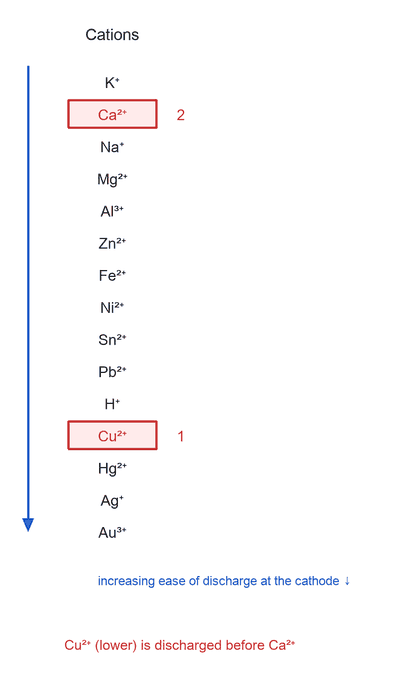
Concept: In an Assertion–Reason item, judge the Assertion (A) true or false, then the Reason (R), and only if both are true ask whether R tells why A is true. When two or more ions of the same sign reach an electrode, the ion lower in the electrochemical series is discharged in preference (selective discharge). The cation series is K⁺, Ca²⁺, Na⁺, Mg²⁺, Al³⁺, Zn²⁺, Fe²⁺, Ni²⁺, Sn²⁺, Pb²⁺, H⁺, Cu²⁺, Hg²⁺, Ag⁺, Au³⁺ and the anion series is SO₄²⁻, NO₃⁻, Cl⁻, Br⁻, I⁻, OH⁻; in both lists the ease of discharge increases downwards.
Step 1 — Judge the assertion.
Both ions move to the cathode, and is discharged first, so A is true:
Step 2 — Judge the reason.
Calcium is near the top of the series and copper is below hydrogen, so is placed above . R is true.
Step 3 — Decide whether R explains A.
Yes. An ion lower in the series is discharged in preference, and is lower because is above it. R gives exactly the reason for A.
Watch out: With EQUAL concentrations, the position in the series alone decides the order of discharge.
Why the other options are wrong:
- (B) Both (A) and (R) are true, and (R) is not the correct explanation of (A): The reason is the very rule that decides the order of discharge, so it is the correct explanation.
- (C) (A) is true but (R) is false: The reason is true: calcium is above copper in the series.
- (D) (A) is false but (R) is true: The assertion is true: copper ions are discharged first.
Therefore, both (A) and (R) are true and (R) explains (A), option (A).
- 431 mark
Question 43
Three different solutions X (sodium chloride solution), Y (acetic acid) and Z (sugar solution) were used for electrolysis by a student.
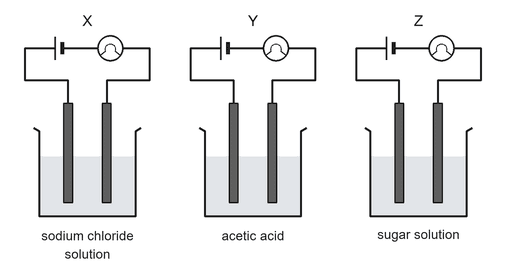
When the circuit was completed, he noticed that the bulb glowed in the electrolytic cell containing:
Solve with AIAnswer
- Correct
(A) X & Y
(B) Y & Z
(C) Z & X
(D) X, Y & Z
Answer: (A) X & Y
Concept: Electrolytes conduct because they contain mobile ions. A strong electrolyte is almost completely dissociated, so it contains (almost) only ions; a weak electrolyte is only partly dissociated, so it contains ions together with many un-ionised molecules; a non-electrolyte forms no ions and contains only molecules. The bulb glows only when the liquid contains mobile ions.
Step 1 — X, sodium chloride solution.
This is a strong electrolyte with many ions, so the bulb glows brightly.
Step 2 — Y, acetic acid.
This is a weak electrolyte with a few ions and many molecules, so the bulb glows dimly; it does glow.
Step 3 — Z, sugar solution.
This is a non-electrolyte with molecules and no ions, so the bulb does not glow.

Watch out: A dim glow is still a glow; a weak electrolyte does conduct.
Why the other options are wrong:
- (B) Y & Z: Z contains no ions, so the bulb in the sugar solution cell does not glow.
- (C) Z & X: Z does not conduct, and the pair leaves out Y, which does conduct a little.
- (D) X, Y & Z: Sugar solution (Z) is a non-electrolyte, so the bulb in its cell does not glow.
Therefore, the bulb glowed in the cells containing X and Y, option (A).
- 441 mark
Question 44
Complete the following sentences by choosing the correct answer from the brackets:
The metal to be refined is kept at the ............... during the process of electro-refining. [cathode / anode]
Solve with AIWritten solution
Solution:
Concept: In electro-refining a thick block of the impure metal is the anode, a thin sheet of the pure metal is the cathode, and the electrolyte is a solution of a salt of that metal. The anode dissolves, pure metal is deposited on the cathode, and insoluble impurities fall below the anode as anode mud.
Step 1 — Decide where the impure metal goes.
The impure metal must dissolve so that its pure metal can be carried across to the cathode. Dissolving (oxidation) happens at the anode, so the metal to be refined is the anode.
Step 2 — Illustrate with copper.
For copper, the impure copper anode dissolves:
Watch out: The CATHODE is the thin sheet of pure metal that collects the refined metal.
Therefore, the metal to be refined is kept at the anode during electro-refining.
- 451 mark
Question 45
State the terms for the following:
The process by which a base metal is coated with another metal, either to protect the metal or to give it an attractive appearance.
Solve with AIWritten solution
Solution:
Concept: In electroplating the article to be plated is made the cathode, a block of the pure plating metal is made the anode, and the electrolyte is a solution of a salt of the plating metal. The metal ions are discharged on the article; the anode dissolves and replaces them.
Step 1 — Read the description.
A base metal is coated with another metal using electricity, to protect it from corrosion or to make it look attractive.
Step 2 — Name the term.
This process is electroplating, for example coating iron with nickel or chromium, or a spoon with silver.
Watch out: Galvanising (coating iron with zinc by dipping in molten zinc) does not use electrolysis; the term asked here is electroplating.
Therefore, the term is electroplating.
- 461 mark
Question 46
Smith wrote the following statements incorrectly. Insert a word to correct the statements.
Lead bromide conducts electricity.
Solve with AIWritten solution
Solution:
Concept: Solid lead bromide does not conduct, because its Pb²⁺ and Br⁻ ions are held in fixed positions. On melting, the ions become free to move: Pb²⁺ ions go to the cathode and are reduced to lead, and Br⁻ ions go to the anode and are oxidised to bromine.
Step 1 — Find what is wrong.
Solid lead bromide does not conduct, because its ions are held in fixed positions in the crystal.
Step 2 — Insert the word.
When it is melted, the Pb²⁺ and Br⁻ ions become free to move and carry the current, so the correct word to insert is 'molten'.
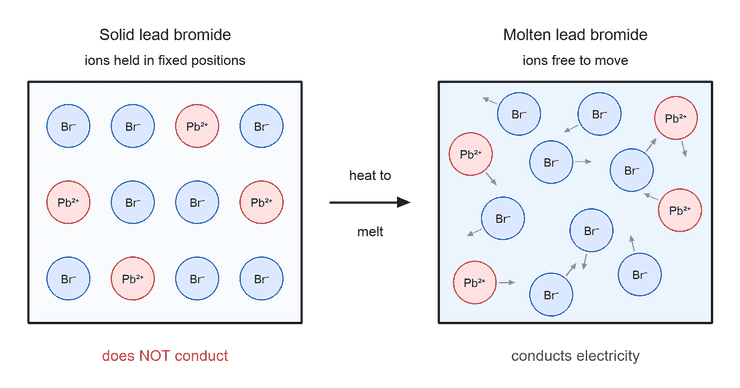
Watch out: Only one word may be inserted; 'molten' (or 'fused') is the word that makes the statement true.
Therefore, the corrected statement is: Molten lead bromide conducts electricity.
- 472 marks
Question 47
Select the correct answer from the options given in the brackets:
(a) The ion which is discharged at the cathode during the electrolysis of solution using copper electrodes. [, , , ]
(b) During electroplating of an article with Ag using sodium argentocyanide as an electrolyte, the anode is made of. [Cu, Ag, Pt, Na]
Solve with AIWritten solution
Solution:
Concept: When two or more ions of the same sign reach an electrode, the ion lower in the electrochemical series is discharged in preference (selective discharge). The cation series is K⁺, Ca²⁺, Na⁺, Mg²⁺, Al³⁺, Zn²⁺, Fe²⁺, Ni²⁺, Sn²⁺, Pb²⁺, H⁺, Cu²⁺, Hg²⁺, Ag⁺, Au³⁺ and the anion series is SO₄²⁻, NO₃⁻, Cl⁻, Br⁻, I⁻, OH⁻; in both lists the ease of discharge increases downwards. In electroplating the article to be plated is made the cathode, a block of the pure plating metal is made the anode, and the electrolyte is a solution of a salt of the plating metal. The metal ions are discharged on the article; the anode dissolves and replaces them.
(a) Ion discharged at the cathode
Step 1 — Keep only the cations.
The ions and are anions and go to the anode, so only and reach the cathode.
Step 2 — Choose the ion discharged.
The ion is lower than in the series, so it is discharged:
(b) Anode in silver plating
Step 3 — Name the anode.
The anode is a block of pure silver, Ag. It dissolves and keeps up the supply of ions:
Watch out: In plating, the anode is ALWAYS the plating metal itself, not an inert electrode.
Therefore, (a) Cu²⁺ is discharged at the cathode, and (b) the anode is made of Ag.
- 481 mark
Question 48
Define:
Electrolyte
Solve with AIWritten solution
Solution:
Concept: An electrolyte conducts by mobile ions and is decomposed (chemically changed) by the current.
Step 1 — State the definition.
An electrolyte is a compound which, in the molten state or in aqueous solution, conducts an electric current and is decomposed by it.
Step 2 — Give examples.
Molten or aqueous sodium chloride, copper sulphate solution and dilute sulphuric acid are electrolytes.
Watch out: The definition must say 'decomposed by the current'; metals conduct but are not electrolytes.
Therefore, an electrolyte is a compound that conducts electricity in the molten or aqueous state and is decomposed by the current.
- 491 mark
Question 49
With respect to the electrolysis of copper (II) sulphate solution using copper electrodes, which statement is correct?
Solve with AIAnswer
- Correct
(A) Copper metal is deposited at the negative electrode.
(B) Oxygen gas is produced at the positive electrode.
(C) The positive electrode increases in mass.
(D) The negative electrode decreases in mass.
Answer: (A) Copper metal is deposited at the negative electrode.
Concept: When copper sulphate solution is electrolysed with copper electrodes, Cu²⁺ ions are discharged on the cathode as copper, and the copper anode (an active electrode) dissolves, putting the same number of Cu²⁺ ions back into the solution. The negative electrode is the cathode and the positive electrode is the anode.
Step 1 — Negative electrode (cathode).
At the cathode ions gain electrons and reddish-brown copper is deposited, so statement (A) is correct:
Step 2 — Positive electrode (anode).
At the anode the copper atoms lose electrons and the anode dissolves:
Watch out: Copper GOES ON at the negative electrode and COMES OFF the positive electrode.
Why the other options are wrong:
- (B) Oxygen gas is produced at the positive electrode: Oxygen is given off only with an inert (platinum) anode; a copper anode dissolves instead, and no oxygen forms.
- (C) The positive electrode increases in mass: The positive electrode dissolves, so it loses mass.
- (D) The negative electrode decreases in mass: The negative electrode receives the copper deposit, so it gains mass.
Therefore, the correct statement is (A), copper metal is deposited at the negative electrode.
- 501 mark
Question 50
Assertion (A): Dilute Sulphuric acid is a stronger electrolyte than concentrated Sulphuric acid.
Reason (R): Dilute Sulphuric acid has a higher concentration of mobile ions.
Solve with AIAnswer
(A) (A) is true but (R) is false.
(B) (A) is false but (R) is true.
- Correct
(C) Both (A) and (R) are true and (R) is the correct explanation of (A).
(D) Both (A) and (R) are true, but (R) is not the correct explanation of (A).
Answer: (C) Both (A) and (R) are true and (R) is the correct explanation of (A).
Concept: In an Assertion–Reason item, judge the Assertion (A) true or false, then the Reason (R), and only if both are true ask whether R tells why A is true. The strength of an electrolyte depends on how far it is ionised, that is, on how many mobile ions it has.
Step 1 — Judge the assertion.
Concentrated sulphuric acid contains very little water, so it is hardly ionised and is a poor conductor. On dilution it ionises almost completely, so dilute sulphuric acid conducts well. A is true.
Step 2 — Judge the reason.
Because almost all of it is ionised, dilute sulphuric acid has a much higher concentration of mobile ions than the concentrated acid. R is true.
Step 3 — Decide whether R explains A.
Yes. More mobile ions means better conduction, which is exactly what makes the dilute acid the stronger electrolyte.

Watch out: MORE acid per litre does not mean MORE ions; ionisation needs water.
Why the other options are wrong:
- (A) (A) is true but (R) is false: The reason is true: the dilute acid has more mobile ions.
- (B) (A) is false but (R) is true: The assertion is true: the dilute acid is the stronger electrolyte.
- (D) Both (A) and (R) are true, but (R) is not the correct explanation of (A): The higher concentration of mobile ions is the very cause of the better conduction, so R does explain A.
Therefore, both (A) and (R) are true and (R) is the correct explanation of (A), option (C).
- 511 mark
Question 51
Assertion (A): In the electrolysis of acidified water, the volume of hydrogen liberated is twice the volume of oxygen formed.
Reason (R): Water has hydrogen and oxygen in the ratio of 1:2 by volume.
Solve with AIAnswer
- Correct
(A) (A) is true but (R) is false.
(B) (A) is false but (R) is true.
(C) Both (A) and (R) are true and (R) is the correct explanation of (A).
(D) Both (A) and (R) are true, but (R) is not the correct explanation of (A).
Answer: (A) (A) is true but (R) is false.
Concept: In an Assertion–Reason item, judge the Assertion (A) true or false, then the Reason (R), and only if both are true ask whether R tells why A is true. Water is H₂O: two volumes of hydrogen combine with one volume of oxygen, and electrolysis gives them back in the same ratio.
Step 1 — Judge the assertion.
Four electrons are given up at the anode to make one oxygen molecule, and the same four electrons make two hydrogen molecules at the cathode:
Equal volumes of gases hold equal numbers of molecules, so the volume of hydrogen is twice the volume of oxygen. A is true.
Step 2 — Judge the reason.
Water has hydrogen and oxygen in the ratio 2 : 1 by volume, not 1 : 2, so R as printed is false.
Watch out: Read the order of the ratio: 'hydrogen and oxygen in the ratio 1 : 2' puts oxygen as the larger, which is wrong.
Why the other options are wrong:
- (B) (A) is false but (R) is true: The assertion is true, as Step 1 shows.
- (C) Both (A) and (R) are true and (R) is the correct explanation of (A): The reason is false, so it cannot be a correct explanation.
- (D) Both (A) and (R) are true, but (R) is not the correct explanation of (A): The reason is false, so 'both true' does not apply.
Therefore, the assertion is true but the reason is false, option (A).
- 525 marks
Question 52
Match Column A with Column B:
Column A Column B (a) 1. Oxidation (b) 2. Ionisation (c) 3. Reduction (d) 4. Redox (e) 5. Electrolytic dissociation Solve with AIWritten solution
Solution:
Concept: Oxidation is the loss of electrons and reduction is the gain of electrons. In electrolysis oxidation always happens at the anode and reduction at the cathode, at the same time. An ionic compound DISSOCIATES (its ions separate); a polar covalent compound IONISES in water (its ions are formed).
Step 1 — Match (a).
In , copper oxide loses oxygen and is reduced, while carbon gains oxygen and is oxidised. Both happen together, so (a) is 4. Redox.
Step 2 — Match (b).
In , the aluminium ion gains three electrons, so (b) is 3. Reduction.
Step 3 — Match (c).
Lead bromide is ionic; its ions already exist and separate on melting, so (c) is 5. Electrolytic dissociation.
Step 4 — Match (d).
The oxide ions lose electrons, so (d) is 1. Oxidation. Two oxide ions carry four extra electrons, so four electrons must be removed to form one oxygen molecule:
Step 5 — Match (e).
Hydrogen chloride is a polar covalent compound; its ions are formed when it dissolves in water, so (e) is 2. Ionisation.
Watch out: PbBr₂ → ions is dissociation (ions already there), while HCl → ions is ionisation (ions formed).
Note: Equation (d) as printed, , shows 2e⁻ and does not balance in charge; the balanced form removes 4e⁻. The match is oxidation either way.
Therefore, (a) – 4 Redox, (b) – 3 Reduction, (c) – 5 Electrolytic dissociation, (d) – 1 Oxidation, (e) – 2 Ionisation.
- 531 mark
Question 53
Complete the following sentences by choosing the correct option from the brackets:
The reaction that takes place at the anode during the electrolysis of molten lead bromide is ............... . [ / ]
Solve with AIWritten solution
Solution:
Concept: Solid lead bromide does not conduct, because its Pb²⁺ and Br⁻ ions are held in fixed positions. On melting, the ions become free to move: Pb²⁺ ions go to the cathode and are reduced to lead, and Br⁻ ions go to the anode and are oxidised to bromine.
Step 1 — Follow the bromide ions.
The ions move to the anode and each loses one electron; two bromine atoms then join to form a bromine molecule:
Adding these for two ions gives:
Step 2 — Reject the other choice.
The other choice, , starts from bromine atoms and ends with bromide ions after LOSING electrons. That is impossible, and it does not balance in charge.
Watch out: At the anode electrons are LOST, so the bromide ion (−) must turn into neutral bromine, never the other way.
Therefore, the reaction at the anode is 2Br⁻ − 2e⁻ → Br₂.
- 541 mark
Question 54
Differentiate between the following pairs based on the criteria given in the bracket:
Electrolyte and Metallic conductor (the particles conducting electricity)
Solve with AIWritten solution
Solution:
Concept: An electrolyte and a metallic conductor both conduct, but different particles carry the current.
Step 1 — Electrolyte.
In an electrolyte electricity is conducted by mobile ions, positive and negative, which move to the electrodes; the electrolyte is decomposed.
Step 2 — Metallic conductor.
In a metallic conductor electricity is conducted by free electrons; the metal undergoes no chemical change.
Watch out: The positive ions of a metal are fixed; only its electrons move.
Therefore, an electrolyte conducts by mobile ions, while a metallic conductor conducts by free electrons.
- 554 marks
Question 55
The diagram given below shows the electroplating of a spoon with silver. With reference to the diagram, answer the following questions:
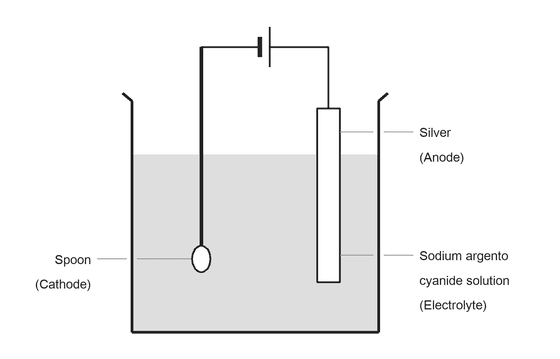
(a) Write an equation for the reaction that occurs at the cathode.
(b) Silver nitrate solution is not preferred as an electrolyte in the above process. Give a reason.
(c) Why is alternating current not used in the process?
(d) What is the observation at the anode?
Solve with AIWritten solution
Solution:
Concept: In electroplating the article to be plated is made the cathode, a block of the pure plating metal is made the anode, and the electrolyte is a solution of a salt of the plating metal. The metal ions are discharged on the article; the anode dissolves and replaces them. The coat is good when silver is deposited slowly and the electrodes keep a fixed polarity.
(a) Reaction at the cathode
Step 1 — Write the cathode reaction.
The spoon is the cathode. The ions gain an electron each and are deposited on it as silver:
(b) Why silver nitrate is not preferred
Step 2 — Compare the electrolytes.
With silver nitrate solution silver is deposited very fast, so the coat is not smooth and uniform and does not stick firmly. Sodium argentocyanide gives ions slowly, so silver is laid down slowly and evenly.
(c) Why alternating current is not used
Step 3 — Think about the polarity.
Alternating current reverses the polarity of the electrodes many times a second. The spoon would then be the cathode and the anode by turns: silver deposited in one half-cycle would dissolve again in the next, so no lasting coat would form. Direct current keeps the spoon as the cathode all the time.
(d) Observation at the anode
Step 4 — Describe the anode.
The silver anode dissolves and becomes thinner:
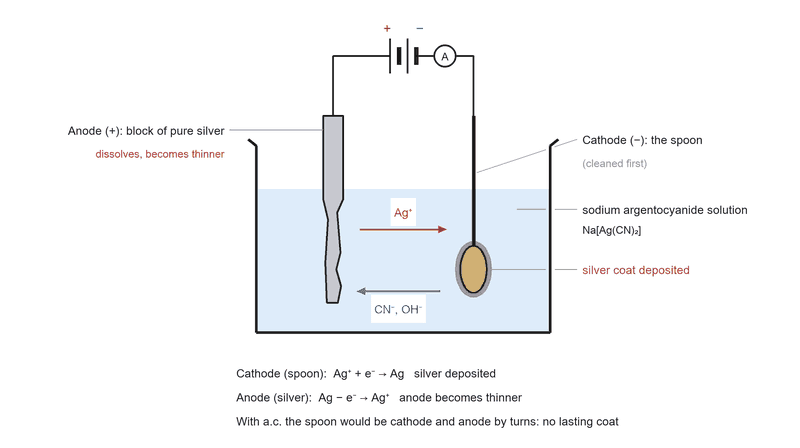
Watch out: The spoon must ALWAYS be the cathode; anything that makes it the anode, even for a moment, removes silver.
Therefore, (a) Ag⁺ + e⁻ → Ag; (b) silver nitrate deposits silver too fast, giving an uneven coat; (c) a.c. keeps reversing the electrodes, so the deposited silver dissolves again; (d) the silver anode dissolves and becomes thinner.
- 563 marks
Question 56
K, L and M are beakers containing three different solutions as shown below.
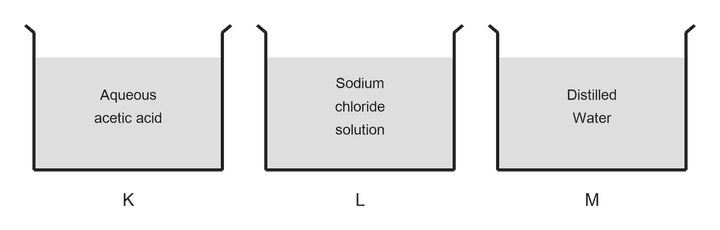
Name the beaker which:
(a) contains only ions.
(b) contains only molecules.
(c) has pH less than 7.
Solve with AIWritten solution
Solution:
Concept: Electrolytes conduct because they contain mobile ions. A strong electrolyte is almost completely dissociated, so it contains (almost) only ions; a weak electrolyte is only partly dissociated, so it contains ions together with many un-ionised molecules; a non-electrolyte forms no ions and contains only molecules. An acid gives H⁺ ions, so its pH is below 7.
(a) Contains only ions
Step 1 — Beaker L.
Sodium chloride is a strong electrolyte, completely dissociated into and ions, so beaker L contains only ions (apart from the solvent water).
(b) Contains only molecules
Step 2 — Beaker M.
Distilled water is almost entirely H₂O molecules; it has practically no ions, so beaker M contains only molecules.
(c) pH less than 7
Step 3 — Beaker K.
Acetic acid is a weak acid. The few ions it gives make the solution acidic, so its pH is less than 7:
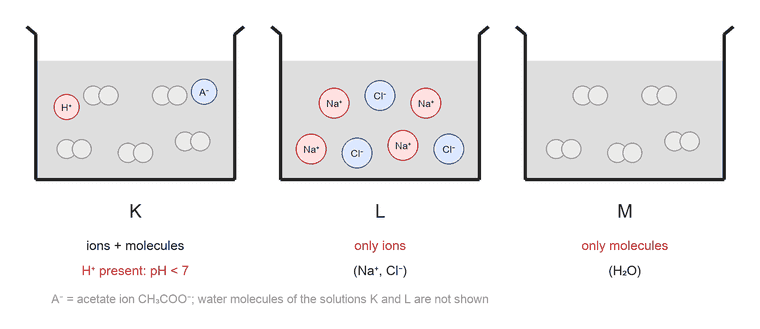
Watch out: Acetic acid is weak, so K holds ions AND molecules; it is not the beaker with only ions.
Therefore, (a) L, (b) M and (c) K.
- 571 mark
Question 57
Metallic and non-metallic elements can both be extracted by electrolysis. Which of the following will undergo reduction at the electrode?
Solve with AIAnswer
(A) Bromine
(B) Chlorine
- Correct
(C) Hydrogen
(D) Oxygen
Answer: (C) Hydrogen
Concept: Oxidation is the loss of electrons and reduction is the gain of electrons. In electrolysis oxidation always happens at the anode and reduction at the cathode, at the same time. Hydrogen is formed when H⁺ ions gain electrons; the halogens and oxygen are formed when negative ions lose electrons.
Step 1 — Hydrogen (cathode).
Hydrogen is formed at the cathode when ions gain electrons, which is reduction:
Step 2 — The other three (anode).
Bromine and chlorine come from and ions, and oxygen from ions, by LOSS of electrons at the anode, which is oxidation.
Watch out: Non-metals come from negative ions at the anode (oxidation); hydrogen is the exception, coming from H⁺ at the cathode.
Why the other options are wrong:
- (A) Bromine: Bromine forms at the anode by oxidation: .
- (B) Chlorine: Chlorine forms at the anode by oxidation: .
- (D) Oxygen: Oxygen forms at the anode by oxidation of ions.
Therefore, the element formed by reduction is hydrogen, option (C).
- 581 mark
Question 58
Name the following:
Two metal wires/plates through which electricity enters and leaves the electrolytic cell during electrolysis.
Solve with AIWritten solution
Solution:
Concept: In an electrolytic cell the anode is the electrode joined to the positive (+) terminal of the battery and the cathode is the electrode joined to the negative (−) terminal. Cations (+) move to the cathode and gain electrons there (reduction); anions (−) move to the anode and lose electrons there (oxidation).
Step 1 — Read the description.
Electricity enters and leaves the electrolyte through two metal wires or plates dipped in it.
Step 2 — Name them.
These are the electrodes: the anode (joined to the positive terminal) and the cathode (joined to the negative terminal).
Watch out: The vessel is the electrolytic cell (voltameter); the plates themselves are the electrodes.
Therefore, they are called electrodes (the anode and the cathode).
- 593 marks
Question 59
A student wanted to electroplate a spoon with silver. He tried four different set-ups to electroplate the spoon as depicted in the diagrams given below.
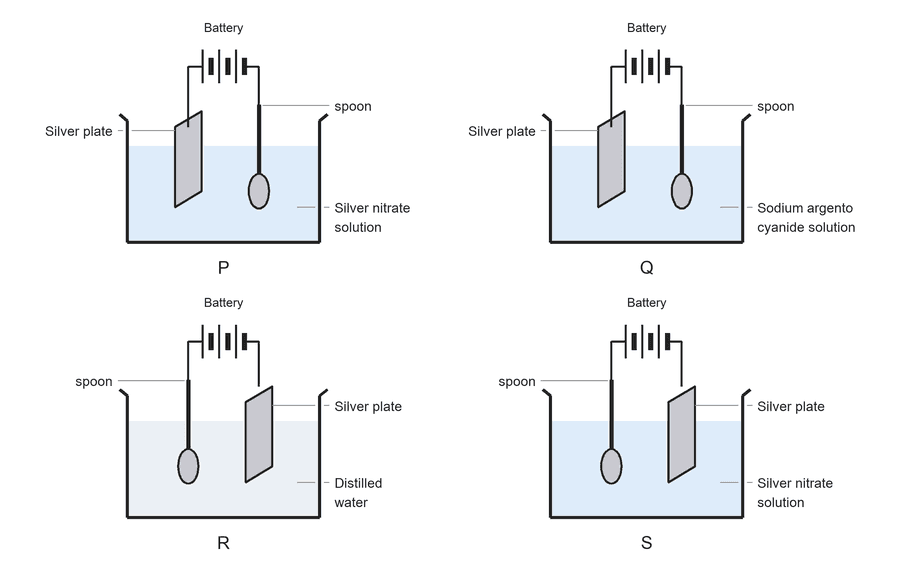
Answer the following questions based on the above diagrams:
(a) Identify the set-up made by the student which would result in the uniform and smooth electroplating of the spoon with silver.
(b) In which set up will the coating on the spoon be uneven?
(c) Write the reaction taking place at the anode for the correct set-up.
Solve with AIWritten solution
Solution:
Concept: In electroplating the article to be plated is made the cathode, a block of the pure plating metal is made the anode, and the electrolyte is a solution of a salt of the plating metal. The metal ions are discharged on the article; the anode dissolves and replaces them. For silver the electrolyte must be sodium argentocyanide, which gives Ag⁺ ions slowly.
Step 1 — Read the battery.
In every set-up the long thin plate of the battery (+) is on the left, so the left electrode is the anode and the right electrode is the cathode. In P and Q the silver plate is the anode and the spoon the cathode; in R and S the spoon is joined to + and is the anode.
(a) Uniform and smooth plating
Step 2 — Find the correct set-up.
Set-up Q has the spoon as the cathode, a silver plate as the anode and sodium argentocyanide solution, so silver is deposited slowly and evenly.
(b) Uneven coating
Step 3 — Find the faulty electrolyte.
Set-up P also has the spoon as the cathode, but the electrolyte is silver nitrate. Silver is deposited very fast, so the coat is uneven. (In R the spoon is the anode and distilled water has almost no ions, so no current flows; in S the spoon is the anode, so it is not plated at all.)
(c) Reaction at the anode in set-up Q
Step 4 — Write the anode reaction.
The silver plate dissolves to replace the Ag⁺ ions deposited on the spoon:
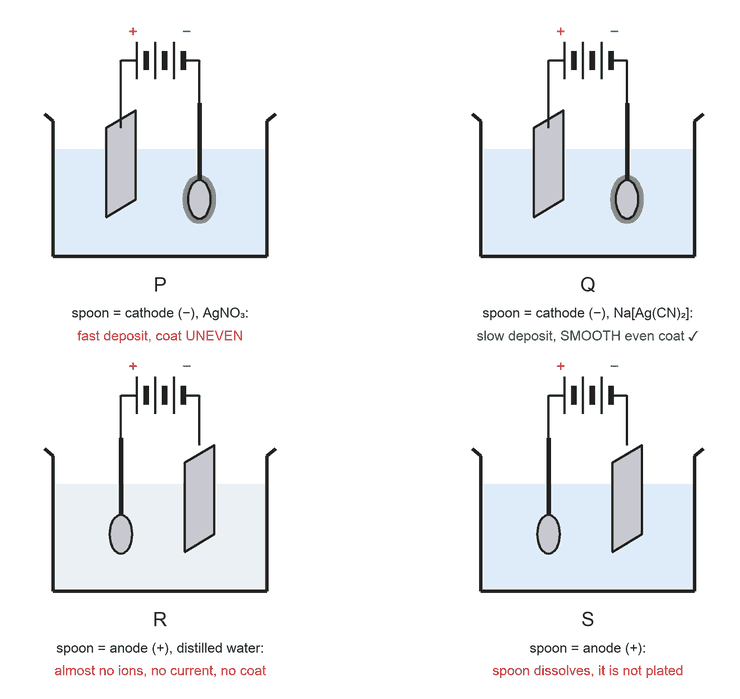
Watch out: Check BOTH the polarity (spoon at −) and the electrolyte (argentocyanide); a set-up needs both to be right.
Therefore, (a) Q, (b) P, and (c) Ag − e⁻ → Ag⁺.
- 603 marks
Question 60
Metal X is low in the reactivity series and it is obtained by the electrolysis of its bromide.
Complete the following blanks by choosing the correct word from the options given in the brackets:
(a) Metal X is ............... (lead / sodium)
(b) The bromide is in the ............... state. (solution / molten)
(c) The sulphate of metal X will have the formula ............... ( / )
Solve with AIWritten solution
Solution:
Concept: Solid lead bromide does not conduct, because its Pb²⁺ and Br⁻ ions are held in fixed positions. On melting, the ions become free to move: Pb²⁺ ions go to the cathode and are reduced to lead, and Br⁻ ions go to the anode and are oxidised to bromine. Lead forms the Pb²⁺ ion, so it has valency 2.
(a) Metal X
Step 1 — Choose the metal.
Sodium is at the top of the reactivity series, while lead is much lower. So the metal low in the series, obtained by electrolysis of its bromide, is lead.
(b) State of the bromide
Step 2 — Choose the state.
Solid lead bromide does not conduct; its ions become free only on melting, so the bromide is electrolysed in the molten state:
(c) Formula of the sulphate
Step 3 — Balance the charges.
The lead ion carries a charge of 2+ and the sulphate ion a charge of 2−, so one ion of each makes a neutral compound:
Writing X for lead, the formula of the sulphate is XSO₄.
Watch out: X₂SO₄ would need a metal of valency 1, like sodium.
Therefore, (a) lead, (b) molten, and (c) XSO₄.