
Question 293 marksAsked 2023Easy
Answer the following questions with reference to electrorefining of copper:
(a) What is the anode made of?
(b) What do you observe at the cathode?
(c) Write the reaction taking place at the cathode.
Confirming your payment
Sign up now and get 250 free tokens.
Previous Year Questions · Question 29 of 60
Answer the following questions with reference to electrorefining of copper:
(a) What is the anode made of?
(b) What do you observe at the cathode?
(c) Write the reaction taking place at the cathode.
Solution:
Concept: In electro-refining a thick block of the impure metal is the anode, a thin sheet of the pure metal is the cathode, and the electrolyte is a solution of a salt of that metal. The anode dissolves, pure metal is deposited on the cathode, and insoluble impurities fall below the anode as anode mud. For copper the electrolyte is copper sulphate solution with a little dilute sulphuric acid.
(a) The anode
Step 1 — Name the anode.
The copper to be purified is the anode, so it is made of thick blocks (slabs) of impure copper.
(b) Observation at the cathode
Step 2 — Describe the cathode.
Pure copper is deposited on the thin cathode strips, so a reddish-brown (pink) layer of copper grows and the cathode becomes thicker.
(c) Reaction at the cathode
Step 3 — Write the cathode reaction.
The ions gain two electrons each at the cathode:
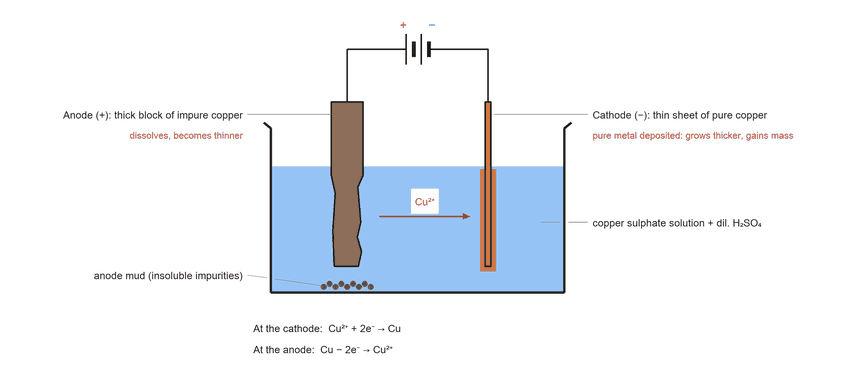
The copper deposited is very pure, about 99.9 % or better.
Watch out: The cathode GAINS copper and becomes thicker; it is the anode that dissolves.
Therefore, (a) the anode is made of impure copper, (b) reddish-brown pure copper is deposited on the cathode, which becomes thicker, and (c) Cu²⁺ + 2e⁻ → Cu.