Solution:
Concept: Bromine is a reddish-brown substance, and of two cations the one lower in the electrochemical series is discharged more readily. When two or more ions of the same sign reach an electrode, the ion lower in the electrochemical series is discharged in preference (selective discharge). The cation series is K⁺, Ca²⁺, Na⁺, Mg²⁺, Al³⁺, Zn²⁺, Fe²⁺, Ni²⁺, Sn²⁺, Pb²⁺, H⁺, Cu²⁺, Hg²⁺, Ag⁺, Au³⁺ and the anion series is SO₄²⁻, NO₃⁻, Cl⁻, Br⁻, I⁻, OH⁻; in both lists the ease of discharge increases downwards.
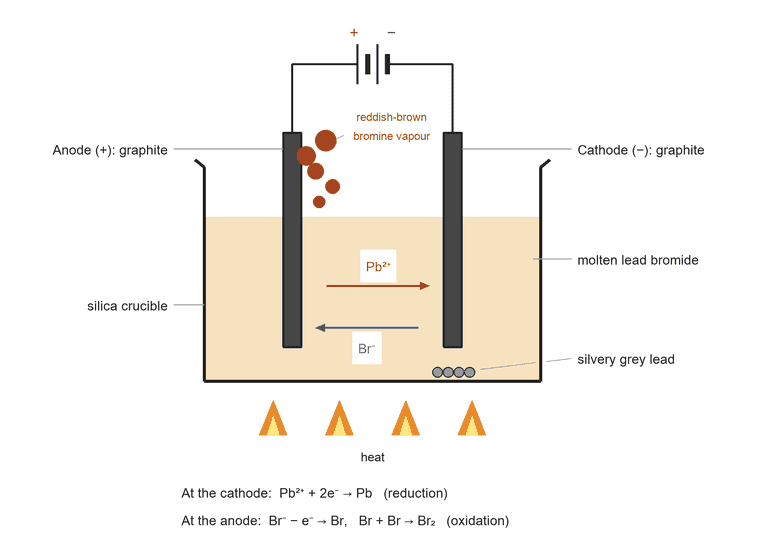
(a) Reddish-brown fumes at the anode
Step 1 — Find which melt gives a coloured vapour.
Molten lead bromide gives bromine at the anode, which is seen as reddish-brown fumes. Molten sodium chloride would give chlorine, a greenish-yellow gas:
2Br−−2e−⟶Br2
(b) Ion discharged most readily
Step 2 — Place the two ions in the series.
In the series Fe2+ lies above hydrogen and Cu2+ lies below it. Cu2+ is lower, so it accepts electrons more easily:
Cu2++2e−⟶Cu
Watch out: Reddish-brown means bromine, which comes only from a bromide.
Therefore, (a) PbBr₂ and (b) Cu²⁺.
