
Question 111 markAsked 2018Easy
State one relevant observation for each of the following:
At the anode, when molten lead bromide is electrolyzed using graphite electrodes.
Confirming your payment
Sign up now and get 250 free tokens.
Previous Year Questions · Question 11 of 60
State one relevant observation for each of the following:
At the anode, when molten lead bromide is electrolyzed using graphite electrodes.
Solution:
Concept: Solid lead bromide does not conduct, because its Pb²⁺ and Br⁻ ions are held in fixed positions. On melting, the ions become free to move: Pb²⁺ ions go to the cathode and are reduced to lead, and Br⁻ ions go to the anode and are oxidised to bromine.
Step 1 — Find the ions at the anode.
The negative ions of the melt move to the anode.
Step 2 — Describe the change.
Each bromide ion loses one electron there, and the bromine atoms join in pairs to form bromine:
At the temperature of the melt the bromine comes off as a vapour, seen as dark reddish-brown fumes.
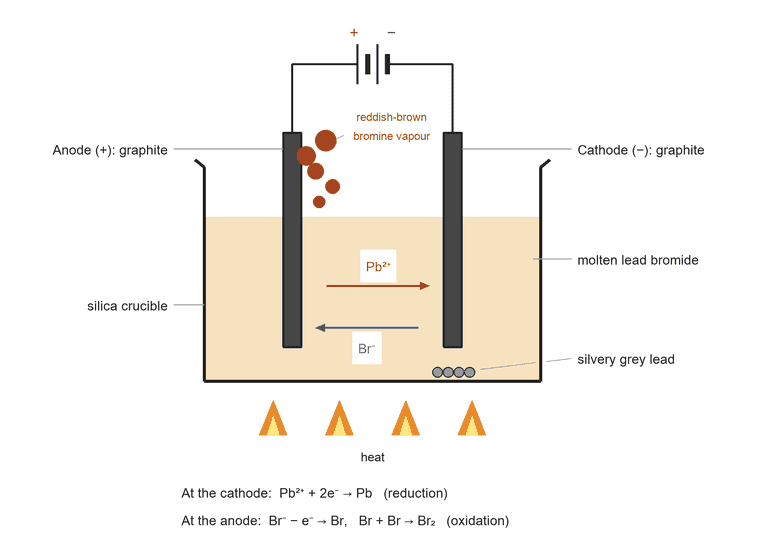
Watch out: Silvery grey lead is the observation at the CATHODE, not the anode.
Therefore, dark reddish-brown fumes of bromine are seen at the anode.