
Question 161 markMCQAsked 2019Easy
An electrolyte which completely dissociates into ions is:
Confirming your payment
Sign up now and get 250 free tokens.
Previous Year Questions · Question 16 of 60
An electrolyte which completely dissociates into ions is:
(A) Alcohol
(B) Carbonic acid
(C) Sucrose
(D) Sodium hydroxide
Answer: (D) Sodium hydroxide
Concept: Electrolytes conduct because they contain mobile ions. A strong electrolyte is almost completely dissociated, so it contains (almost) only ions; a weak electrolyte is only partly dissociated, so it contains ions together with many un-ionised molecules; a non-electrolyte forms no ions and contains only molecules. Strong acids and strong bases such as sodium hydroxide are strong electrolytes.
Step 1 — Look at sodium hydroxide.
Sodium hydroxide is an ionic compound and a strong base; in water it is practically completely dissociated into ions:
Step 2 — Compare with the others.
Alcohol and sucrose are covalent and form no ions, and carbonic acid is a weak acid that ionises only partly. So sodium hydroxide is the one that dissociates completely.
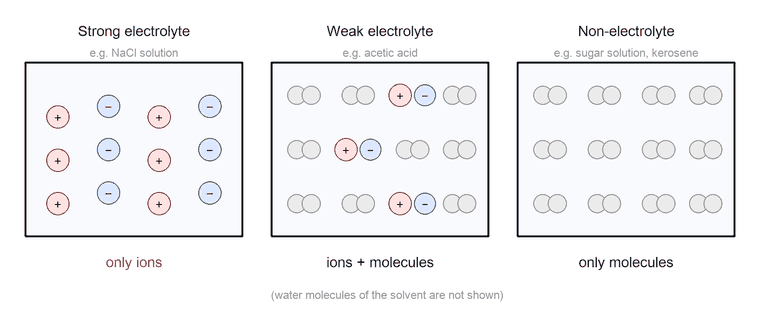
Watch out: 'Completely dissociates' means a STRONG electrolyte; any acid is not enough, it must be a strong one.
Why the other options are wrong:
Therefore, the electrolyte which completely dissociates into ions is sodium hydroxide, option (D).