Solution:
Concept: An electrolyte conducts by mobile ions and is decomposed by the current; a metal conducts by free electrons and is not decomposed.
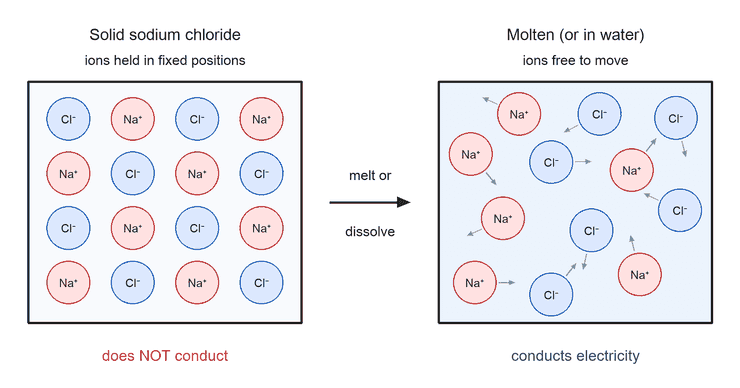
(i) Sodium chloride conducts only when fused or dissolved
Step 1 — Look at the solid.
In solid sodium chloride the Na+ and Cl− ions are held in fixed positions in the crystal by strong electrostatic forces of attraction. They cannot move, so they cannot carry a current.
Step 2 — Look at the melt or the solution.
On fusion (melting) or on dissolving in water these forces are overcome and the ions become free to move. Mobile ions carry the current, so fused or aqueous sodium chloride conducts.
(ii) Sodium argentocyanide is preferred to silver nitrate
Step 3 — Compare the two electrolytes.
Sodium argentocyanide, Na[Ag(CN)2], is a complex salt that gives Ag+ ions slowly, so silver is deposited slowly and evenly, giving a smooth, firm and lasting coat. With silver nitrate solution the silver is deposited very fast, so the coat is rough and uneven and does not stick well.
(iii) Copper is a non-electrolyte
Step 4 — See how copper conducts.
Copper conducts by the movement of free electrons, and it undergoes no chemical change when the current passes.
Step 5 — Compare with the definition.
An electrolyte must conduct by ions and be decomposed by the current. Copper does neither, so although it is a good conductor it is a non-electrolyte (a metallic conductor).
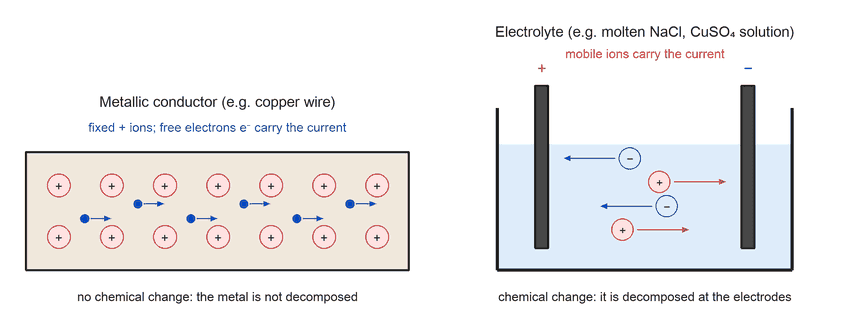
Watch out: 'Good conductor' and 'electrolyte' are not the same thing: an electrolyte must be chemically decomposed by the current.
Therefore, (i) its ions are free to move only when fused or dissolved; (ii) sodium argentocyanide releases Ag⁺ ions slowly, giving a smooth, even, firm coat (silver nitrate deposits silver too fast); (iii) copper conducts by electrons and is not decomposed, so it is not an electrolyte.
