Solution:
Concept: When two or more ions of the same sign reach an electrode, the ion lower in the electrochemical series is discharged in preference (selective discharge). The cation series is K⁺, Ca²⁺, Na⁺, Mg²⁺, Al³⁺, Zn²⁺, Fe²⁺, Ni²⁺, Sn²⁺, Pb²⁺, H⁺, Cu²⁺, Hg²⁺, Ag⁺, Au³⁺ and the anion series is SO₄²⁻, NO₃⁻, Cl⁻, Br⁻, I⁻, OH⁻; in both lists the ease of discharge increases downwards. In electroplating, the electrolyte must contain ions of the metal that is to be deposited.
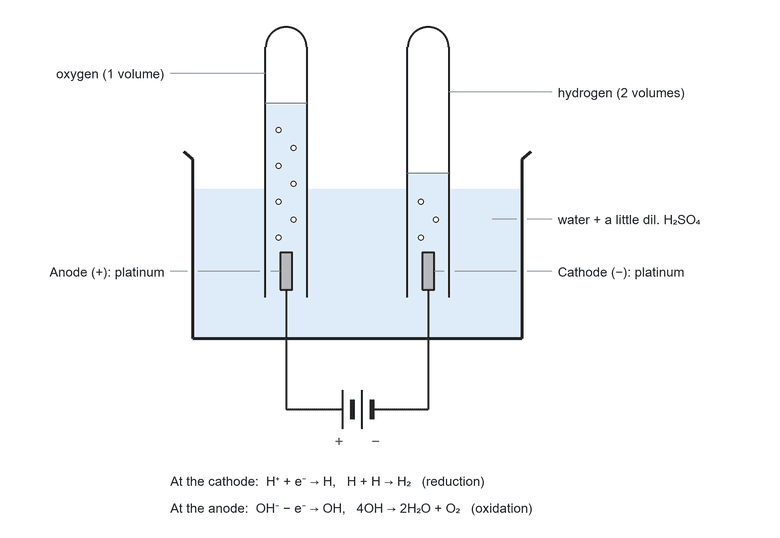
(i) Product at the anode
Step 1 — Find the anions at the anode.
Acidified water contains SO42− ions from the sulphuric acid and OH− ions from water. Both move to the platinum anode.
Step 2 — Choose the ion discharged.
The OH− ion is lower than SO42− in the anion series, so OH− ions lose electrons:
OH−−e−⟶OH
The OH groups then combine to give water and oxygen gas:
4OH⟶2H2O+O2
(ii) Metallic ions in the electrolyte
Step 3 — Match the ion to the coat.
The copper article is made the cathode and must receive a coat of silver, so the electrolyte must supply silver ions, Ag+. In practice a solution of sodium argentocyanide, Na[Ag(CN)2], is used, which gives the silver ions slowly.
At the article each silver ion gains one electron:
Ag++e−⟶Ag

Watch out: The anode product is a GAS, oxygen; hydrogen is the cathode product.
Therefore, (i) oxygen gas is formed at the anode, and (ii) silver ions (Ag⁺) must be present in the electrolyte.
