Solution:
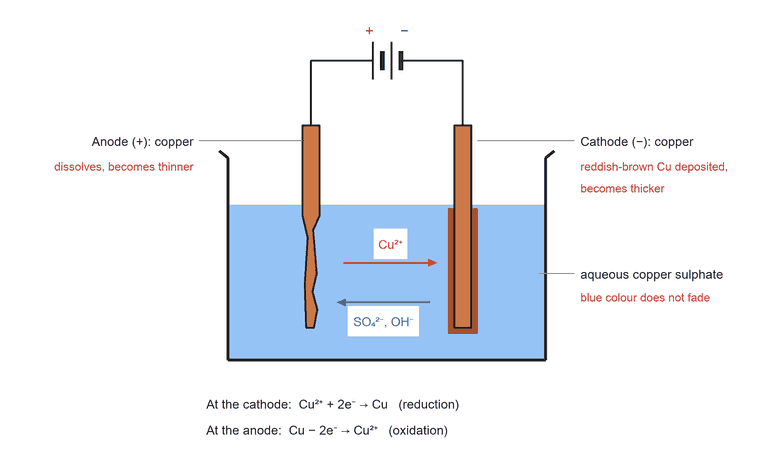
Concept: In an electrolytic cell the anode is the electrode joined to the positive (+) terminal of the battery and the cathode is the electrode joined to the negative (−) terminal. Cations (+) move to the cathode and gain electrons there (reduction); anions (−) move to the anode and lose electrons there (oxidation). An inert electrode (platinum, graphite) only passes electrons and takes no part in the reaction. An active electrode (copper, nickel, silver) takes part: as an anode, its own atoms lose electrons and go into the solution as ions, so the anode dissolves.
(i) Acidified copper sulphate solution, copper electrodes
Step 1 — List the ions.
The solution contains Cu2+ and SO42− ions from copper sulphate, H+ ions from the acid and a few H+ and OH− ions from water.
Step 2 — Reaction at the cathode (copper).
Both Cu2+ and H+ move to the cathode. Cu2+ is lower than H+ in the electrochemical series, so it is discharged and copper is deposited:
Cu2++2e−⟶Cu
Step 3 — Reaction at the anode (copper).
The anions SO42− and OH− move to the anode, but neither is discharged, because the copper anode is an active electrode. Its own atoms lose electrons more easily and go into the solution as copper ions, so the anode dissolves:
Cu−2e−⟶Cu2+
(ii) Molten lead bromide, inert electrodes
Step 4 — List the ions.
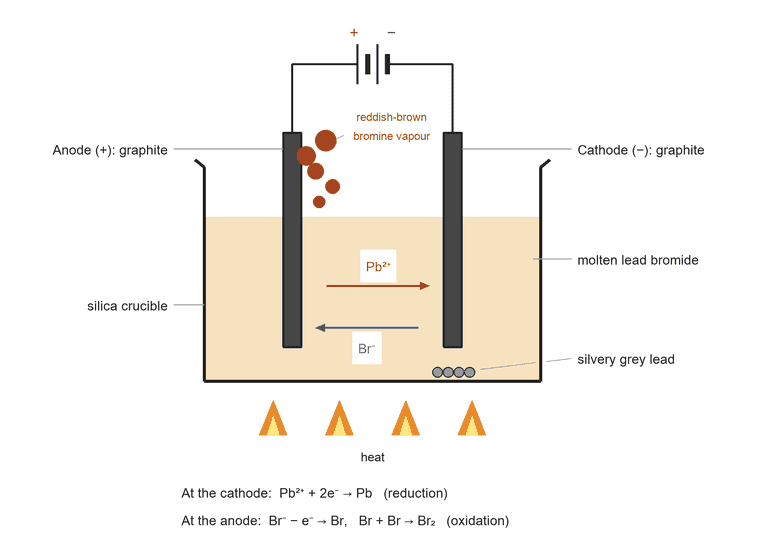
Molten lead bromide contains only Pb2+ and Br− ions, now free to move.
Step 5 — Reaction at the cathode (graphite).
The Pb2+ ions move to the cathode and each gains two electrons, forming lead metal:
Pb2++2e−⟶Pb
Step 6 — Reaction at the anode (graphite).
The Br− ions move to the anode and each loses one electron. The bromine atoms formed then join in pairs to give bromine molecules:
Br−−e−⟶Br
Br+Br⟶Br2
Watch out: With copper electrodes the anode reaction is the copper anode dissolving, not the discharge of OH⁻ ions (that happens only with an inert anode).
Therefore, (i) cathode: Cu²⁺ + 2e⁻ → Cu and anode: Cu − 2e⁻ → Cu²⁺; (ii) cathode: Pb²⁺ + 2e⁻ → Pb and anode: Br⁻ − e⁻ → Br, Br + Br → Br₂.
