
Question 11 markMCQAsked 2016Easy
The particles present in strong electrolytes are:
Confirming your payment
Sign up now and get 250 free tokens.
Previous Year Questions · Question 1 of 60
The particles present in strong electrolytes are:
(A) only molecules
(B) mainly ions
(C) ions and molecules
(D) only atoms.
Answer: (B) mainly ions
Concept: Electrolytes conduct because they contain mobile ions. A strong electrolyte is almost completely dissociated, so it contains (almost) only ions; a weak electrolyte is only partly dissociated, so it contains ions together with many un-ionised molecules; a non-electrolyte forms no ions and contains only molecules.
Step 1 — Recall what a strong electrolyte is.
A strong electrolyte, such as sodium chloride, sodium hydroxide or hydrochloric acid, breaks up almost completely into ions when it is melted or dissolved in water.
Step 2 — Name the particles.
Since almost every unit has split into ions, the particles of the electrolyte are mainly ions; practically no undissociated molecules are left. These many mobile ions are why a strong electrolyte conducts well.
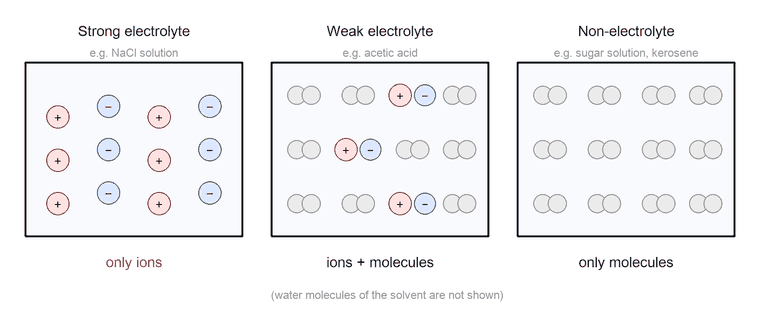
Watch out: The water molecules of a solution are the solvent, not particles of the electrolyte; do not let them push you to 'ions and molecules', which describes a weak electrolyte.
Why the other options are wrong:
Therefore, the particles present in strong electrolytes are mainly ions, option (B).