Solution:
Concept: An inert electrode (platinum, graphite) only passes electrons and takes no part in the reaction. An active electrode (copper, nickel, silver) takes part: as an anode, its own atoms lose electrons and go into the solution as ions, so the anode dissolves. Nickel electrodes are active: the nickel anode dissolves to give Ni²⁺ ions, and Ni²⁺ ions are deposited on the cathode. This is the set-up used for nickel plating.
(i) Observations at the cathode and the anode
Step 1 — At the cathode.
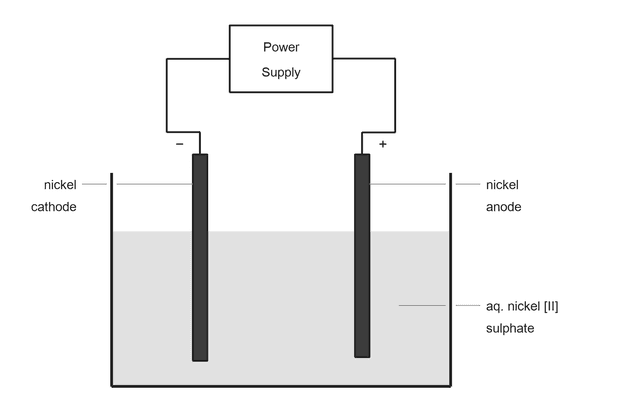
In the diagram the left electrode is joined to the − end of the supply, so it is the cathode. Ni2+ ions gain electrons there, so a grey layer of nickel is deposited and the cathode becomes thicker:
Ni2++2e−⟶Ni
Step 2 — At the anode.
The right electrode, joined to +, is the nickel anode. Its atoms lose electrons and go into the solution, so the anode dissolves and becomes thinner:
Ni−2e−⟶Ni2+
The green colour of the solution stays the same, because the anode replaces the ions removed.

(ii) The spectator cation
Step 3 — Find the cation that is not discharged.
Both Ni2+ (from the salt) and H+ (from water) reach the cathode. In this solution Ni2+ is discharged (it is present in a much higher concentration), so H+ takes no part in the electrode reactions and stays in the solution as a spectator ion.
(iii) The correct anode equation
Step 4 — Test each equation.
The anode reaction is an oxidation: each nickel atom LOSES two electrons. Equation 1, Ni⟶Ni2++2e−, shows exactly this, and it balances in atoms and in charge.
Equation 2, Ni+2e−⟶Ni2+, does not balance in charge (2− on the left, 2+ on the right). Equation 3, Ni2+⟶Ni+2e−, does not balance in charge either. Equation 4, Ni2++2e−⟶Ni, is correct but it is the cathode reaction (a gain of electrons).
Watch out: The spectator is the cation that is NOT discharged; Ni²⁺ is discharged at the cathode, so it is not the answer.
Note: The electrochemical series puts Ni²⁺ above H⁺, yet nickel is deposited from nickel sulphate solution. This is because Ni²⁺ ions are present in a far higher concentration than H⁺ ions; concentration also affects which ion is discharged.
Therefore, (i) nickel is deposited on the cathode (it becomes thicker) and the nickel anode dissolves (it becomes thinner); (ii) the spectator cation is H⁺; (iii) equation 1, Ni → Ni²⁺ + 2e⁻, is correct.