
Question 131 markAsked 2018Easy
Fill up the blanks with the correct choice given in brackets.
Electrolysis of aqueous sodium chloride solution will form ............... at the cathode. (hydrogen gas / sodium metal)
Confirming your payment
Sign up now and get 250 free tokens.
Previous Year Questions · Question 13 of 60
Fill up the blanks with the correct choice given in brackets.
Electrolysis of aqueous sodium chloride solution will form ............... at the cathode. (hydrogen gas / sodium metal)
Solution:
Concept: When two or more ions of the same sign reach an electrode, the ion lower in the electrochemical series is discharged in preference (selective discharge). The cation series is K⁺, Ca²⁺, Na⁺, Mg²⁺, Al³⁺, Zn²⁺, Fe²⁺, Ni²⁺, Sn²⁺, Pb²⁺, H⁺, Cu²⁺, Hg²⁺, Ag⁺, Au³⁺ and the anion series is SO₄²⁻, NO₃⁻, Cl⁻, Br⁻, I⁻, OH⁻; in both lists the ease of discharge increases downwards.
Step 1 — Find the cations at the cathode.
Aqueous sodium chloride contains ions from the salt and ions from water. Both move to the cathode.
Step 2 — Choose the ion discharged.
The ion is much lower than in the series, so ions gain electrons and hydrogen gas is formed:
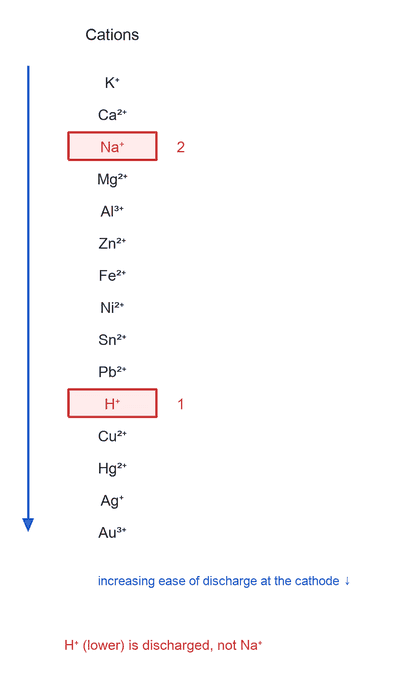
Step 3 — Why not sodium.
Sodium is near the top of the series. Even if any sodium were formed it would react at once with the water, so sodium metal is obtained only from MOLTEN sodium chloride.
Watch out: In aqueous solutions of salts of very reactive metals (K, Na, Ca, Mg, Al), the cathode always gives hydrogen.
Therefore, electrolysis of aqueous sodium chloride solution will form hydrogen gas at the cathode.