
Question 144 marksAsked 2018Easy
Copy and complete the following table which refers to the conversion of ions to neutral particles.
| Conversion | Ionic equation | Oxidation/Reduction |
|---|---|---|
| Chloride ion to chlorine molecule | ||
| Lead [II] ion to lead |
Confirming your payment
Sign up now and get 250 free tokens.
Previous Year Questions · Question 14 of 60
Copy and complete the following table which refers to the conversion of ions to neutral particles.
| Conversion | Ionic equation | Oxidation/Reduction |
|---|---|---|
| Chloride ion to chlorine molecule | ||
| Lead [II] ion to lead |
Solution:
Concept: Oxidation is the loss of electrons and reduction is the gain of electrons. In electrolysis oxidation always happens at the anode and reduction at the cathode, at the same time.
Step 1 — Chloride ion to chlorine molecule.
Each ion loses one electron, and two chlorine atoms join to form a molecule. Loss of electrons is oxidation:
Step 2 — Lead (II) ion to lead.
Each ion gains two electrons and becomes a lead atom. Gain of electrons is reduction:
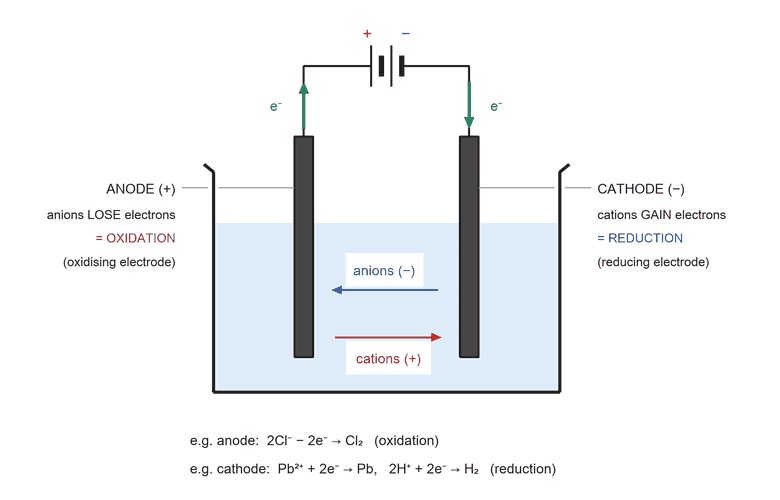
Step 3 — Complete the table.
Putting both results in the table:
| Conversion | Ionic equation | Oxidation/Reduction |
|---|---|---|
| Chloride ion to chlorine molecule | Oxidation | |
| Lead [II] ion to lead | Reduction |
Watch out: Check the electrons: two Cl⁻ ions give ONE Cl₂ molecule and lose 2 electrons in all; Pb²⁺ needs 2 electrons.
Therefore, Cl⁻ → Cl₂ (2Cl⁻ − 2e⁻ → Cl₂) is oxidation and Pb²⁺ → Pb (Pb²⁺ + 2e⁻ → Pb) is reduction.