
Question 421 markMCQAsked 2025Easy
Assertion (A): In a solution containing equal concentration of ions and ions, ions will be discharged in preference to ions.
Reason (R): ions are placed above ions in the electrochemical series.
Confirming your payment
Sign up now and get 250 free tokens.
Previous Year Questions · Question 42 of 60
Assertion (A): In a solution containing equal concentration of ions and ions, ions will be discharged in preference to ions.
Reason (R): ions are placed above ions in the electrochemical series.
(A) Both (A) and (R) are true, and (R) is the correct explanation of (A).
(B) Both (A) and (R) are true, and (R) is not the correct explanation of (A).
(C) (A) is true but (R) is false.
(D) (A) is false but (R) is true.
Answer: (A) Both (A) and (R) are true, and (R) is the correct explanation of (A).
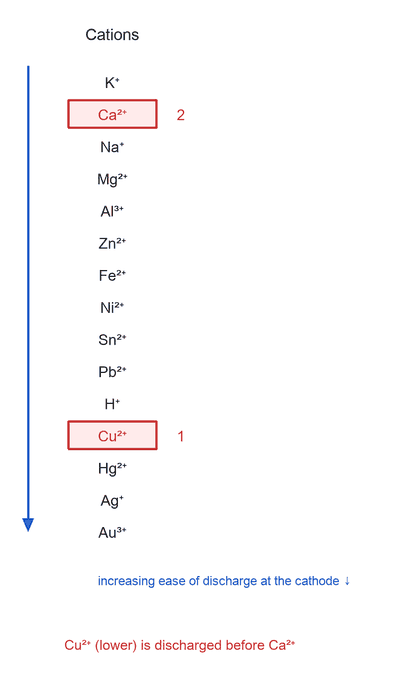
Concept: In an Assertion–Reason item, judge the Assertion (A) true or false, then the Reason (R), and only if both are true ask whether R tells why A is true. When two or more ions of the same sign reach an electrode, the ion lower in the electrochemical series is discharged in preference (selective discharge). The cation series is K⁺, Ca²⁺, Na⁺, Mg²⁺, Al³⁺, Zn²⁺, Fe²⁺, Ni²⁺, Sn²⁺, Pb²⁺, H⁺, Cu²⁺, Hg²⁺, Ag⁺, Au³⁺ and the anion series is SO₄²⁻, NO₃⁻, Cl⁻, Br⁻, I⁻, OH⁻; in both lists the ease of discharge increases downwards.
Step 1 — Judge the assertion.
Both ions move to the cathode, and is discharged first, so A is true:
Step 2 — Judge the reason.
Calcium is near the top of the series and copper is below hydrogen, so is placed above . R is true.
Step 3 — Decide whether R explains A.
Yes. An ion lower in the series is discharged in preference, and is lower because is above it. R gives exactly the reason for A.
Watch out: With EQUAL concentrations, the position in the series alone decides the order of discharge.
Why the other options are wrong:
Therefore, both (A) and (R) are true and (R) explains (A), option (A).