Solution:
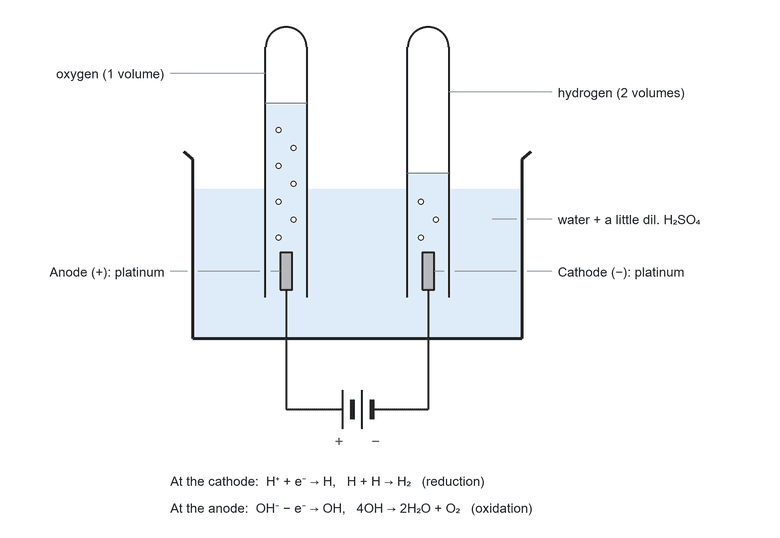
Concept: Pure water has very few ions, so it hardly conducts. A little dilute sulphuric acid supplies many mobile ions, and the acidified water is then electrolysed with platinum electrodes: hydrogen is given off at the cathode and oxygen at the anode, in the ratio 2 : 1 by volume.
(a) Why dilute sulphuric acid is added
Step 1 — Give the reason.
Pure water contains very few ions, so hardly any current flows through it. Dilute sulphuric acid ionises and supplies many mobile ions, so the water conducts and is decomposed:
H2SO4⟶2H++SO42−
The SO42− ions are not discharged, so only the water is decomposed, and the acid is non-volatile, so it does not boil off.
(b) Reaction at the cathode
Step 2 — Write the cathode reaction.
The H+ ions gain electrons at the cathode and the hydrogen atoms join in pairs:
H++e−⟶H
H+H⟶H2
(c) Observation at the anode
Step 3 — Describe the anode.
Bubbles of a colourless gas, oxygen, are given off at the anode. Its volume is half the volume of hydrogen at the cathode:
4OH⟶2H2O+O2
Watch out: The acid is added to make the water CONDUCT; it is not used up, so its amount stays the same.
Therefore, (a) dilute sulphuric acid supplies mobile ions so that the water conducts; (b) H⁺ + e⁻ → H, then H + H → H₂; (c) bubbles of colourless oxygen gas are given off at the anode.
