
Question 402 marksAsked 2025Easy
Justify the following statements:
(a) Anode is known as the oxidizing electrode.
(b) Graphite electrodes are preferred in the electrolysis of molten lead bromide.
Confirming your payment
Sign up now and get 250 free tokens.
Previous Year Questions · Question 40 of 60
Justify the following statements:
(a) Anode is known as the oxidizing electrode.
(b) Graphite electrodes are preferred in the electrolysis of molten lead bromide.
Solution:
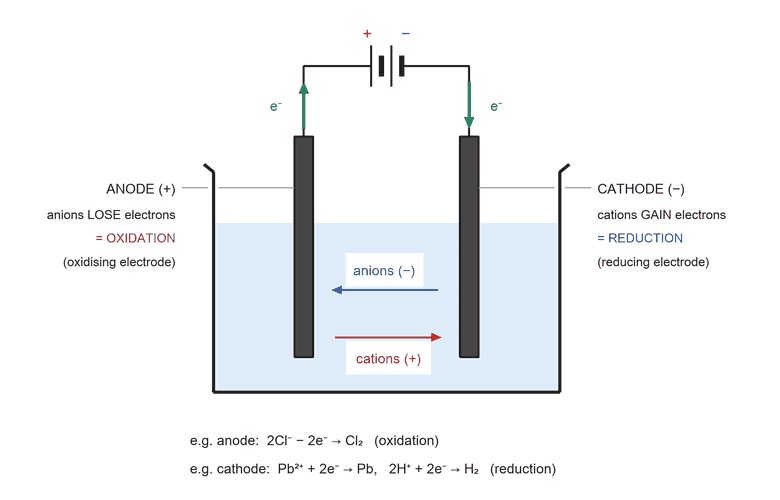
Concept: Oxidation is the loss of electrons and reduction is the gain of electrons. In electrolysis oxidation always happens at the anode and reduction at the cathode, at the same time.
(a) Anode is the oxidising electrode
Step 1 — See what happens at the anode.
Anions move to the anode and lose electrons to it (or the atoms of an active anode lose electrons). For example, chloride ions give chlorine:
Step 2 — Name the change.
Loss of electrons is oxidation, so the anode, where oxidation takes place, is called the oxidising electrode.
(b) Graphite electrodes for molten lead bromide
Step 3 — Give the reason.
Graphite is inert and is not affected by the reactive bromine vapour given off at the anode; it also stands the heat of the melt and is cheap. Platinum can be attacked by hot bromine and is very costly.
Watch out: The anode is the OXIDISING electrode and the cathode the reducing electrode.
Therefore, (a) oxidation (loss of electrons) takes place at the anode, so it is the oxidising electrode; (b) graphite is inert and unaffected by the reactive bromine vapour.