Answer: (A) X & Y
Concept: Electrolytes conduct because they contain mobile ions. A strong electrolyte is almost completely dissociated, so it contains (almost) only ions; a weak electrolyte is only partly dissociated, so it contains ions together with many un-ionised molecules; a non-electrolyte forms no ions and contains only molecules. The bulb glows only when the liquid contains mobile ions.
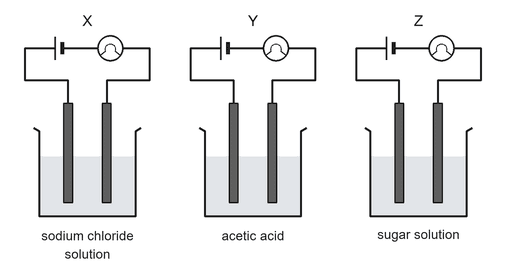
Step 1 — X, sodium chloride solution.
This is a strong electrolyte with many ions, so the bulb glows brightly.
Step 2 — Y, acetic acid.
This is a weak electrolyte with a few ions and many molecules, so the bulb glows dimly; it does glow.
Step 3 — Z, sugar solution.
This is a non-electrolyte with molecules and no ions, so the bulb does not glow.

Watch out: A dim glow is still a glow; a weak electrolyte does conduct.
Why the other options are wrong:
- (B) Y & Z: Z contains no ions, so the bulb in the sugar solution cell does not glow.
- (C) Z & X: Z does not conduct, and the pair leaves out Y, which does conduct a little.
- (D) X, Y & Z: Sugar solution (Z) is a non-electrolyte, so the bulb in its cell does not glow.
Therefore, the bulb glowed in the cells containing X and Y, option (A).