Solution:
Concept: In electroplating the article to be plated is made the cathode, a block of the pure plating metal is made the anode, and the electrolyte is a solution of a salt of the plating metal. The metal ions are discharged on the article; the anode dissolves and replaces them. For silver the electrolyte must be sodium argentocyanide, which gives Ag⁺ ions slowly.
Step 1 — Read the battery.
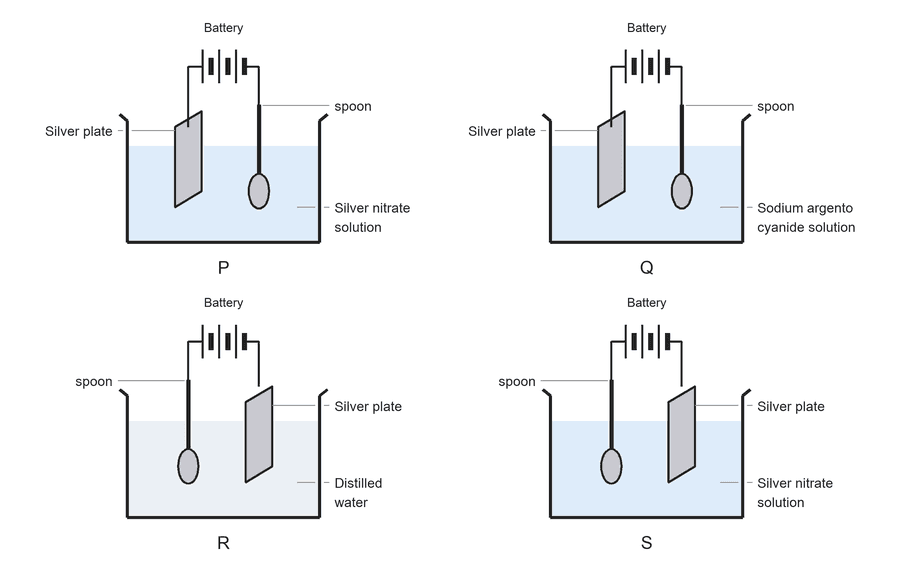
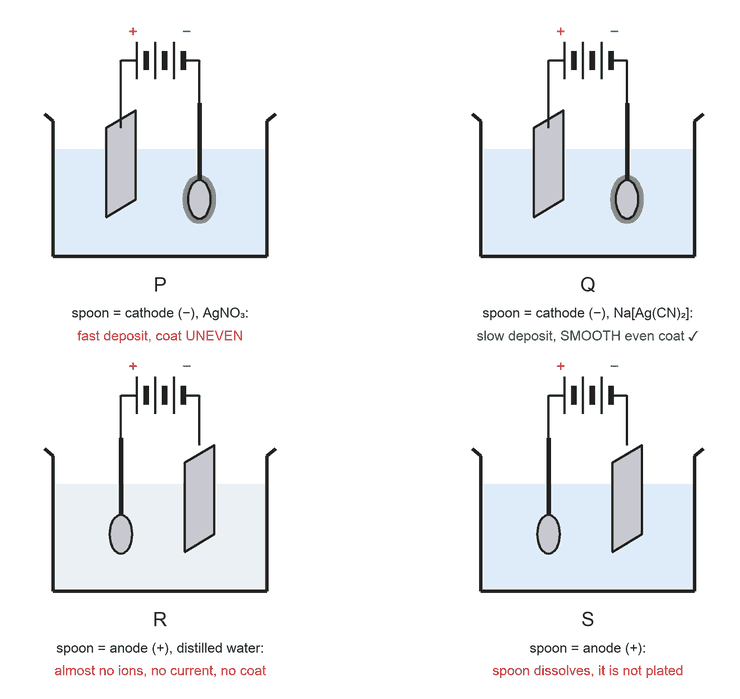
In every set-up the long thin plate of the battery (+) is on the left, so the left electrode is the anode and the right electrode is the cathode. In P and Q the silver plate is the anode and the spoon the cathode; in R and S the spoon is joined to + and is the anode.
(a) Uniform and smooth plating
Step 2 — Find the correct set-up.
Set-up Q has the spoon as the cathode, a silver plate as the anode and sodium argentocyanide solution, so silver is deposited slowly and evenly.
(b) Uneven coating
Step 3 — Find the faulty electrolyte.
Set-up P also has the spoon as the cathode, but the electrolyte is silver nitrate. Silver is deposited very fast, so the coat is uneven. (In R the spoon is the anode and distilled water has almost no ions, so no current flows; in S the spoon is the anode, so it is not plated at all.)
(c) Reaction at the anode in set-up Q
Step 4 — Write the anode reaction.
The silver plate dissolves to replace the Ag⁺ ions deposited on the spoon:
Ag−e−⟶Ag+
Watch out: Check BOTH the polarity (spoon at −) and the electrolyte (argentocyanide); a set-up needs both to be right.
Therefore, (a) Q, (b) P, and (c) Ag − e⁻ → Ag⁺.