Solution:
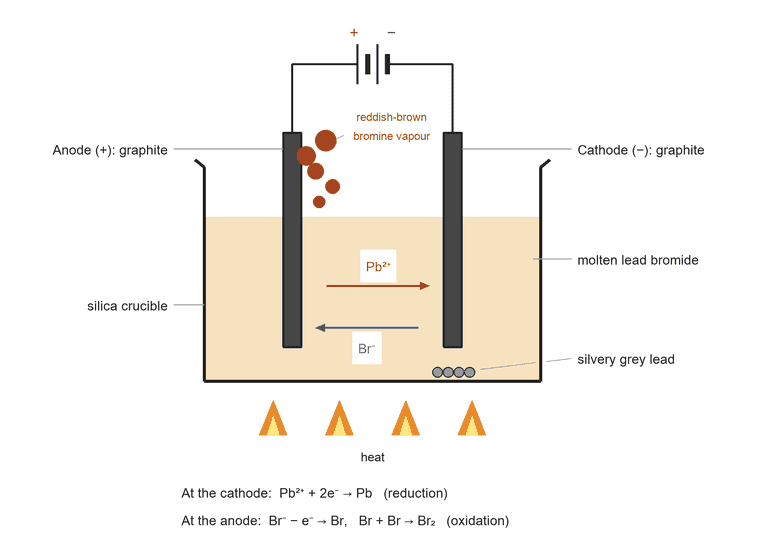
Concept: Solid lead bromide does not conduct, because its Pb²⁺ and Br⁻ ions are held in fixed positions. On melting, the ions become free to move: Pb²⁺ ions go to the cathode and are reduced to lead, and Br⁻ ions go to the anode and are oxidised to bromine. Lead forms the Pb²⁺ ion, so it has valency 2.
(a) Metal X
Step 1 — Choose the metal.
Sodium is at the top of the reactivity series, while lead is much lower. So the metal low in the series, obtained by electrolysis of its bromide, is lead.
(b) State of the bromide
Step 2 — Choose the state.
Solid lead bromide does not conduct; its ions become free only on melting, so the bromide is electrolysed in the molten state:
Pb2++2e−⟶Pb
(c) Formula of the sulphate
Step 3 — Balance the charges.
The lead ion carries a charge of 2+ and the sulphate ion a charge of 2−, so one ion of each makes a neutral compound:
Pb2++SO42−⟶PbSO4
Writing X for lead, the formula of the sulphate is XSO₄.
Watch out: X₂SO₄ would need a metal of valency 1, like sodium.
Therefore, (a) lead, (b) molten, and (c) XSO₄.
