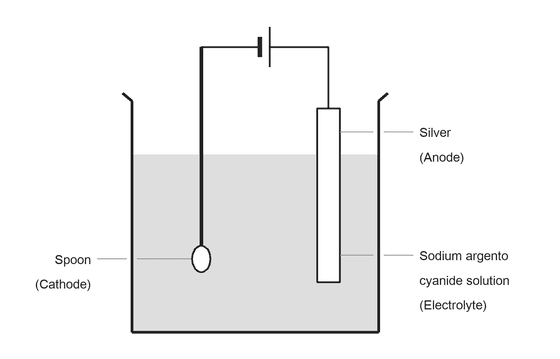
Solution:
Concept: In electroplating the article to be plated is made the cathode, a block of the pure plating metal is made the anode, and the electrolyte is a solution of a salt of the plating metal. The metal ions are discharged on the article; the anode dissolves and replaces them. The coat is good when silver is deposited slowly and the electrodes keep a fixed polarity.
(a) Reaction at the cathode
Step 1 — Write the cathode reaction.
The spoon is the cathode. The Ag+ ions gain an electron each and are deposited on it as silver:
Ag++e−⟶Ag
(b) Why silver nitrate is not preferred
Step 2 — Compare the electrolytes.
With silver nitrate solution silver is deposited very fast, so the coat is not smooth and uniform and does not stick firmly. Sodium argentocyanide gives Ag+ ions slowly, so silver is laid down slowly and evenly.
(c) Why alternating current is not used
Step 3 — Think about the polarity.
Alternating current reverses the polarity of the electrodes many times a second. The spoon would then be the cathode and the anode by turns: silver deposited in one half-cycle would dissolve again in the next, so no lasting coat would form. Direct current keeps the spoon as the cathode all the time.
(d) Observation at the anode
Step 4 — Describe the anode.
The silver anode dissolves and becomes thinner:
Ag−e−⟶Ag+
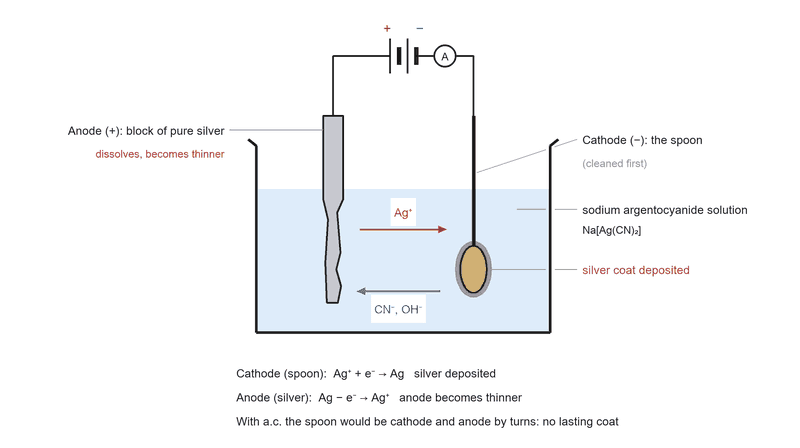
Watch out: The spoon must ALWAYS be the cathode; anything that makes it the anode, even for a moment, removes silver.
Therefore, (a) Ag⁺ + e⁻ → Ag; (b) silver nitrate deposits silver too fast, giving an uneven coat; (c) a.c. keeps reversing the electrodes, so the deposited silver dissolves again; (d) the silver anode dissolves and becomes thinner.