Solution:
Concept: In an electrolytic cell the anode is the electrode joined to the positive (+) terminal of the battery and the cathode is the electrode joined to the negative (−) terminal. Cations (+) move to the cathode and gain electrons there (reduction); anions (−) move to the anode and lose electrons there (oxidation).
Step 1 — Match (i).
A substance that conducts electricity in the aqueous or molten state (and is decomposed) is an electrolyte, so (i) is D.
Step 2 — Match (ii).
Loss of electrons is oxidation, and it takes place at the anode, so (ii) is A.
Step 3 — Match (iii).
At the cathode, cations gain electrons, that is, they are reduced. So the cathode is the reducing electrode, and (iii) is B.
Step 4 — Match (iv).
The electrode joined to the positive terminal of the battery is the anode, so (iv) is C. Word E (reduction) is not needed.
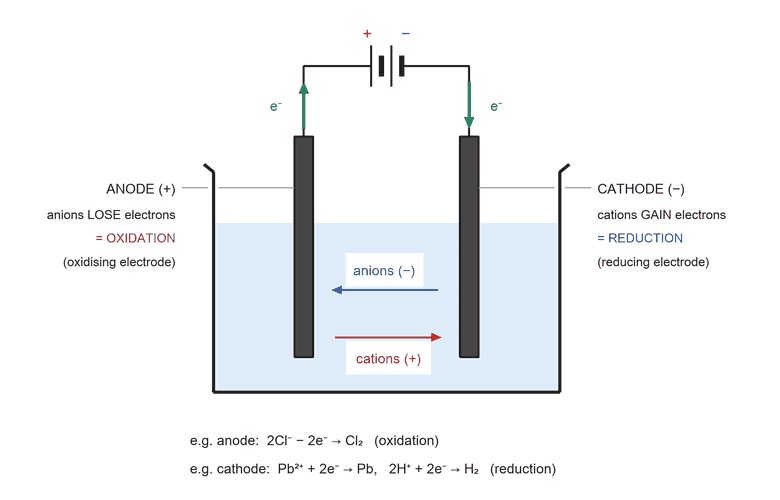
Watch out: The cathode is the REDUCING electrode because reduction happens there, and the anode is the oxidising electrode.
Therefore, (i) D: an electrolyte, (ii) A: oxidation, (iii) B: cathode, (iv) C: anode.
