
Question 74 marksAsked 2017Medium
State the observations at the anode and at the cathode during the electrolysis of :
(i) fused lead bromide using graphite electrodes.
(ii) copper sulphate solution using copper electrodes.
Confirming your payment
Sign up now and get 250 free tokens.
Previous Year Questions · Question 7 of 60
State the observations at the anode and at the cathode during the electrolysis of :
(i) fused lead bromide using graphite electrodes.
(ii) copper sulphate solution using copper electrodes.
Solution:
Concept: What is seen at each electrode depends on the ions present and on whether the electrode is inert (graphite) or active (copper). In an electrolytic cell the anode is the electrode joined to the positive (+) terminal of the battery and the cathode is the electrode joined to the negative (−) terminal. Cations (+) move to the cathode and gain electrons there (reduction); anions (−) move to the anode and lose electrons there (oxidation).
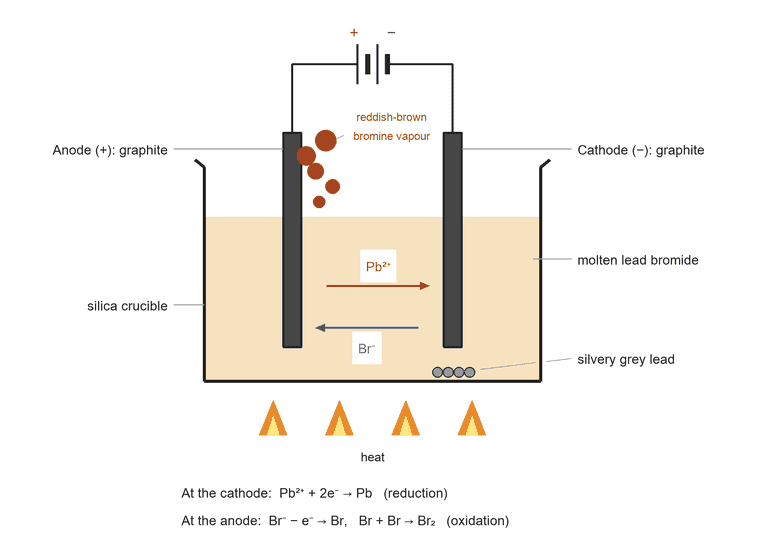
(i) Fused lead bromide, graphite electrodes
Step 1 — Observation at the anode.
The ions lose electrons at the anode and bromine is formed; it is seen as dark reddish-brown fumes of bromine vapour:
Step 2 — Observation at the cathode.
The ions gain electrons at the cathode and silvery grey lead metal is formed (it collects below the cathode as molten lead):
(ii) Copper sulphate solution, copper electrodes
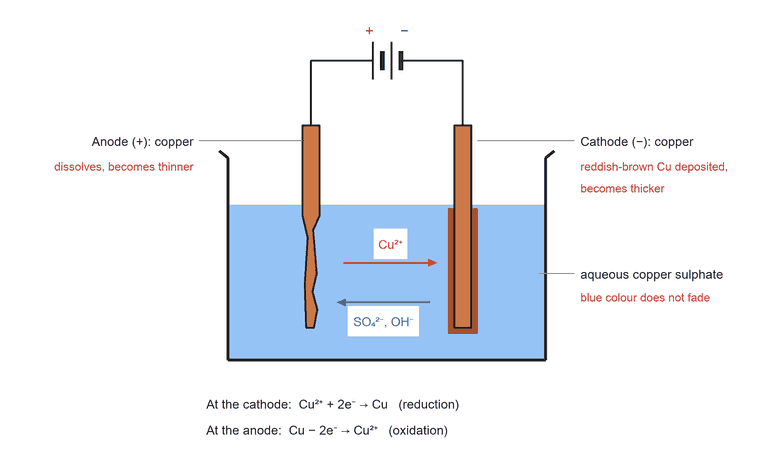
Step 3 — Observation at the anode.
The copper anode is an active electrode; its atoms lose electrons and go into the solution, so the anode dissolves and gradually becomes thinner. No gas is given off:
Step 4 — Observation at the cathode.
The ions gain electrons at the cathode, so a reddish-brown (pink) layer of copper is deposited and the cathode becomes thicker:
For every ion removed at the cathode the anode adds one, so the blue colour of the solution does not fade.
Watch out: With copper electrodes NO oxygen is given off at the anode; the anode itself dissolves.
Therefore, (i) anode: reddish-brown fumes of bromine; cathode: silvery grey lead; (ii) anode: the copper anode dissolves and becomes thinner; cathode: reddish-brown copper is deposited and the cathode becomes thicker.