
Question 82 marksAsked 2017Easy
Select the ion in each case, that would get selectively discharged from the aqueous mixture of the ions listed below:
(i) , and ;
(ii) , and .
Confirming your payment
Sign up now and get 250 free tokens.
Previous Year Questions · Question 8 of 60
Select the ion in each case, that would get selectively discharged from the aqueous mixture of the ions listed below:
(i) , and ;
(ii) , and .
Solution:
Concept: When two or more ions of the same sign reach an electrode, the ion lower in the electrochemical series is discharged in preference (selective discharge). The cation series is K⁺, Ca²⁺, Na⁺, Mg²⁺, Al³⁺, Zn²⁺, Fe²⁺, Ni²⁺, Sn²⁺, Pb²⁺, H⁺, Cu²⁺, Hg²⁺, Ag⁺, Au³⁺ and the anion series is SO₄²⁻, NO₃⁻, Cl⁻, Br⁻, I⁻, OH⁻; in both lists the ease of discharge increases downwards.
(i) Anions SO₄²⁻, NO₃⁻ and OH⁻
Step 1 — Place the anions in the series.
In the anion series comes first, then , and is last, the lowest of the three.
Step 2 — Choose the ion discharged.
The lowest anion is discharged first, so is discharged at the anode:
(ii) Cations Pb²⁺, Ag⁺ and Cu²⁺
Step 3 — Place the cations in the series.
In the cation series lies above hydrogen, while and then lie below it; is the lowest of the three.
Step 4 — Choose the ion discharged.
The lowest cation is discharged first, so is discharged at the cathode:
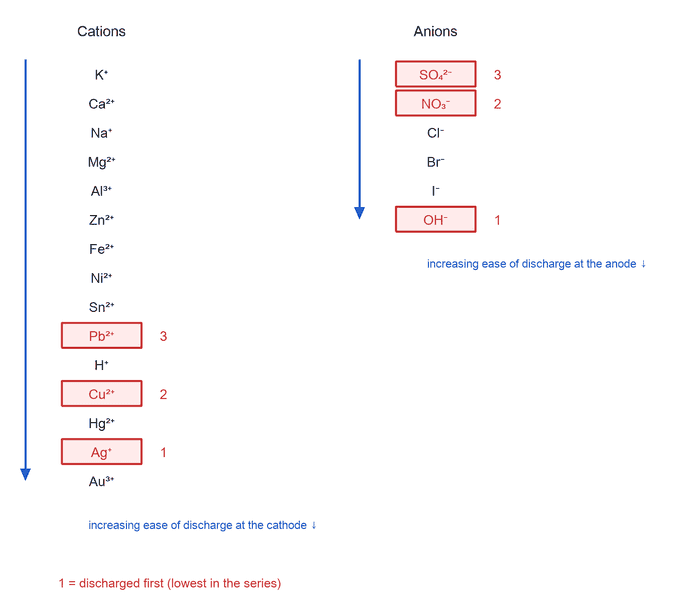
Watch out: The ion LOWER in the series is discharged first; the order of preference here is Ag⁺, then Cu²⁺, then Pb²⁺.
Therefore, (i) OH⁻ ions and (ii) Ag⁺ ions are selectively discharged.