
Question 91 markMCQAsked 2018Easy
The electrolysis of acidified water is an example of:
Confirming your payment
Sign up now and get 250 free tokens.
Previous Year Questions · Question 9 of 60
The electrolysis of acidified water is an example of:
(A) Reduction
(B) Oxidation
(C) Redox reaction
(D) Synthesis
Answer: (C) Redox reaction
Concept: Oxidation is the loss of electrons and reduction is the gain of electrons. In electrolysis oxidation always happens at the anode and reduction at the cathode, at the same time.
Step 1 — Look at the cathode.
At the cathode ions gain electrons, which is reduction:
Step 2 — Look at the anode.
At the anode ions lose electrons, which is oxidation:
Step 3 — Put the two together.
Reduction and oxidation happen at the same time in the same cell, so the electrolysis of acidified water as a whole is a redox reaction.
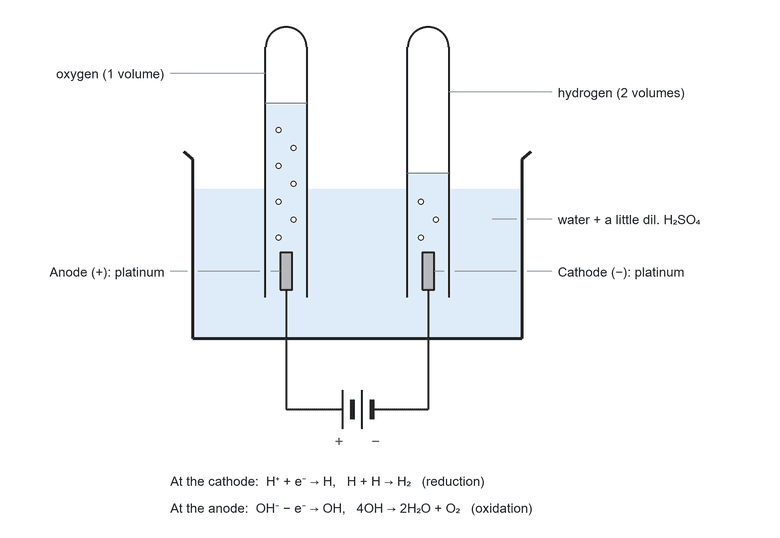
Watch out: Do not choose just one half; every electrolysis has both an oxidation (anode) and a reduction (cathode).
Why the other options are wrong:
Therefore, the electrolysis of acidified water is a redox reaction, option (C).