
Question 311 markAsked 2023Easy
Choose the answer from the list which fits in the description:
[, PbO, NaCl, CuO, ]
(c) A compound which is a non-electrolyte.
Confirming your payment
Sign up now and get 250 free tokens.
Previous Year Questions · Question 31 of 60
Choose the answer from the list which fits in the description:
[, PbO, NaCl, CuO, ]
(c) A compound which is a non-electrolyte.
Solution:
Concept: Electrolytes conduct because they contain mobile ions. A strong electrolyte is almost completely dissociated, so it contains (almost) only ions; a weak electrolyte is only partly dissociated, so it contains ions together with many un-ionised molecules; a non-electrolyte forms no ions and contains only molecules. Ionic compounds are electrolytes; a covalent compound that forms no ions is a non-electrolyte.
Step 1 — Sort the list.
NaCl, PbO, CuO and NH₄Cl are ionic compounds, so they are electrolytes (sodium chloride and ammonium chloride conduct in solution, and lead oxide conducts when fused).
Step 2 — Pick the covalent one.
Carbon tetrachloride, , is a covalent liquid made only of molecules. It has no ions, so it does not conduct electricity even as a liquid; it is a non-electrolyte.
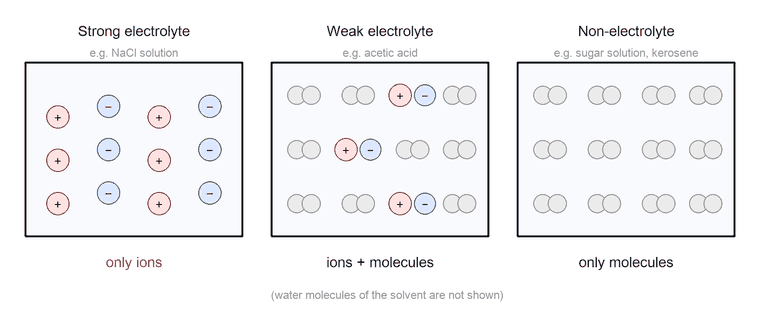
Watch out: Being a liquid is not enough to conduct; the liquid must contain ions.
Therefore, the non-electrolyte is CCl₄ (carbon tetrachloride).