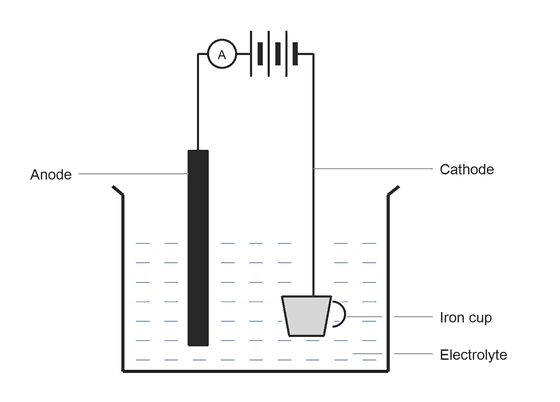
Solution:
Concept: In electroplating the article to be plated is made the cathode, a block of the pure plating metal is made the anode, and the electrolyte is a solution of a salt of the plating metal. The metal ions are discharged on the article; the anode dissolves and replaces them. In an electrolytic cell the anode is the electrode joined to the positive (+) terminal of the battery and the cathode is the electrode joined to the negative (−) terminal. Cations (+) move to the cathode and gain electrons there (reduction); anions (−) move to the anode and lose electrons there (oxidation).
(a) Why the iron cup is placed at the cathode
Step 1 — Follow the nickel ions.
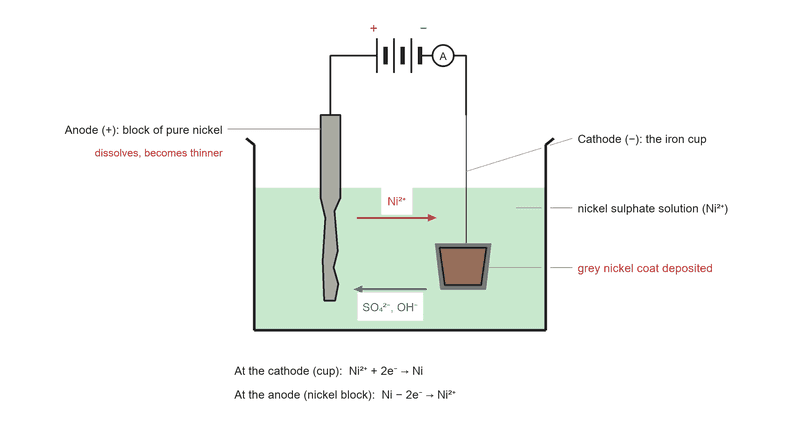
The nickel ions, Ni2+, are positive, so they move to the cathode. There they gain electrons and are deposited as nickel metal. The cup must therefore be the cathode to receive the nickel coat.
(b) Ion in the electrolyte
Step 2 — Name the ion.
The electrolyte must contain the ions of the plating metal, nickel ions Ni2+, for example from nickel sulphate solution, NiSO4.
(c) Condition for a smooth, firm, even deposit
Step 3 — Give the condition.
A low current should be passed for a longer time, so that nickel is deposited slowly and evenly. (The cup must also be cleaned thoroughly before plating.)
(d) Reaction at the cathode
Step 4 — Write the cathode reaction.
Each Ni2+ ion gains two electrons on the cup:
Ni2++2e−⟶Ni
(e) Change at the anode
Step 5 — Describe the anode.
The anode is a block of pure nickel. Its atoms lose electrons and go into the solution, so the anode dissolves and becomes thinner:
Ni−2e−⟶Ni2+
This keeps the Ni2+ concentration of the electrolyte steady.
Watch out: A large current gives a quick but rough, loosely held coat; low current for a long time gives a good one.
Therefore, (a) Ni²⁺ ions go to the cathode and are deposited there, so the cup is the cathode; (b) Ni²⁺; (c) a low current for a longer time; (d) Ni²⁺ + 2e⁻ → Ni; (e) the nickel anode dissolves and becomes thinner.