
Question 193 marksAsked 2019Easy
Name the particles present in:
(i) Strong electrolyte
(ii) Non- electrolyte
(iii) Weak electrolyte
Confirming your payment
Sign up now and get 250 free tokens.
Previous Year Questions · Question 19 of 60
Name the particles present in:
(i) Strong electrolyte
(ii) Non- electrolyte
(iii) Weak electrolyte
Solution:
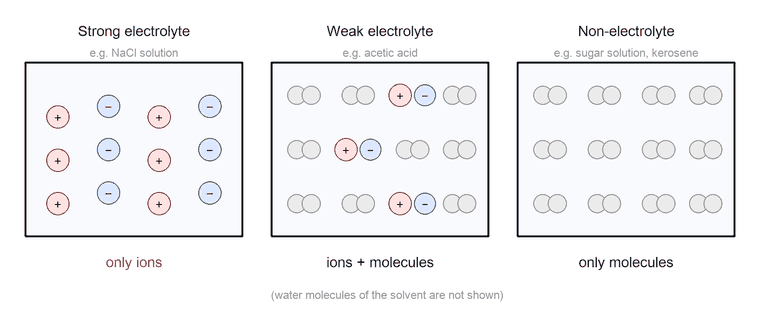
Concept: Electrolytes conduct because they contain mobile ions. A strong electrolyte is almost completely dissociated, so it contains (almost) only ions; a weak electrolyte is only partly dissociated, so it contains ions together with many un-ionised molecules; a non-electrolyte forms no ions and contains only molecules.
(i) Strong electrolyte
Step 1 — Particles in a strong electrolyte.
A strong electrolyte is almost completely dissociated, so it contains only ions, for example sodium chloride solution.
(ii) Non-electrolyte
Step 2 — Particles in a non-electrolyte.
A non-electrolyte forms no ions at all, so it contains only molecules, for example sugar solution or kerosene.
(iii) Weak electrolyte
Step 3 — Particles in a weak electrolyte.
A weak electrolyte is only partly dissociated, so it contains ions as well as molecules, for example acetic acid.
Watch out: The water of a solution is the solvent; the question asks about the particles of the electrolyte itself.
Therefore, (i) a strong electrolyte has only ions, (ii) a non-electrolyte has only molecules, and (iii) a weak electrolyte has ions and molecules.