
Question 525 marksAsked 2026Medium
Match Column A with Column B:
| Column A | Column B |
|---|---|
| (a) | 1. Oxidation |
| (b) | 2. Ionisation |
| (c) | 3. Reduction |
| (d) | 4. Redox |
| (e) | 5. Electrolytic dissociation |
Confirming your payment
Sign up now and get 250 free tokens.
Previous Year Questions · Question 52 of 60
Match Column A with Column B:
| Column A | Column B |
|---|---|
| (a) | 1. Oxidation |
| (b) | 2. Ionisation |
| (c) | 3. Reduction |
| (d) | 4. Redox |
| (e) | 5. Electrolytic dissociation |
Solution:
Concept: Oxidation is the loss of electrons and reduction is the gain of electrons. In electrolysis oxidation always happens at the anode and reduction at the cathode, at the same time. An ionic compound DISSOCIATES (its ions separate); a polar covalent compound IONISES in water (its ions are formed).
Step 1 — Match (a).
In , copper oxide loses oxygen and is reduced, while carbon gains oxygen and is oxidised. Both happen together, so (a) is 4. Redox.
Step 2 — Match (b).
In , the aluminium ion gains three electrons, so (b) is 3. Reduction.
Step 3 — Match (c).
Lead bromide is ionic; its ions already exist and separate on melting, so (c) is 5. Electrolytic dissociation.
Step 4 — Match (d).
The oxide ions lose electrons, so (d) is 1. Oxidation. Two oxide ions carry four extra electrons, so four electrons must be removed to form one oxygen molecule:
Step 5 — Match (e).
Hydrogen chloride is a polar covalent compound; its ions are formed when it dissolves in water, so (e) is 2. Ionisation.
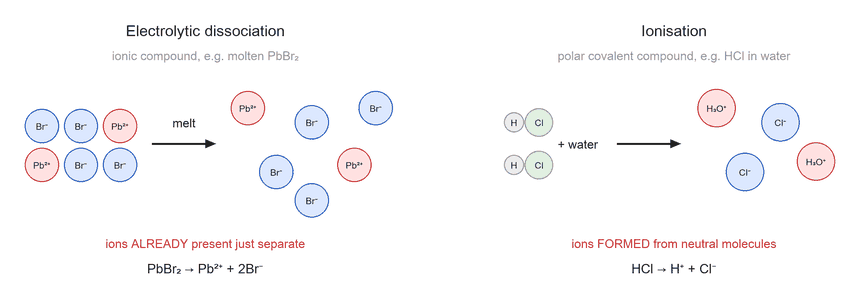
Watch out: PbBr₂ → ions is dissociation (ions already there), while HCl → ions is ionisation (ions formed).
Note: Equation (d) as printed, , shows 2e⁻ and does not balance in charge; the balanced form removes 4e⁻. The match is oxidation either way.
Therefore, (a) – 4 Redox, (b) – 3 Reduction, (c) – 5 Electrolytic dissociation, (d) – 1 Oxidation, (e) – 2 Ionisation.