
Question 371 markMCQAsked 2025Medium
Aqueous copper (II) sulphate is electrolysed using copper electrodes. Which statement about the electrolysis is not correct?
Confirming your payment
Sign up now and get 250 free tokens.
Previous Year Questions · Question 37 of 60
Aqueous copper (II) sulphate is electrolysed using copper electrodes. Which statement about the electrolysis is not correct?
(A) An oxidation reaction occurs at the positive electrode.
(B) The current is carried through the electrolyte by ions.
(C) The positive electrode loses mass.
(D) The number of copper (II) ions in the electrolyte decreases.
Answer: (D) The number of copper (II) ions in the electrolyte decreases.
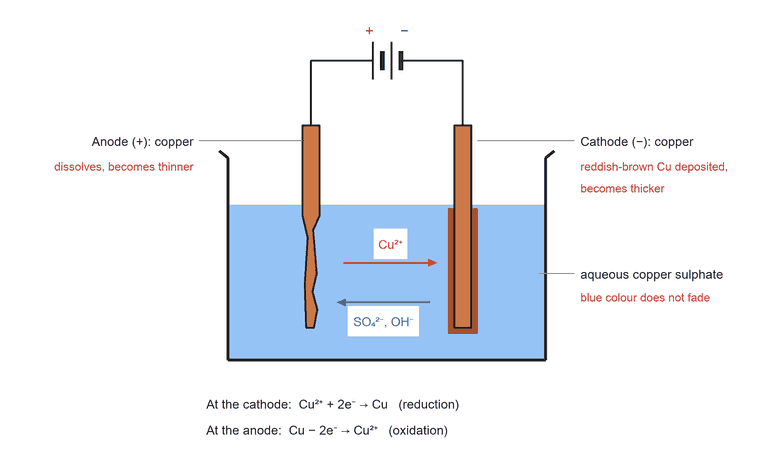
Concept: When copper sulphate solution is electrolysed with copper electrodes, Cu²⁺ ions are discharged on the cathode as copper, and the copper anode (an active electrode) dissolves, putting the same number of Cu²⁺ ions back into the solution.
Step 1 — Reaction at the negative electrode (cathode).
At the cathode ions gain electrons and copper is deposited:
Step 2 — Reaction at the positive electrode (anode).
At the anode copper atoms lose electrons and go into the solution:
Step 3 — Count the copper ions.
One ion is removed at the cathode for each one added at the anode, so their number stays the same and the blue colour does not fade. Statement (D) says the number decreases, so it is the statement that is not correct.
Watch out: This question asks for the statement that is NOT correct; the three true statements are the wrong choices.
Why the other options are wrong:
Therefore, the statement that is not correct is (D), the number of copper (II) ions in the electrolyte decreases.