
Question 352 marksAsked 2024Easy
X - (in solution state)
Y - (in molten state)
From the above reactions X or Y, identify the reaction which exhibits:
(a) electrolytic dissociation
(b) ionization
Confirming your payment
Sign up now and get 250 free tokens.
Previous Year Questions · Question 35 of 60
X - (in solution state)
Y - (in molten state)
From the above reactions X or Y, identify the reaction which exhibits:
(a) electrolytic dissociation
(b) ionization
Solution:
Concept: Electrolytic dissociation is the separation of ions that are ALREADY present in an ionic (electrovalent) compound when it is melted or dissolved. Ionisation is the FORMATION of ions from a polar covalent compound, made of molecules, when it dissolves in water.
(a) Electrolytic dissociation
Step 1 — Look at reaction Y.
Lead bromide is an ionic compound. Its and ions already exist in the solid and only become free to move on melting, so Y shows electrolytic dissociation.
(b) Ionisation
Step 2 — Look at reaction X.
Hydrogen chloride is a polar covalent compound made of molecules. Its ions are formed only when it dissolves in water, so X shows ionisation.
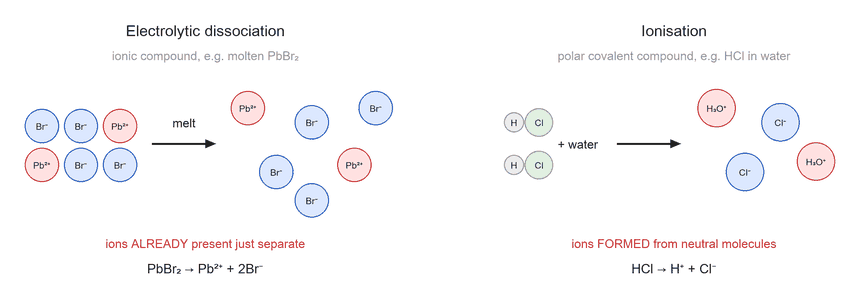
Watch out: Ask whether the ions existed BEFORE: yes means dissociation, no means ionisation.
Therefore, (a) electrolytic dissociation is Y and (b) ionisation is X.