
Question 211 markAsked 2020Easy
State one relevant reason for each of the following:
(i) Graphite anode is preferred to platinum in the electrolysis of molten lead bromide.
Confirming your payment
Sign up now and get 250 free tokens.
Previous Year Questions · Question 21 of 60
State one relevant reason for each of the following:
(i) Graphite anode is preferred to platinum in the electrolysis of molten lead bromide.
Solution:
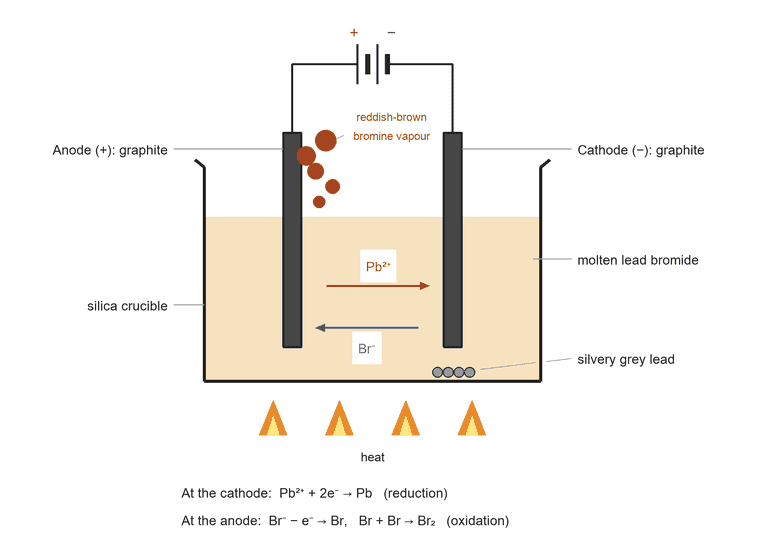
Concept: Solid lead bromide does not conduct, because its Pb²⁺ and Br⁻ ions are held in fixed positions. On melting, the ions become free to move: Pb²⁺ ions go to the cathode and are reduced to lead, and Br⁻ ions go to the anode and are oxidised to bromine. The anode must stand up to the hot, reactive bromine given off on it.
Step 1 — See what forms at the anode.
Bromine is given off at the anode as a hot, very reactive vapour:
Step 2 — Give the reason.
Graphite is inert and is not affected by the reactive bromine vapour. Platinum can be attacked by hot bromine and is also very costly, so graphite is preferred.
Watch out: The reason must be about the bromine at the ANODE; the lead at the cathode does not harm either electrode.
Therefore, graphite is preferred because it is inert and unaffected by the reactive bromine vapour formed at the anode (and it is cheap).