Solution:
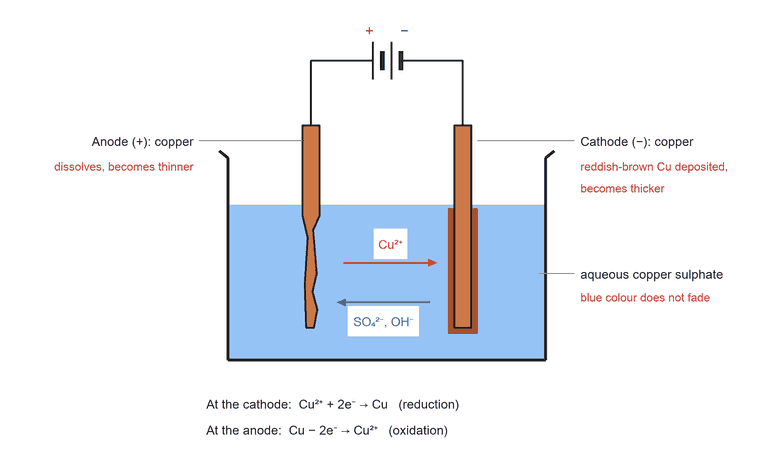
Concept: When two or more ions of the same sign reach an electrode, the ion lower in the electrochemical series is discharged in preference (selective discharge). The cation series is K⁺, Ca²⁺, Na⁺, Mg²⁺, Al³⁺, Zn²⁺, Fe²⁺, Ni²⁺, Sn²⁺, Pb²⁺, H⁺, Cu²⁺, Hg²⁺, Ag⁺, Au³⁺ and the anion series is SO₄²⁻, NO₃⁻, Cl⁻, Br⁻, I⁻, OH⁻; in both lists the ease of discharge increases downwards. In electroplating the article to be plated is made the cathode, a block of the pure plating metal is made the anode, and the electrolyte is a solution of a salt of the plating metal. The metal ions are discharged on the article; the anode dissolves and replaces them.
(a) Ion discharged at the cathode
Step 1 — Keep only the cations.
The ions OH− and SO42− are anions and go to the anode, so only Cu2+ and H+ reach the cathode.
Step 2 — Choose the ion discharged.
The Cu2+ ion is lower than H+ in the series, so it is discharged:
Cu2++2e−⟶Cu
(b) Anode in silver plating
Step 3 — Name the anode.
The anode is a block of pure silver, Ag. It dissolves and keeps up the supply of Ag+ ions:
Ag−e−⟶Ag+

Watch out: In plating, the anode is ALWAYS the plating metal itself, not an inert electrode.
Therefore, (a) Cu²⁺ is discharged at the cathode, and (b) the anode is made of Ag.
