
Question 491 markMCQAsked 2026Easy
With respect to the electrolysis of copper (II) sulphate solution using copper electrodes, which statement is correct?
Confirming your payment
Sign up now and get 250 free tokens.
Previous Year Questions · Question 49 of 60
With respect to the electrolysis of copper (II) sulphate solution using copper electrodes, which statement is correct?
(A) Copper metal is deposited at the negative electrode.
(B) Oxygen gas is produced at the positive electrode.
(C) The positive electrode increases in mass.
(D) The negative electrode decreases in mass.
Answer: (A) Copper metal is deposited at the negative electrode.
Concept: When copper sulphate solution is electrolysed with copper electrodes, Cu²⁺ ions are discharged on the cathode as copper, and the copper anode (an active electrode) dissolves, putting the same number of Cu²⁺ ions back into the solution. The negative electrode is the cathode and the positive electrode is the anode.
Step 1 — Negative electrode (cathode).
At the cathode ions gain electrons and reddish-brown copper is deposited, so statement (A) is correct:
Step 2 — Positive electrode (anode).
At the anode the copper atoms lose electrons and the anode dissolves:
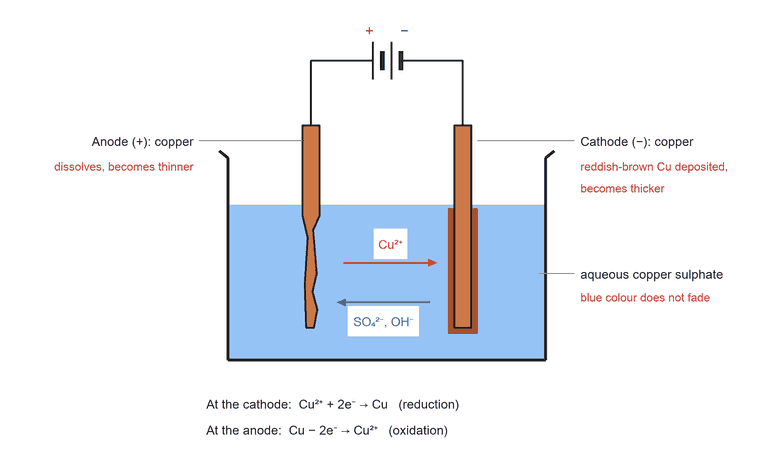
Watch out: Copper GOES ON at the negative electrode and COMES OFF the positive electrode.
Why the other options are wrong:
Therefore, the correct statement is (A), copper metal is deposited at the negative electrode.