
Opening your dashboard
Class 10 Physics Chapter 5: Refraction through a Lens Solutions
142 textbook questions with step-by-step answers, free to read, for ICSE 2026-27.
Get talked through Ch 5, not just shown the answer
Reading a finished solution is not the same as being able to do it. The AI tutor takes one question at a time and works it with you, in your own words, until you can.
- Ask it out loud, in your own words
- It gives you the next step, not the answer
- Stuck on part (ii)? Start there
142 questions with solutions
1–5 marks · Mixed difficulty
The first 72 solutions are on this page. This chapter is a long one, so the rest open on their own page to keep this one quick to load.
- 11 mark
Question 1
The given figure shows a kind of a lens. It is a :
 Solve with AI
Answer
(A) convex lens
(B) biconvex lens
(C) concave lens
- Correct
(D) concavo-convex
Answer: (D) concavo-convex
Concept: A lens that is thicker in the middle than at its edges is a convex (converging) lens; a lens that is thinner in the middle is a concave (diverging) lens. The name of a lens lists its two surfaces.
Step 1 — Look at the two surfaces.
In the figure one surface bulges outward (convex) and the other curves inward (concave), and both curve the same way, so the lens is a meniscus lens.
Step 2 — Look at the thickness.
The lens is thicker in the middle than at its two ends, so it is the converging meniscus lens, called concavo-convex.
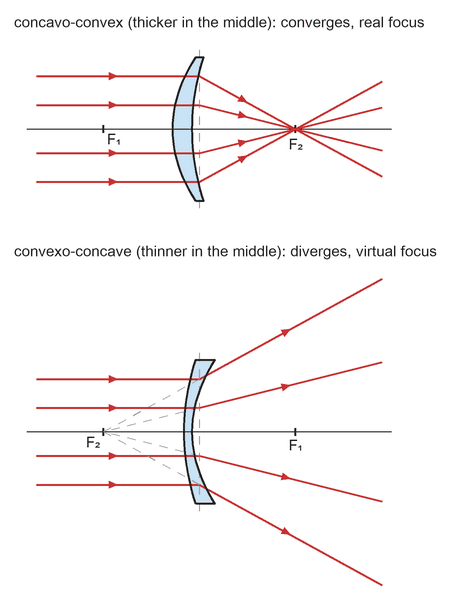
Watch out: Both meniscus lenses have one concave and one convex surface; only the thickness in the middle tells them apart.
Why the other options are wrong:
- (A) convex lens: the lens does converge light like a convex lens, but the question asks for its particular kind, and "convex lens" does not describe its concave surface.
- (B) biconvex lens: a biconvex lens has both surfaces bulging outward; here one surface curves inward.
- (C) concave lens: a concave lens is thinner in the middle; this lens is thicker in the middle.
Therefore, the lens is a concavo-convex lens, option (D).
- 21 mark
Question 2
A plano-concave lens has :
Solve with AIAnswer
(A) one surface convex and the other surface plane.
(B) one surface concave and the other surface convex
- Correct
(C) one surface plane and the other surface concave
(D) none of the above
Answer: (C) one surface plane and the other surface concave
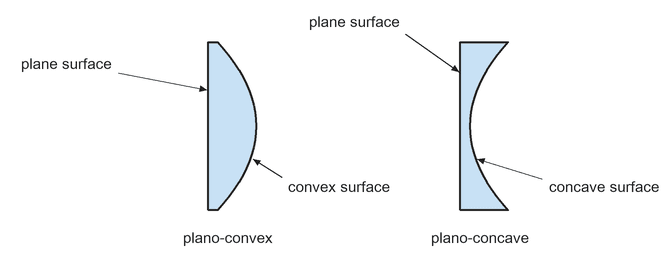
Concept: The name of a lens tells its two surfaces: 'plano' means a plane (flat) surface and 'concave' means a surface that curves inward.
Step 1 — Split the name.
Plano-concave = plano + concave, so the lens has one plane surface and one concave surface.
Step 2 — Check its shape.
Such a lens is thinner in the middle than at its edges, so it is a diverging lens.
Why the other options are wrong:
- (A) one surface convex and the other surface plane: one plane and one convex surface make a plano-convex lens.
- (B) one surface concave and the other surface convex: one concave and one convex surface make a meniscus lens (concavo-convex or convexo-concave).
- (D) none of the above: option (C) is a correct description, so 'none of the above' is wrong.
Therefore, a plano-concave lens has one surface plane and the other concave, option (C).
- 31 mark
Question 3
The incorrect statement is :
Solve with AIAnswer
(A) both convexo-concave and concavo-convex lenses have one surface concave and the other surface convex.
- Correct
(B) a convexo-concave lens is thicker in the middle and has a converging action.
(C) A concavo-convex lens is thicker in the middle and has a converging action.
(D) a convexo-concave lens is thinner in the middle and has a diverging action.
Answer: (B) a convexo-concave lens is thicker in the middle and has a converging action.
Concept: A lens that is thicker in the middle than at its edges is a convex (converging) lens; a lens that is thinner in the middle is a concave (diverging) lens. The name of a lens lists its two surfaces. A meniscus lens has one convex and one concave surface; whether it converges or diverges depends on its thickness in the middle.
Step 1 — Describe the convexo-concave lens.
In a convexo-concave lens the concave surface is curved more strongly, so the lens is thinner in the middle and diverges light.
Step 2 — Compare with statement (B).
Statement (B) says a convexo-concave lens is thicker in the middle and converging, which is the opposite, so (B) is the incorrect statement.
Watch out: The question asks for the INCORRECT statement, so the three true statements are the wrong choices.
Why the other options are wrong:
- (A) this is true: both meniscus lenses have one concave and one convex surface.
- (C) this is true: a concavo-convex lens is thicker in the middle and converges light.
- (D) this is true: it correctly describes a convexo-concave lens.
Therefore, the incorrect statement is (B).
- 41 mark
Question 4
A convex lens in its upper part has a prism with its base .............. and a concave lens in its upper part has a prism with its base .............. .
Solve with AIAnswer
- Correct
(A) downward, upward
(B) upward, downward
(C) upward, upward
(D) downward, downward
Answer: (A) downward, upward
Concept: A lens can be treated as a set of small prisms, and a prism always bends a ray towards its base. In a convex lens the prisms have their bases towards the principal axis; in a concave lens their bases face away from it.
Step 1 — Upper part of a convex lens.
A convex lens bends a ray in its upper part downward, towards the axis. A prism bends light towards its base, so the base of this prism must point downward.
Step 2 — Upper part of a concave lens.
A concave lens bends a ray in its upper part upward, away from the axis, so the base of this prism must point upward.
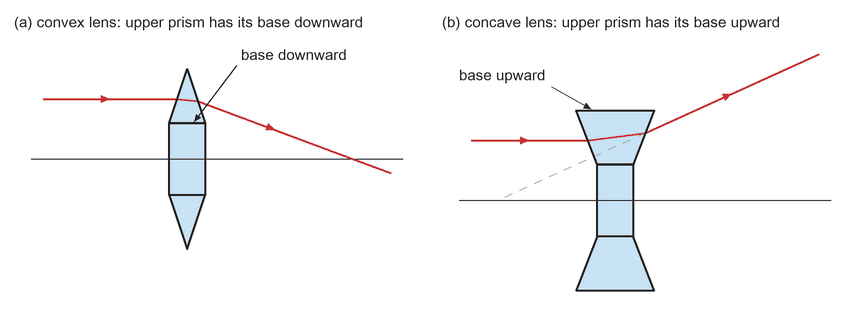
Watch out: The base points the way the ray is bent: towards the axis for a convex lens, away from it for a concave lens.
Why the other options are wrong:
- (B) upward, downward: it swaps the two lenses: a base upward would bend the convex lens's rays away from the axis.
- (C) upward, upward: both prisms with bases upward would make both lenses diverge light, but a convex lens converges it.
- (D) downward, downward: both prisms with bases downward would make both lenses converge light, but a concave lens diverges it.
Therefore, the blanks are 'downward, upward', option (A).
- 51 mark
Question 5
The correct differences between a convex and concave lens are :
(1) convex lens is thin in the middle and concave lens is thick in the middle.
(2) convex lens converges the incident rays towards the principal axis whereas concave lens diverges
(3) convex lens has a virtual focus and concave lens has a real focus.
Solve with AIAnswer
(A) (1)
(B) (3)
(C) (1), (2) and (3)
- Correct
(D) (2)
Answer: (D) (2)
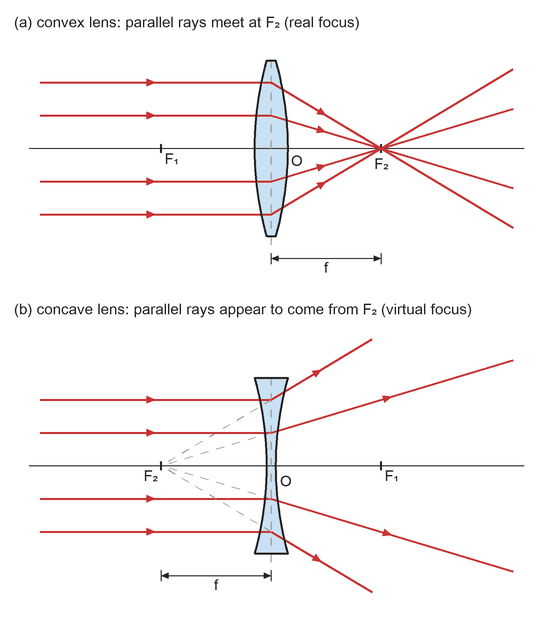
Concept: A convex lens is thick in the middle, converges rays and has a real focus; a concave lens is thin in the middle, diverges rays and has a virtual focus.
Step 1 — Check statement 1.
Statement 1 says the convex lens is thin in the middle and the concave lens thick in the middle. This swaps them, so statement 1 is false.
Step 2 — Check statement 2.
A convex lens bends rays towards the principal axis and a concave lens bends them away from it, so statement 2 is true.
Step 3 — Check statement 3.
Parallel rays actually meet at the focus of a convex lens (real focus) and only appear to come from the focus of a concave lens (virtual focus). Statement 3 swaps these, so it is false.
Why the other options are wrong:
- (A) (1): it picks statement 1, which is false.
- (B) (3): it picks statement 3, which is false.
- (C) (1), (2) and (3): it includes statements 1 and 3, which are both false.
Therefore, only statement 2 is correct, option (D).
- 61 mark
Question 6
A ray of light after refraction through a lens emerges parallel to the principal axis of the lens. The incident ray passes through :
Solve with AIAnswer
(A) its optical centre
- Correct
(B) its first focus
(C) its second focus
(D) the centre of curvature of the first surface.
Answer: (B) its first focus
Concept: A lens has two principal foci. Rays from (or aimed at) the first focus emerge parallel to the principal axis; rays incident parallel to the axis pass through (convex lens) or appear to come from (concave lens) the second focus . In Selina's labelling, is on the object side of a convex lens, but on the far side of a concave lens.
Step 1 — Recall what emerges parallel.
By definition, rays passing through the first focus of a convex lens (or aimed at of a concave lens) emerge parallel to the principal axis.
Step 2 — Apply it.
The emergent ray here is parallel to the axis, so the incident ray must have passed through (or been directed towards) the first focus.

Watch out: The ray that comes OUT parallel went IN through ; the ray that goes IN parallel comes OUT through .
Why the other options are wrong:
- (A) its optical centre: a ray through the optical centre goes straight on, so it would come out parallel only if it went in along the axis itself.
- (C) its second focus: the second focus is where rays incident parallel to the axis meet, or appear to come from: the reverse case.
- (D) the centre of curvature of the first surface: a centre of curvature is not a focus; a ray through it does not emerge parallel to the axis.
Therefore, the incident ray passes through the first focus, option (B).
- 71 mark
Question 7
A ray of light incident on a lens parallel to its principal axis, after refraction passes through or appears to come from :
Solve with AIAnswer
(A) its first focus
(B) its optical centre
- Correct
(C) its second focus
(D) the centre of curvature of its second surface.
Answer: (C) its second focus
Concept: A lens has two principal foci. Rays from (or aimed at) the first focus emerge parallel to the principal axis; rays incident parallel to the axis pass through (convex lens) or appear to come from (concave lens) the second focus . In Selina's labelling, is on the object side of a convex lens, but on the far side of a concave lens.
Step 1 — Recall the definition.
The second focus is defined by rays incident parallel to the principal axis.
Step 2 — Apply it to both lenses.
After refraction such a ray passes through for a convex lens (a real focus) and appears to come from for a concave lens (a virtual focus).
Why the other options are wrong:
- (A) its first focus: rays through the first focus emerge parallel: that is the reverse of this case.
- (B) its optical centre: a ray parallel to the axis (and off the axis) does not pass through the optical centre.
- (D) the centre of curvature of its second surface: a centre of curvature is not a focus of the lens.
Therefore, the ray passes through or appears to come from the second focus, option (C).
- 81 mark
Question 8
A lens is called equi-convex or equi-concave when :
Solve with AIAnswer
(A) the radius of curvature of first surface of lens is greater than the radius of curvature of the second surface.
(B) the radius of curvature of the second surface of the lens is greater than the radius of curvature of the first surface.
- Correct
(C) the radius of curvature of the two surfaces of the lens are equal.
(D) none of the above
Answer: (C) the radius of curvature of the two surfaces of the lens are equal.
Concept: Each surface of a lens is part of a sphere; the radius of that sphere is the radius of curvature of the surface. 'Equi' means equal.
Step 1 — Use the meaning of 'equi'.
An equi-convex or equi-concave lens has its two surfaces curved by the same amount.
Step 2 — Write it with radii.
Equal curving means equal radii of curvature of the two surfaces.
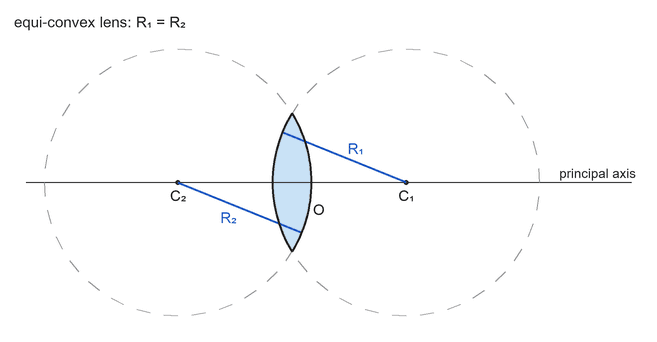
Why the other options are wrong:
- (A) a larger radius for the first surface means the two surfaces are curved by different amounts.
- (B) a larger radius for the second surface also means unequal curvature.
- (D) none of the above: option (C) is correct, so 'none of the above' is wrong.
Therefore, a lens is equi-convex or equi-concave when the radii of curvature of its two surfaces are equal, option (C).
- 91 mark
Question 9
The focal length of a lens depends upon :
Solve with AIAnswer
(A) the refractive index of the material of lens relative to its surrounding medium
(B) the amount of light entering the lens
(C) the radius of curvature of the two surfaces of lens
- Correct
(D) both (A) and (C)
Answer: (D) both (A) and (C)
Concept: The focal length of a lens depends on the refractive index of its material relative to the surrounding medium and on the radii of curvature of its surfaces: more bending (larger relative refractive index, more curved surfaces) gives a shorter focal length.
Step 1 — First factor.
Light bends at the lens surfaces because the lens and the surrounding medium have different refractive indices, so the refractive index of the lens material relative to its surroundings decides how much it bends.
Step 2 — Second factor.
More strongly curved surfaces (smaller radii of curvature) bend the light more, so the radii of curvature of the two surfaces also decide the focal length.

Watch out: The brightness of light has nothing to do with where the rays meet.
Why the other options are wrong:
- (A) this is a true factor, but it is only one of the two.
- (B) the amount of light entering the lens: the amount of light changes only the brightness of the image, not the focal length.
- (C) this is a true factor, but it is only one of the two.
Therefore, the focal length depends on both (A) and (C), option (D).
- 101 mark
Question 10
If a lens is placed in water instead of air, its focal length :
Solve with AIAnswer
- Correct
(A) increases
(B) decreases
(C) remains the same
(D) can both increase or decrease
Answer: (A) increases
Concept: The focal length of a lens depends on the refractive index of its material relative to the surrounding medium and on the radii of curvature of its surfaces: more bending (larger relative refractive index, more curved surfaces) gives a shorter focal length. The bending depends on how different the refractive index of the glass is from that of the medium around it.
Step 1 — Compare the media.
Glass (about 1.5) compared with air has a relative refractive index of about 1.5. Compared with water (about 1.33) it is only about 1.5 ÷ 1.33.
Step 2 — Decide the effect.
The relative refractive index is much closer to 1 in water, so the lens bends light less and the rays meet farther away. The focal length increases (for ordinary glass, to about four times its value in air).
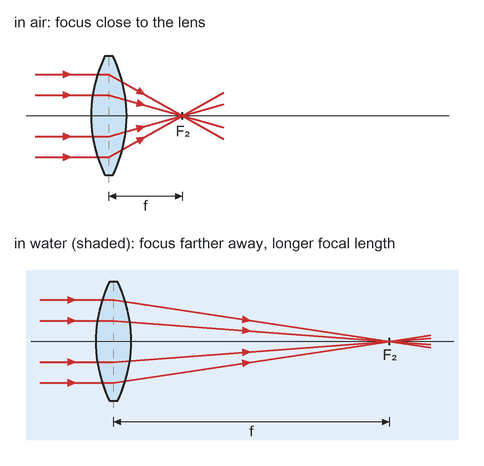
Watch out: The lens itself does not change; only the medium around it does, and that changes how much the light bends.
Why the other options are wrong:
- (B) decreases: it would need the lens to bend light more in water, but it bends light less.
- (C) remains the same: it ignores the effect of the surrounding medium on the bending.
- (D) can both increase or decrease: for a glass lens moved from air into water the change is always an increase, because water is optically less dense than glass.
Therefore, the focal length increases, option (A).
- 111 mark
Question 11
If half part of a convex lens is covered, the focal length ....... but the intensity of the image .......... .
Solve with AIAnswer
(A) increases, decreases
(B) decreases, increases
(C) does not change, increases
- Correct
(D) does not change, decreases
Answer: (D) does not change, decreases
Concept: The focal length depends only on the shape and material of the lens, not on how much of it is uncovered; the brightness of the image depends on how much light passes through.
Step 1 — Focal length.
Covering half the lens does not change its curvature or its glass, so the focal length does not change. Rays from every point of the object still pass through the uncovered half, so the complete image forms at the same place.
Step 2 — Intensity.
Only about half as much light now reaches the image, so the image is less bright: its intensity decreases.
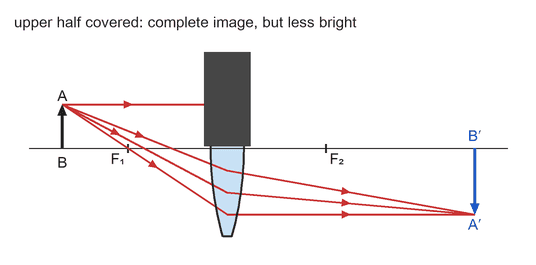
Watch out: Covering half the lens does NOT cut off half of the image; the whole image forms, only dimmer.
Why the other options are wrong:
- (A) increases, decreases: the focal length does not change.
- (B) decreases, increases: the focal length does not change, and less light cannot make the image brighter.
- (C) does not change, increases: the focal length is right, but less light reaching the image cannot increase its intensity.
Therefore, the focal length does not change but the intensity of the image decreases, option (D).
- 121 mark
Question 12
The focal length of a thin convex lens is ......... than that of a thick lens.
Solve with AIAnswer
(A) less
- Correct
(B) more
(C) same
(D) none of the above
Answer: (B) more
Concept: The focal length of a lens depends on the refractive index of its material relative to the surrounding medium and on the radii of curvature of its surfaces: more bending (larger relative refractive index, more curved surfaces) gives a shorter focal length.
Step 1 — Compare the surfaces.
A thin convex lens has gently curved surfaces (large radii of curvature); a thick lens of the same glass has strongly curved surfaces.
Step 2 — Compare the focal lengths.
The gently curved thin lens bends light less, so parallel rays meet farther from it: its focal length is more.
Why the other options are wrong:
- (A) less: it reverses the relation: the thick lens has the shorter focal length.
- (C) same: it ignores the effect of the curvature of the surfaces.
- (D) none of the above: option (B) is correct, so 'none of the above' is wrong.
Therefore, the focal length of a thin convex lens is more than that of a thick lens, option (B).
- 131 mark
Question 13
The radius of the sphere whose part is the lens' surface is called the ........... of that surface.
Solve with AIAnswer
(A) centre of curvature
(B) focal length
(C) pole
- Correct
(D) radius of curvature
Answer: (D) radius of curvature
Concept: Each curved surface of a lens is part of a sphere. The centre of that sphere is the centre of curvature of the surface and its radius is the radius of curvature.
Step 1 — Read what is asked.
The blank asks for the name of the radius of the sphere of which the lens surface is a part.
Step 2 — Name it.
That radius is the radius of curvature of the surface; in the figure and are the radii of curvature and , the centres of curvature.
Why the other options are wrong:
- (A) centre of curvature: the centre of curvature is the centre of the sphere, a point, not its radius.
- (B) focal length: the focal length is the distance from the optical centre to the focus, a different distance.
- (C) pole: 'pole' is a term used for spherical mirrors, not for a lens surface.
Therefore, the blank is 'radius of curvature', option (D).
- 141 mark
Question 14
Identify the incorrect statement :
Solve with AIAnswer
(A) if the medium on both sides of a lens is same, its first and second focal lengths are equal, i.e. (numerically).
- Correct
(B) when we say focal length of a lens, we mean the first focal length of the lens.
(C) a convex lens has a real focus.
(D) a concave lens has a virtual focus.
Answer: (B) when we say focal length of a lens, we mean the first focal length of the lens.
Concept: A lens has two foci, and . When we say 'the focus' of a lens we mean its second focus , so the focal length of a lens means its second focal length, .
Step 1 — Check statement (B).
Statement (B) says 'focal length' means the first focal length. It means the second focal length, so (B) is incorrect.
Step 2 — Check the others.
With the same medium on both sides, in size; a convex lens has a real focus and a concave lens a virtual focus. These are all true.
Watch out: The question asks for the INCORRECT statement.
Why the other options are wrong:
- (A) this is true: with the same medium on both sides the two focal lengths are equal in size.
- (C) a convex lens has a real focus: this is true: parallel rays actually meet at the focus of a convex lens.
- (D) a concave lens has a virtual focus: this is true: parallel rays only appear to come from the focus of a concave lens.
Therefore, the incorrect statement is (B).
- 151 mark
Question 15
What is a lens ?
Solve with AIWritten solution
Solution:
Concept: A lens is described by what it is made of (a transparent refracting material) and the shape of its two surfaces.
Step 1 — Give the definition.
A lens is a transparent refracting medium bounded by two spherical surfaces, or by one spherical surface and one plane surface.
Step 2 — Explain what it does.
Light passing through a lens is refracted at both surfaces, so a lens either converges (convex lens) or diverges (concave lens) a beam of light. Each spherical surface is part of a sphere, as the figure shows.
Therefore, a lens is a transparent refracting medium bounded by two spherical surfaces, or by one spherical and one plane surface.
- 162 marks
Question 16
Which lens is converging : (i) an equiconcave lens or an equiconvex lens. (ii) a concavo-convex lens or a convexo-concave lens ?
Solve with AIWritten solution
Solution:
Concept: A lens that is thicker in the middle than at its edges is a convex (converging) lens; a lens that is thinner in the middle is a concave (diverging) lens. The name of a lens lists its two surfaces.
Step 1 — (i) Equiconcave or equiconvex.
An equiconvex lens bulges outward on both sides, so it is thicker in the middle and converging. An equiconcave lens is thinner in the middle, so it diverges light.
Step 2 — (ii) Concavo-convex or convexo-concave.
A concavo-convex lens has its convex surface more strongly curved, so it is thicker in the middle and converging. A convexo-concave lens is thinner in the middle and diverging, as the figure shows.
Watch out: A concavo-convex lens has a concave surface, yet it converges, because it is thicker in the middle.
Therefore, (i) the equiconvex lens and (ii) the concavo-convex lens are converging.
- 171 mark
Question 17
State the condition when a lens is called equiconvex or equi-concave.
Solve with AIWritten solution
Solution:
Concept: 'Equi' means equal; each surface of a lens is part of a sphere whose radius is the radius of curvature of that surface.
Step 1 — State the condition.
A lens is called equiconvex or equi-concave when the radii of curvature of its two surfaces are equal.
Step 2 — What it means.
The centres of curvature and are then at equal distances from the optical centre, and the two surfaces are curved by the same amount.
Therefore, a lens is equiconvex or equi-concave when the radii of curvature of its two surfaces are equal ().
- 181 mark
Question 18
Define the term focal length of a lens.
Solve with AIWritten solution
Solution:
Concept: The focal length is measured from the optical centre O to the focus, and 'the focus' of a lens means its second focus .
Step 1 — Give the definition.
The focal length of a lens is the distance between its optical centre O and its second focus .
Step 2 — Explain the focus for each lens.
For a convex lens is where rays parallel to the axis actually meet; for a concave lens it is the point from which they appear to diverge.
Watch out: The focal length is measured from the optical centre, not from the surface of the lens.
Therefore, the focal length of a lens is the distance from its optical centre to its second focus.
- 191 mark
Question 19
What do you mean by focal plane of a lens ?
Solve with AIWritten solution
Solution:
Concept: A focal plane is a plane through a focus of the lens, at right angles to the principal axis.
Step 1 — Give the definition.
The focal plane of a lens is the plane passing through its focus and normal (perpendicular) to the principal axis. A lens has two focal planes, one through each focus.
Step 2 — Show its use.
A parallel beam falling obliquely on a convex lens does not meet at ; it meets at a point B in the second focal plane. B lies on the ray of the beam that passes undeviated through O. (For a concave lens the beam appears to diverge from such a point.)
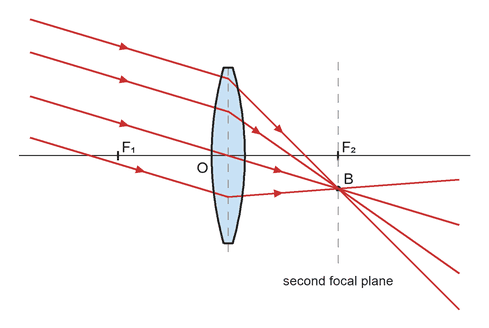
Therefore, the focal plane is the plane through a focus of the lens, normal to its principal axis.
- 202 marks
Question 20
State the condition for each of the following :
(a) a lens has both its focal lengths equal.
(b) a ray passes undeviated through the lens.
Solve with AIWritten solution
Solution:
Concept: Part (a) depends on the media on the two sides of the lens; part (b) depends on the special point on the principal axis inside the lens, the optical centre.
Step 1 — (a) Equal focal lengths.
A lens has both its focal lengths equal when the medium is the same on both sides of the lens (for example, air on both sides). Then in size.
Step 2 — (b) Undeviated ray.
A ray passes undeviated through a lens when it is incident towards the optical centre of the lens. Near the optical centre the two surfaces are parallel, like a thin glass slab, so the ray comes out in its original direction.
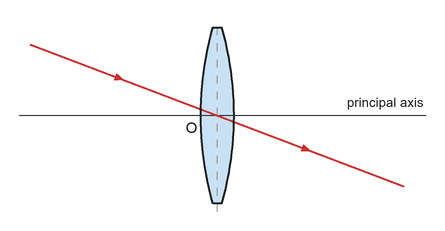
Therefore, (a) the medium must be the same on both sides of the lens, and (b) the ray must be directed towards the optical centre.
- 212 marks
Question 21
Complete the following sentences :
(a) If half part of a convex lens is covered, the focal length .................. change, but the intensity of the image ..................
(b) A convex lens is placed in water. Its focal length will ..................
(c) The focal length of a thin convex lens is ............. than that of a thick convex lens.
Solve with AIWritten solution
Solution:
Concept: The focal length of a lens depends on the refractive index of its material relative to the surrounding medium and on the radii of curvature of its surfaces: more bending (larger relative refractive index, more curved surfaces) gives a shorter focal length.
Step 1 — (a) Half the lens covered.
The shape and glass of the lens are unchanged, so the focal length does not change. Less light reaches the image, so its intensity decreases; the complete image still forms at the same place.
Step 2 — (b) Lens placed in water.
Glass relative to water (about 1.5 ÷ 1.33 ≈ 1.13) bends light less than glass relative to air (about 1.5), so the focal length will increase.
Step 3 — (c) Thin and thick lenses.
The gently curved surfaces of a thin lens bend light less, so the rays meet farther away: its focal length is more than that of a thick convex lens.
Watch out: Covering half the lens dims the image; it does not cut the image in half.
Therefore, (a) does not, decreases; (b) increase; (c) more.
- 223 marks
Question 22
Name the two kinds of lens. Draw diagrams to illustrate them.
Solve with AIWritten solution
Solution:
Concept: A lens that is thicker in the middle than at its edges is a convex (converging) lens; a lens that is thinner in the middle is a concave (diverging) lens. The name of a lens lists its two surfaces.
Step 1 — Convex (converging) lens.
It is thicker in the middle than at the edges and converges a parallel beam of light to a point. Its types are biconvex (both surfaces convex), plano-convex (one plane, one convex) and concavo-convex (one concave, one convex, thicker in the middle).
Step 2 — Concave (diverging) lens.
It is thinner in the middle than at the edges and spreads out (diverges) a parallel beam. Its types are biconcave (both surfaces concave), plano-concave (one plane, one concave) and convexo-concave (one convex, one concave, thinner in the middle).
Step 3 — Diagrams.
The figure shows the three convex lenses (top row) and the three concave lenses (bottom row).

Therefore, the two kinds of lens are the convex (converging) lens and the concave (diverging) lens.
- 232 marks
Question 23
State difference between a convex and a concave lens in their (a) appearence, and (b) action on the incident light.
Solve with AIWritten solution
Solution:
Concept: The shape of a lens decides its action: thick in the middle converges, thin in the middle diverges.
Step 1 — (a) Appearance.
A convex lens is thicker in the middle and thinner at the edges. A concave lens is thinner in the middle and thicker at the edges.
Step 2 — (b) Action on the incident light.
A convex lens converges the incident rays towards the principal axis, so a parallel beam actually meets at a point (a real focus). A concave lens diverges the incident rays away from the principal axis, so a parallel beam appears to come from a point (a virtual focus).
Therefore, a convex lens is thick in the middle and converges light, while a concave lens is thin in the middle and diverges light.
- 242 marks
Question 24
Define the term principal axis of a lens.
Solve with AIWritten solution
Solution:
Concept: Each surface of a lens is part of a sphere with its own centre of curvature; the principal axis is fixed by these two centres.
Step 1 — Give the definition.
The principal axis of a lens is the straight line joining the centres of curvature and of its two surfaces. It passes through the optical centre O and can be extended on either side of the lens.
Step 2 — A lens with one plane surface.
A plane surface is treated as part of a sphere of infinite radius, so for a plano lens the principal axis is the line through the centre of curvature of the curved surface, perpendicular to the plane surface.
Therefore, the principal axis is the line joining the centres of curvature of the two surfaces of the lens.
- 253 marks
Question 25
Explain optical centre of a lens with the help of proper diagram(s).
Solve with AIWritten solution
Solution:
Concept: At the optical centre the two lens surfaces are parallel to each other, so a ray through it behaves as if it passed through a thin parallel-sided glass slab.
Step 1 — Give the definition.
The optical centre of a lens is the point on the principal axis inside the lens such that a ray of light directed towards it passes through the lens without any deviation. It is marked O.
Step 2 — Explain why.
Near the optical centre the two surfaces are parallel, like a glass slab. A ray through a slab emerges parallel to its incident direction, shifted slightly sideways. For a thin lens this sideways shift is so small that it is ignored, so the ray goes straight through.
Step 3 — Its position.
For an equiconvex or equiconcave lens the optical centre is at the geometric centre of the lens. The same rule holds for a concave lens: a ray aimed at its optical centre also passes straight through.
Therefore, the optical centre is the point on the principal axis of a lens through which a ray passes undeviated.
- 262 marks
Question 26
A ray of light incident at a point on the principal axis of a convex lens passes undeviated through the lens. (a) What special name is given to this point on the principal axis ? (b) Draw a labelled diagram to support your answer in part (a).
Solve with AIWritten solution
Solution:
Concept: The only point on the principal axis through which a ray passes without bending is the optical centre.
Step 1 — (a) Name the point.
The point is the optical centre (O) of the lens.
Step 2 — (b) Labelled diagram.
A ray directed towards O passes straight through the lens without bending, because near O the two surfaces of the thin lens are parallel, like a thin glass slab. The diagram shows the lens, the principal axis, O, and the incident and emergent rays in one straight line.
Therefore, (a) the point is the optical centre O, and (b) a ray through O goes straight on, as drawn.
- 273 marks
Question 27
Define the term principal foci of a convex lens and illustrate your answer with the aid of proper diagrams.
Solve with AIWritten solution
Solution:
Concept: Light can fall on a lens from either side, so a lens has two principal foci: the first focus and the second focus .
Step 1 — First focus.
The first focus of a convex lens is the point on the principal axis such that rays of light coming from it become parallel to the principal axis after refraction. The distance is the first focal length.
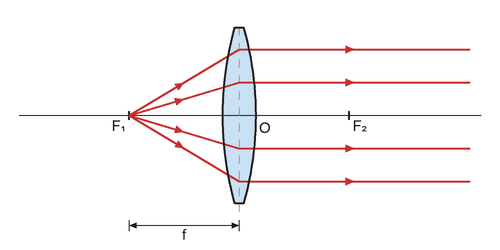
Step 2 — Second focus.
The second focus is the point on the principal axis at which rays of light incident parallel to the principal axis meet after refraction. The distance is the focal length f.
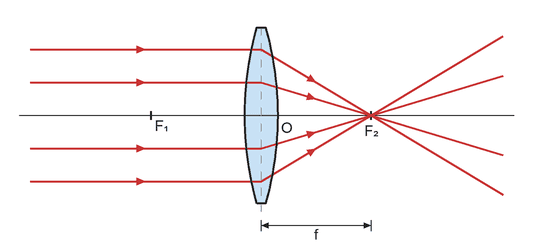
Step 3 — Nature of the foci.
The rays actually pass through these points, so both foci of a convex lens are real. With the same medium on both sides, and are at equal distances from O.
Therefore, the principal foci of a convex lens are (rays from it emerge parallel) and (parallel rays meet there), both real.
- 283 marks
Question 28
Define the term principal foci of a concave lens and show them with the help of proper diagrams.
Solve with AIWritten solution
Solution:
Concept: A concave lens spreads light out, so its foci are found by producing rays backward or forward (dashed lines). Both foci are virtual.
Step 1 — First focus.
The first focus is the point on the principal axis, on the far side of the lens, such that rays of light directed towards it become parallel to the principal axis after refraction.
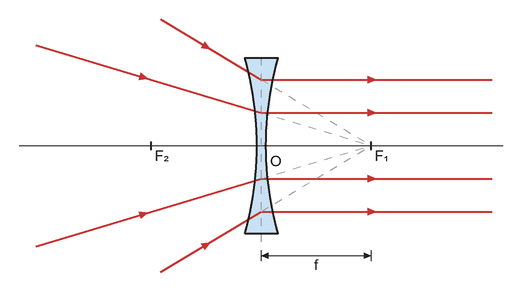
Step 2 — Second focus.
The second focus is the point on the principal axis, on the same side as the incident light, from which rays incident parallel to the principal axis appear to diverge after refraction. Its distance from O is the focal length.

Step 3 — Nature of the foci.
The rays never actually pass through or ; they are only aimed at, or appear to come from, these points, so both foci are virtual.
Watch out: For a concave lens is on the SAME side as the incident light, the opposite of a convex lens.
Therefore, the principal foci of a concave lens are (rays aimed at it emerge parallel) and (parallel rays appear to come from it), both virtual.
- 292 marks
Question 29
Draw a diagram to represent the second focus of a concave lens.
Solve with AIWritten solution
Solution:
Concept: The second focus is defined by rays incident parallel to the principal axis.
Step 1 — Draw the rays.
Draw rays parallel to the principal axis falling on the concave lens. After refraction they diverge (spread away from the axis).
Step 2 — Locate the focus.
Produce the refracted rays backward (dashed lines). They meet at a point on the principal axis, on the same side as the incident light: this is the second focus.
Watch out: The rays only appear to come from , so this focus is virtual; draw the backward extensions dashed.
Therefore, the second focus of a concave lens is the point on the incident side from which parallel rays appear to diverge, as drawn.
- 302 marks
Question 30
Draw a diagram to represent the second focus of a convex lens.
Solve with AIWritten solution
Solution:
Concept: The second focus is defined by rays incident parallel to the principal axis.
Step 1 — Draw the rays.
Draw rays parallel to the principal axis falling on the convex lens. After refraction they converge (bend towards the axis).
Step 2 — Locate the focus.
The refracted rays actually meet at a point on the principal axis, on the other side of the lens: this is the second focus. The distance is the focal length f.
Therefore, the second focus of a convex lens is the real point beyond the lens where parallel rays meet, as drawn.
- 314 marks
Question 31
Out of the two lenses, one concave and the other convex, state which one will show divergent action on a light beam. Draw diagrams to illustrate you answer.
Solve with AIWritten solution
Solution:
Concept: A lens thinner in the middle bends rays away from the principal axis (divergent action); a lens thicker in the middle bends them towards it (convergent action).
Step 1 — Name the lens.
The concave lens shows divergent action.
Step 2 — Concave lens: divergent action.
A parallel beam falling on a concave lens spreads out after refraction. Produced backward (dashed), the rays appear to come from its focus on the incident side.
Step 3 — Convex lens: convergent action (for comparison).
A parallel beam falling on a convex lens bends towards the axis and actually meets at its focus on the other side.
Step 4 — Reason.
A concave lens can be treated as prisms with their bases away from the axis; each prism bends light towards its base, that is, away from the axis.
Therefore, the concave lens shows divergent action on a light beam.
- 324 marks
Question 32
Show by a diagram the refraction of two light rays incident parallel to the principal axis on a convex lens by treating it as a combination of a glass slab and two triangular glass prisms.
Solve with AIWritten solution
Solution:
Concept: A lens can be treated as a set of small prisms, and a prism always bends a ray towards its base. In a convex lens the prisms have their bases towards the principal axis; in a concave lens their bases face away from it.
Step 1 — Model the lens.
A convex lens can be thought of as a rectangular glass slab in the middle with a triangular prism above it and another below it. Each prism has its base towards the slab, that is, towards the principal axis.
Step 2 — Upper ray.
A ray falling parallel to the axis on the upper prism bends towards that prism's base at both faces, that is, downward, towards the axis.
Step 3 — Lower ray.
A ray falling on the lower prism bends towards its base, that is, upward, towards the axis.
Step 4 — Result.
Both rays bend towards the axis and meet at a point F on the principal axis, the focus. (A ray along the axis passes through the slab without bending.) This is the converging action of a convex lens.
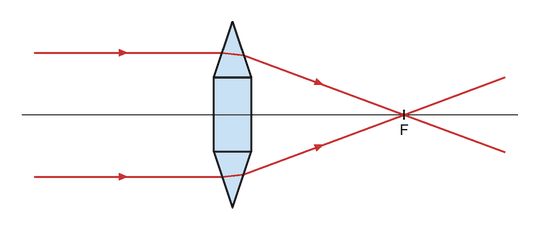
Watch out: A prism bends light towards its BASE, not towards its apex.
Therefore, the two parallel rays bend towards the axis and meet at the focus F, as drawn.
- 334 marks
Question 33
Show by a diagram, the refraction of two light rays incident parallel to the principal axis on a concave lens by treating it as a combination of a glass slab and two triangular glass prisms.
Solve with AIWritten solution
Solution:
Concept: A lens can be treated as a set of small prisms, and a prism always bends a ray towards its base. In a convex lens the prisms have their bases towards the principal axis; in a concave lens their bases face away from it.
Step 1 — Model the lens.
A concave lens can be thought of as a rectangular glass slab in the middle with a prism above and below it. Each prism has its base away from the slab (away from the principal axis) and its narrow end towards the axis.
Step 2 — Upper ray.
A ray falling parallel to the axis on the upper prism bends towards that prism's base, that is, upward, away from the axis.
Step 3 — Lower ray.
A ray falling on the lower prism bends towards its base, that is, downward, away from the axis.
Step 4 — Result.
The two rays move apart: they diverge. Produced backward (dashed), they appear to come from a point F on the principal axis on the incident side, the focus. This is the diverging action of a concave lens.
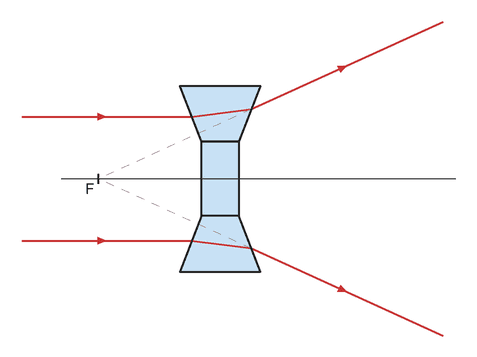
Therefore, the two parallel rays bend away from the axis and appear to come from the focus F, as drawn.
- 344 marks
Question 34
How does the action of a convex lens differ from that of a concave lens on a parallel beam of light incident on them ? Draw diagrams to illustrate your answer.
Solve with AIWritten solution
Solution:
Concept: Both lenses act on a parallel beam, but a convex lens brings the rays together while a concave lens spreads them apart.
Step 1 — Convex lens.
It converges the parallel beam. After refraction the rays bend towards the axis and actually meet at a point on the other side of the lens; this focus is real and could be caught on a screen.
Step 2 — Concave lens.
It diverges the parallel beam. After refraction the rays bend away from the axis and only appear to come from a point on the same side as the incident light; this focus is virtual.
Therefore, a convex lens converges a parallel beam to a real focus beyond the lens, while a concave lens diverges it from a virtual focus in front of the lens.
- 354 marks
Question 35
A ray of light, after refraction through a concave lens emerges parallel to the principal axis. (a) Draw a ray diagram to show the incident ray and its corresponding emergent ray. (b) The incident ray when produced meets the principal axis at a point F. Name the point F.
Solve with AIWritten solution
Solution:
Concept: A lens has two principal foci. Rays from (or aimed at) the first focus emerge parallel to the principal axis; rays incident parallel to the axis pass through (convex lens) or appear to come from (concave lens) the second focus . In Selina's labelling, is on the object side of a convex lens, but on the far side of a concave lens.
Step 1 — (a) Draw the ray diagram.
Draw the incident ray aimed at the focus on the far side of the concave lens. After refraction at the lens it bends away from the axis and emerges parallel to the principal axis. The dashed part shows where the incident ray would have gone.
Step 2 — (b) Name the point F.
The incident ray, produced, meets the axis at the first focus of the concave lens. The ray never actually reaches F; it is only directed towards it, so this focus is virtual.
Watch out: For a concave lens the first focus is on the FAR side of the lens.
Therefore, (a) the ray is drawn aimed at F and emerging parallel, and (b) F is the first focus of the concave lens.
- 364 marks
Question 36
A ray of light after refraction through a convex lens emerges parallel to the principal axis. (a) Draw a ray diagram to show it. (b) The incident ray passes through a point F on the principal axis. Name the point F.
Solve with AIWritten solution
Solution:
Concept: A lens has two principal foci. Rays from (or aimed at) the first focus emerge parallel to the principal axis; rays incident parallel to the axis pass through (convex lens) or appear to come from (concave lens) the second focus . In Selina's labelling, is on the object side of a convex lens, but on the far side of a concave lens.
Step 1 — (a) Draw the ray diagram.
Draw the incident ray from the focus on the incident side to the convex lens. After refraction it bends towards the axis and emerges parallel to the principal axis.
Step 2 — (b) Name the point F.
The point F is the first focus of the convex lens. This is the reverse of a ray incident parallel to the axis, which passes through the second focus .
Therefore, (a) the ray is drawn through F and emerging parallel, and (b) F is the first focus of the convex lens.
- 373 marks
Question 37
A beam of light incident on a convex lens parallel to its principal axis converges at a point F on the principal axis. Name the point F. Draw a ray diagram to show it.
Solve with AIWritten solution
Solution:
Concept: The point where rays incident parallel to the principal axis meet after refraction is, by definition, the second focus.
Step 1 — Name the point.
The point F is the second focus of the convex lens.
Step 2 — Draw the ray diagram.
Rays parallel to the principal axis bend towards the axis on passing through the lens and actually meet at on the other side. The distance is the focal length. Since the rays really meet there, the focus is real.
Therefore, F is the second focus of the convex lens, as drawn.
- 383 marks
Question 38
A beam of light incident on a thin concave lens parallel to its principal axis diverges and appears to come from a point F on the principal axis. Name the point F. Draw a ray diagram to show it.
Solve with AIWritten solution
Solution:
Concept: The point from which rays incident parallel to the principal axis appear to diverge after refraction is, by definition, the second focus of a concave lens.
Step 1 — Name the point.
The point F is the second focus of the concave lens.
Step 2 — Draw the ray diagram.
Rays parallel to the principal axis bend away from the axis on passing through the lens. Produced backward (dashed lines), they meet at on the same side as the incident light. Since the rays only appear to come from it, the focus is virtual.
Therefore, F is the second focus of the concave lens, as drawn.
- 394 marks
Question 39
A parallel oblique beam of light falls on a (i) convex lens, (ii) concave lens. Draw a diagram in each case to show refraction of light through the lens.
Solve with AIWritten solution
Solution:
Concept: A parallel beam that is not parallel to the principal axis is focused at a point in the second focal plane (the plane through perpendicular to the axis). That point lies on the ray of the beam that passes undeviated through the optical centre O.
Step 1 — How to draw it.
First draw the ray of the beam that goes through O; it goes straight on. Where it crosses the focal plane is the point B. Then draw every other ray of the beam to (or from) B.
Step 2 — (i) Convex lens.
The oblique parallel rays converge and actually meet at a point B in the second focal plane, on the other side of the lens.
Step 3 — (ii) Concave lens.
The oblique parallel rays diverge. Produced backward (dashed lines), they appear to come from a point B in the focal plane on the same side as the incident light.
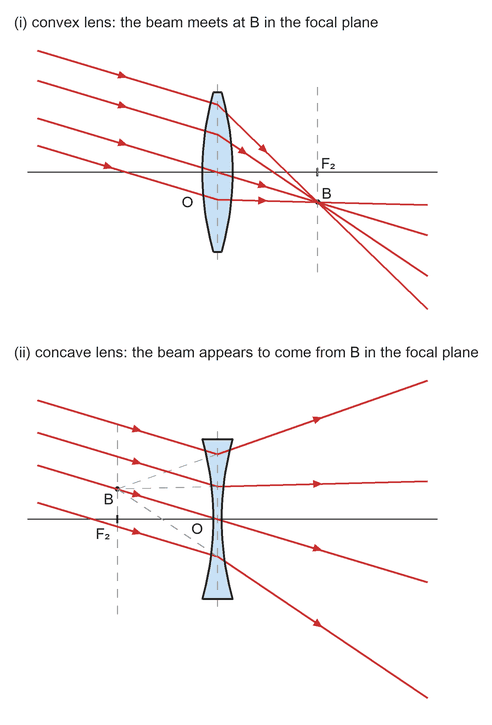
Watch out: An oblique beam is NOT focused at ; only a beam parallel to the axis is.
Therefore, (i) a convex lens brings the oblique beam to a point in its second focal plane, and (ii) a concave lens makes it appear to come from a point in its focal plane, as drawn.
- 404 marks
Question 40
The diagram below shows a lens as a combination of a glass slabs and two prisms.
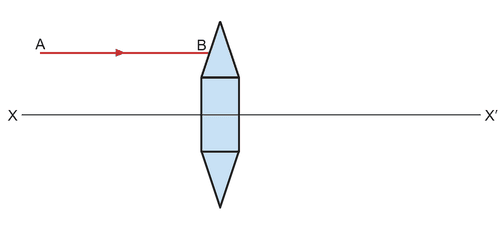
(i) Name the lens formed by the combination.
(ii) What is the line XX′ called ?
(iii) Complete the ray diagram and show the path of the incident ray AB after passing through the lens.
(iv) The final emergent ray will either meet XX′ at a point or appear to come from a point on XX′. Label the point as F. What is this point called ?
Solve with AIWritten solution
Solution:
Concept: A lens can be treated as a set of small prisms, and a prism always bends a ray towards its base. In a convex lens the prisms have their bases towards the principal axis; in a concave lens their bases face away from it.
Step 1 — (i) Name the lens.
The prisms have their bases towards the slab (towards XX′), so the combination is thicker in the middle: it is a convex (converging) lens.
Step 2 — (ii) Name the line XX′.
XX′ is the principal axis of the lens.
Step 3 — (iii) Complete the ray diagram.
The ray AB is parallel to XX′ and falls on the upper prism at B. It bends towards the base of that prism (downward) as it enters, and again as it leaves. The emergent ray travels down to meet XX′ at a point F.
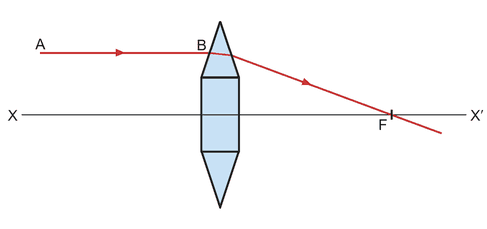
Step 4 — (iv) Name the point F.
F is the second focus of the lens: the point where rays incident parallel to the principal axis meet after refraction. The rays actually meet there, so it is a real focus.
Therefore, (i) a convex lens, (ii) the principal axis, (iii) the ray bends down to meet XX′ at F, and (iv) F is the second focus.
- 414 marks
Question 41
The diagram below shows a lens as a combination of a glass slab and two prisms.

(i) Name the lens formed by the combination.
(ii) What is the line XX′ called ?
(iii) Complete the path of the incident ray AB after passing through the lens.
(iv) The final emergent ray either meets XX′ at a point or appears to come from a point on XX′. Label it as F. What is this point called ?
Solve with AIWritten solution
Solution:
Concept: A lens can be treated as a set of small prisms, and a prism always bends a ray towards its base. In a convex lens the prisms have their bases towards the principal axis; in a concave lens their bases face away from it.
Step 1 — (i) Name the lens.
The prisms have their bases away from XX′, so the combination is thinner in the middle: it is a concave (diverging) lens.
Step 2 — (ii) Name the line XX′.
XX′ is the principal axis of the lens.
Step 3 — (iii) Complete the path.
The ray AB is parallel to XX′ and falls on the upper prism at B. It bends towards the base of that prism, that is, upward, away from XX′. Produced backward (dashed), the emergent ray meets XX′ at a point F on the incident side.
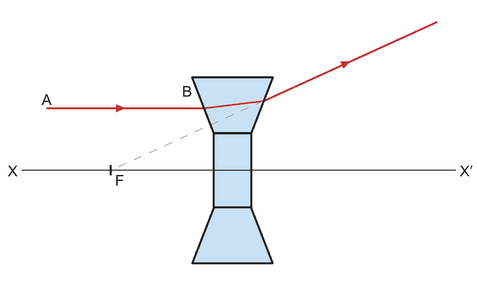
Step 4 — (iv) Name the point F.
F is the second focus of the concave lens: the point from which rays incident parallel to the axis appear to diverge. It is a virtual focus.
Therefore, (i) a concave lens, (ii) the principal axis, (iii) the ray bends up, away from XX′, and (iv) F is the second focus (virtual).
- 424 marks
Question 42
In Fig. 5.17 (a) and (b), and are positions of the two foci of thin lenses. Draw the path taken by the light ray AB after it emerges from each lens.
 Solve with AI
Written solution
Solution:
Concept: In both lenses the ray AB is incident parallel to the principal axis. After refraction such a ray passes through (convex lens) or appears to come from (concave lens) the second focus .
Step 1 — (a) Concave lens.
Here lies on the incident side. The ray diverges (bends away from the axis) at B and travels along the line from through B; produced backward (dashed), the emergent ray passes through .
Step 2 — (b) Convex lens.
Here lies on the other side. The ray converges (bends towards the axis) at B, passes through and continues beyond it.

Step 3 — How to draw it.
Join to the point B where the ray meets the lens, and extend the line on the far side of the lens.
Watch out: Check which side is on in each figure before drawing: it is on the incident side for the concave lens.
Therefore, (a) the ray diverges as if from , and (b) the ray passes through , as drawn.
- 434 marks
Question 43
In Fig. 5.18 (a) and (b), and are the two foci of thin lenses and AB is the incident ray. Complete the diagram to show the path of the ray AB after refraction through each lens.
 Solve with AI
Written solution
Solution:
Concept: In both lenses the ray AB passes through, or is directed towards, the first focus . After refraction such a ray emerges parallel to the principal axis.
Step 1 — (a) Convex lens.
is on the incident side. The ray from A passes through and reaches the lens at B; after refraction it travels parallel to the axis.
Step 2 — (b) Concave lens.
is on the far side. The ray AB is directed towards ; at B it bends away from the axis and emerges parallel to the axis. The dashed line shows its original direction towards .
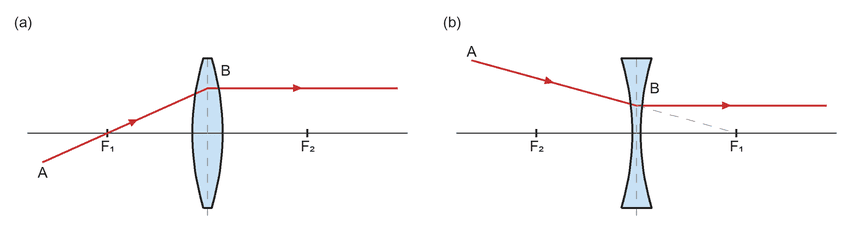
Step 3 — How to draw it.
From B, simply draw a line parallel to the principal axis on the far side of the lens.
Therefore, in both lenses the ray emerges parallel to the principal axis, as drawn.
- 441 mark
Question 44
A ray of light parallel to the principal axis for a concave lens after refraction :
Solve with AIAnswer
(A) passes through the second focus
(B) passes through the first focus
(C) appears to pass through the second focus
- Correct
(D) appears to come from the second focus
Answer: (D) appears to come from the second focus
Concept: A concave lens is a diverging lens: it spreads out a beam parallel to its axis, so the refracted rays never actually meet.
Step 1 — Follow the ray.
A ray parallel to the principal axis bends away from the axis after passing through a concave lens.
Step 2 — Produce it backwards.
Produced backwards (dashed), the refracted ray passes through the second focus , which lies on the same side as the incident light. So the ray only appears to come from .
Watch out: With a concave lens nothing actually passes through a focus; the foci are virtual.
Why the other options are wrong:
- (A) passes through the second focus: that is what a convex lens does; a concave lens never makes this ray actually pass through a focus.
- (B) passes through the first focus: the refracted ray moves away from the axis, so it does not pass through .
- (C) appears to pass through the second focus: the refracted ray moves away from ; only its backward extension meets , so it appears to come FROM , not to pass through it.
Therefore, the ray appears to come from the second focus, option (D).
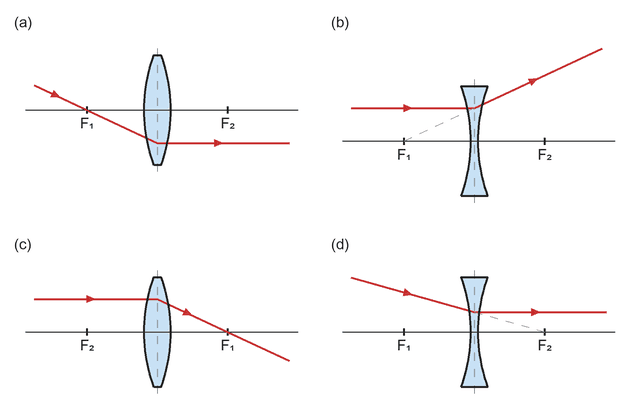
- 451 mark
Question 45
Which of the ray diagrams are correct ?
 Solve with AI
Answer
- Correct
(A) (a)
(B) (b)
(C) (c)
(D) (d)
Answer: (A) (a)
Concept: The foci are named by the side of the lens. For a convex lens is on the incident side and on the far side; for a concave lens is on the incident side and on the far side. Rays through (or towards) emerge parallel; parallel rays go through (or appear to come from) .
Step 1 — Check diagram (a).
In the convex lens the ray passes through on the incident side and emerges parallel to the principal axis. This follows the rule, so diagram (a) is correct.
Step 2 — Check diagrams (b), (c) and (d).
Each ray path has the right shape, but in each one the focus it uses carries the wrong label. The figure shows all four rays with the correct labels.
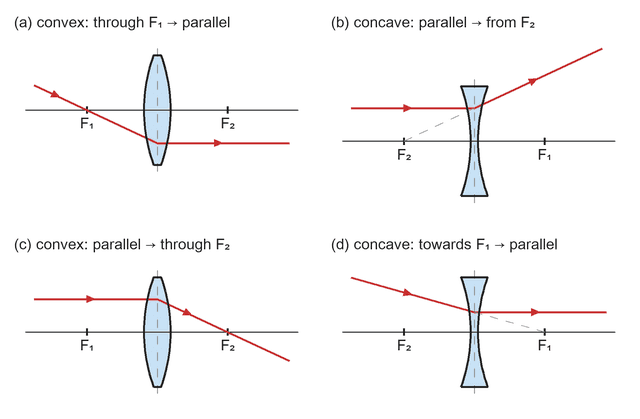
Watch out: Read the focus LABELS, not just the shape of the ray.
Why the other options are wrong:
- (B) (b): in the concave lens a parallel ray should appear to come from on the incident side, but that point is labelled .
- (C) (c): in the convex lens a parallel ray should pass through on the far side, but that point is labelled .
- (D) (d): in the concave lens the ray that emerges parallel must be aimed at on the far side, but that point is labelled .
Therefore, only diagram (a) is correct, option (A).
- 461 mark
Question 46
Identify the incorrect statement :
Solve with AIAnswer
(A) A real image is formed due to actual intersection of the rays refracted by the lens.
- Correct
(B) A virtual image can be obtained on the screen.
(C) A virtual image is erect with respect to the object.
(D) A real image is inverted with respect to the object.
Answer: (B) A virtual image can be obtained on the screen.
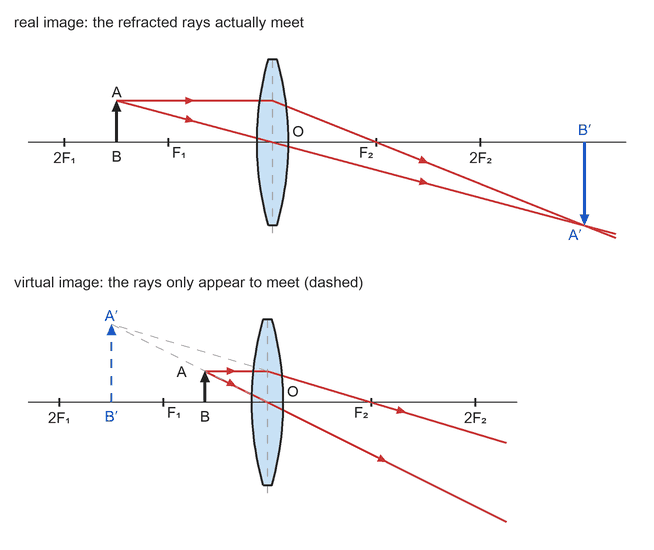
Concept: A real image is formed where refracted rays actually meet, so it can be caught on a screen; a virtual image is where they only appear to meet when produced backwards.
Step 1 — Where a virtual image is.
A virtual image is formed where the refracted rays only appear to meet when produced backwards; no light actually reaches that point.
Step 2 — Judge statement (B).
A screen shows an image only where light arrives, so a virtual image cannot be obtained on a screen; it can only be seen by looking into the lens. Statement (B) is the incorrect one.
Watch out: The question asks for the INCORRECT statement; the other three are true.
Why the other options are wrong:
- (A) this is true: a real image is formed where the refracted rays actually meet.
- (C) this is true: a virtual image formed by a lens is erect.
- (D) this is true: a real image formed by a single lens is inverted.
Therefore, the incorrect statement is (B).
- 471 mark
Question 47
A ray diagram for a convex lens is shown below. In this manner, a convex lens is used in :
 Solve with AI
Answer
(A) camera
(B) cinema
(C) burning glass
- Correct
(D) terrestrial telescope
Answer: (D) terrestrial telescope
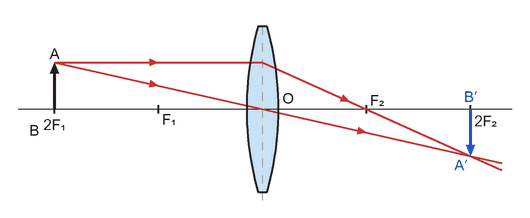
Concept: For a convex lens the image depends on where the object is compared with (one focal length away) and (two focal lengths away): beyond diminished, at same size, between and magnified (all real and inverted); at the image is at infinity; between and O it is virtual, erect and magnified. Each use of a convex lens matches one position of the object.
Step 1 — Read the diagram.
The object AB is at and the image A′B′ is at , so the image is real, inverted and of the same size as the object.
Step 2 — Match the use.
In a terrestrial telescope a convex lens used in this way (the erecting lens) turns the inverted image made by the objective upright without changing its size, so distant objects on the earth are seen erect.
Why the other options are wrong:
- (A) camera: a camera has the object beyond , so its image is diminished.
- (B) cinema: in a cinema projector the film is between and , so the image on the screen is magnified.
- (C) burning glass: a burning glass has its object (the sun) at infinity, so the image is a bright point at .
Therefore, a convex lens is used in this manner in a terrestrial telescope, option (D).
- 481 mark
Question 48
For an object placed at a distance 20 cm in front of a convex lens, the image is at a distance 20 cm behind the lens. The focal length of the convex lens is:
Solve with AIAnswer
(A) 20 cm
- Correct
(B) 10 cm
(C) 15 cm
(D) 40 cm.
Answer: (B) 10 cm
Concept: The lens formula is , and the magnification is .
Step 1 — Write the data with signs.
By the sign convention, distances are measured from O: positive along the incident light, negative against it. The object is in front of the lens and the image behind it, so u = −20 cm and v = +20 cm.
Step 2 — Use the lens formula.
Put u and v into the lens formula (all distances in cm).
Step 3 — Read off f and check.
So f = +10 cm; then 2f is 20 cm, so the object is at and the image at , as expected.

Watch out: Subtracting a negative u adds: 1/20 − (−1/20) = 2/20.
Why the other options are wrong:
- (A) 20 cm: with f = 20 cm the object would be at the focus and the image at infinity.
- (C) 15 cm: with f = 15 cm the lens formula puts the image 60 cm behind the lens, not 20 cm.
- (D) 40 cm: with f = 40 cm the object would be inside the focus, so the image would be virtual, on the object's side.
Therefore, the focal length is 10 cm, option (B).
- 491 mark
Question 49
For the object placed between the optical centre and focus of a convex lens, the image is :
Solve with AIAnswer
(A) real and enlarged
(B) real and diminished
- Correct
(C) virtual and enlarged
(D) virtual and diminished
Answer: (C) virtual and enlarged
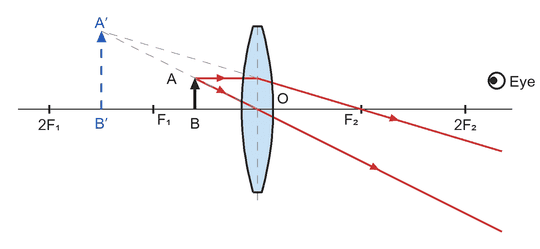
Concept: For a convex lens the image depends on where the object is compared with (one focal length away) and (two focal lengths away): beyond diminished, at same size, between and magnified (all real and inverted); at the image is at infinity; between and O it is virtual, erect and magnified.
Step 1 — Follow the rays.
With the object AB between O and , the lens cannot bring the rays together: they still diverge after the lens.
Step 2 — Find the image.
Produced backwards, the rays meet at A′ on the same side as the object, farther from the lens than AB. The image A′B′ is virtual, erect and enlarged, as in a magnifying glass.
Why the other options are wrong:
- (A) real and enlarged: a real, enlarged image needs the object between and .
- (B) real and diminished: a real, diminished image needs the object beyond .
- (D) virtual and diminished: a virtual, diminished image is what a concave lens forms.
Therefore, the image is virtual and enlarged, option (C).
- 501 mark
Question 50
A concave lens forms the image of an object which is :
Solve with AIAnswer
(A) virtual, inverted, and diminished
- Correct
(B) virtual, upright, and diminished
(C) virtual, inverted, and enlarged
(D) virtual, upright, and enlarged.
Answer: (B) virtual, upright, and diminished
Concept: A concave lens always diverges light, so for a real object its image is always virtual, erect and diminished, formed between and O on the same side as the object.
Step 1 — Nature of the image.
Rays from the object diverge after the lens and only appear to meet when produced backwards, on the object's side. So the image is virtual and upright (erect).
Step 2 — Size of the image.
The image always lies between and the lens, nearer to the lens than the object, so it is diminished, wherever the object is placed.

Why the other options are wrong:
- (A) virtual, inverted, and diminished: a virtual image formed by a lens is erect, not inverted.
- (C) virtual, inverted, and enlarged: the image is neither inverted nor enlarged.
- (D) virtual, upright, and enlarged: a concave lens never forms an enlarged image; a virtual, enlarged image needs a convex lens used as a magnifying glass.
Therefore, the image is virtual, upright and diminished, option (B).
- 511 mark
Question 51
For a convex lens when the object is at , then image is formed at :
Solve with AIAnswer
(A)
- Correct
(B)
(C) beyond
(D) infinity
Answer: (B)
Concept: The lens formula is , and the magnification is . For a convex lens an object at twice the focal length gives an image at twice the focal length on the other side.
Step 1 — Write the object distance.
An object at is two focal lengths in front of the lens, so u = −2f.
Step 2 — Use the lens formula.
Solve the lens formula for 1/v.
Step 3 — Read off the image.
So v = +2f; the image is at . Its magnification is found from m = v/u.
The image is therefore real, inverted and of the same size.
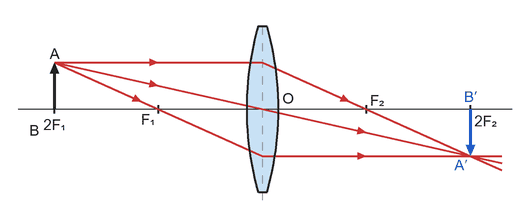
Why the other options are wrong:
- (A) : the image is at only when the object is at infinity.
- (C) beyond : the image is beyond when the object is between and .
- (D) infinity: the image is at infinity when the object is at .
Therefore, the image is formed at , option (B).
- 521 mark
Question 52
A concave lens is used in :
Solve with AIAnswer
(A) in slide projector
(B) as magnifying glass
(C) as burning glass
- Correct
(D) in Galilean telescope
Answer: (D) in Galilean telescope
Concept: Projectors, magnifying glasses and burning glasses all need a lens that converges light; a concave lens diverges light and gives an erect, diminished image.
Step 1 — Look for the diverging use.
Of the four uses, only one needs a diverging lens.
Step 2 — Name it.
A Galilean telescope uses a concave lens as its eye-piece, which gives an erect final image. (A concave lens is also used in spectacles to correct short sight, or myopia.)
Why the other options are wrong:
- (A) in slide projector: a slide projector uses a convex lens to form a real, magnified image on the screen.
- (B) as magnifying glass: a magnifying glass is a convex lens forming a virtual, magnified image.
- (C) as burning glass: a burning glass is a convex lens bringing the sun's rays to a point.
Therefore, a concave lens is used in the Galilean telescope, option (D).
- 531 mark
Question 53
For a concave lens, when the object is at a distance equal to the focal length of the lens, the image is formed at :
Solve with AIAnswer
(A) optical centre
(B) second focus
(C) first focus
- Correct
(D) mid point between the optical centre and second focus of the lens
Answer: (D) mid point between the optical centre and second focus of the lens
Concept: The lens formula is , and the magnification is . A concave lens has a negative focal length.
Step 1 — Write the data.
Let the size of the focal length be . Then f = − (concave lens), and the object is at the focus, so u = −.
Step 2 — Use the lens formula.
Solve the lens formula for 1/v.
Step 3 — Read off the image.
So v = −/2; the image is half the focal length from the lens, on the object's side, midway between O and . Its magnification follows from m = v/u.
So the image is virtual, erect and half the size.
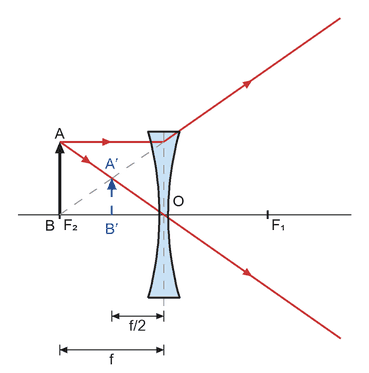
Why the other options are wrong:
- (A) optical centre: the image would be at O only if the object were at the lens itself.
- (B) second focus: the image is at only for an object at infinity.
- (C) first focus: is on the far side; a concave lens forms the image of a real object on the object's side.
Therefore, the image is at the mid point between the optical centre and the second focus, option (D).
- 541 mark
Question 54
Assertion (A) : The focal length of a lens does not change when red light is replaced by blue light.
Reason (R) : The focal length of a lens depends on the refractive index of material of lens.
Solve with AIAnswer
(A) both A and R are true and R is the correct explanation of A
(B) both A and R are True and R is not the correct explanation of A
- Correct
(C) assertion is false but reason is true
(D) assertion is true but reason is false
Answer: (C) assertion is false but reason is true
Concept: The refractive index of glass is not the same for all colours: it is greater for blue light than for red light, so blue light is bent more.
Step 1 — Judge the assertion.
Blue light is bent more by the lens than red light, so it is brought to a focus closer to the lens. The focal length for blue light is shorter, so the focal length does change: the assertion is false.
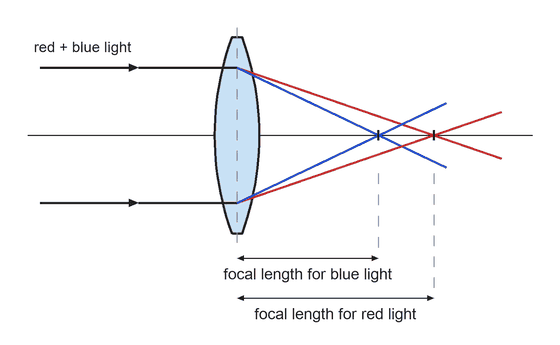
Step 2 — Judge the reason.
The focal length of a lens depends on the refractive index of its material (and on the radii of curvature of its surfaces); a greater refractive index gives a shorter focal length. The reason is true.
Step 3 — Link them.
The reason is true, and in fact it explains why the assertion is false.
Why the other options are wrong:
- (A) it needs the assertion to be true, but the assertion is false.
- (B) it also needs the assertion to be true.
- (D) assertion is true but reason is false: it is the assertion that is false and the reason that is true, not the other way round.
Therefore, the assertion is false but the reason is true, option (C).
- 552 marks
Question 55
A lens forms an inverted image of an object.
(a) Name the kind of lens.
(b) State the nature of the image whether real or virtual ?
Solve with AIWritten solution
Solution:
Concept: A single lens forms an inverted image only when the refracted rays actually meet on the far side of the lens.
Step 1 — (a) Kind of lens.
A concave lens always forms an erect image, so it cannot give an inverted one. The lens is a convex (converging) lens.
Step 2 — (b) Nature of the image.
An inverted image formed by a single lens is formed by the actual meeting of the refracted rays, so it is real and can be obtained on a screen.

Therefore, (a) the lens is convex, and (b) the image is real.
- 562 marks
Question 56
(a) Name the lens which always forms an erect and virtual image.
(b) State whether the image in part (a) is magnified or diminished.
Solve with AIWritten solution
Solution:
Concept: A concave lens always diverges light, so for a real object its image is always virtual, erect and diminished, formed between and O on the same side as the object. A convex lens forms an erect, virtual image only when the object is within its focus.
Step 1 — (a) Name the lens.
A convex lens forms a real, inverted image when the object is beyond its focus, so it does not ALWAYS form an erect, virtual image. The lens that always does is the concave (diverging) lens.
Step 2 — (b) Magnified or diminished.
The image of a concave lens is formed between and the lens, nearer the lens than the object, so it is diminished.
Therefore, (a) the concave lens, and (b) its image is diminished.
- 572 marks
Question 57
Can a concave lens form an image of size two times that of the object ? Give reason.
Solve with AIWritten solution
Solution:
Concept: A concave lens always diverges light, so for a real object its image is always virtual, erect and diminished, formed between and O on the same side as the object. So the magnification of a concave lens is always less than 1.
Step 1 — Follow the rays.
A concave lens diverges the rays falling on it. Their backward extensions always meet between the focus and the lens, nearer to the lens than the object.
Step 2 — Compare the sizes.
So the image is always diminished, whatever the position of the object. An image twice the size of the object needs a magnification of 2, which a concave lens can never give. The diagrams show that the image grows as the object comes closer, but it stays smaller than the object.

Therefore, no: a concave lens always forms a diminished image, so it cannot form an image two times the size of the object.
- 581 mark
Question 58
Give two characteristics of the image formed by a concave lens.
Solve with AIWritten solution
Solution:
Concept: A concave lens always diverges light, so for a real object its image is always virtual, erect and diminished, formed between and O on the same side as the object.
Step 1 — Follow the rays.
A concave lens diverges light, so its image is always formed by the backward extensions of the refracted rays, on the object's side.
Step 2 — State the characteristics.
Such an image is virtual (and erect), and it lies nearer to the lens than the object, so it is diminished.
Therefore, the image formed by a concave lens is virtual (and erect) and diminished.
- 591 mark
Question 59
Give two characteristics of the virtual image formed by a convex lens.
Solve with AIWritten solution
Solution:
Concept: A convex lens forms a virtual image only when the object is between its focus and the lens; the rays then diverge and appear to come from a point behind the object.
Step 1 — Where the image is.
The backward extensions of the refracted rays meet on the same side as the object, farther from the lens than the object.
Step 2 — State the characteristics.
The virtual image is therefore erect (the same way up as the object) and magnified.
Therefore, the virtual image formed by a convex lens is erect and magnified.
- 602 marks
Question 60
Complete the following sentences :
(a) An object is placed at a distance of more than 40 cm from a convex lens of focal length 20 cm. The image formed is real, inverted and......
(b) An object is placed at a distance from a convex lens of focal length . The size of the image formed is ............... that of the object.
(c) An object is placed at a distance 5 cm from a convex lens of focal length 10 cm. The image formed is virtual, upright and ..........
Solve with AIWritten solution
Solution:
Concept: For a convex lens the image depends on where the object is compared with (one focal length away) and (two focal lengths away): beyond diminished, at same size, between and magnified (all real and inverted); at the image is at infinity; between and O it is virtual, erect and magnified.
Step 1 — (a) Object beyond 40 cm.
The focal length is 20 cm, so 2f = 40 cm and the object is beyond . The image is real, inverted and diminished, formed between and . For example, an object 60 cm away gives the image below (all distances in cm).
So v = +30 cm, and the magnification follows from m = v/u.
The image is half as tall as the object.
Step 2 — (b) Object at 2f.
The image is formed at 2f on the other side, and its size is equal to (the same as) that of the object.
Step 3 — (c) Object 5 cm from a lens of focal length 10 cm.
The object is within the focal length, so the image is virtual, upright and magnified. The lens formula confirms it.
So v = −10 cm, and the magnification follows from m = v/u.
The image is twice as tall as the object.
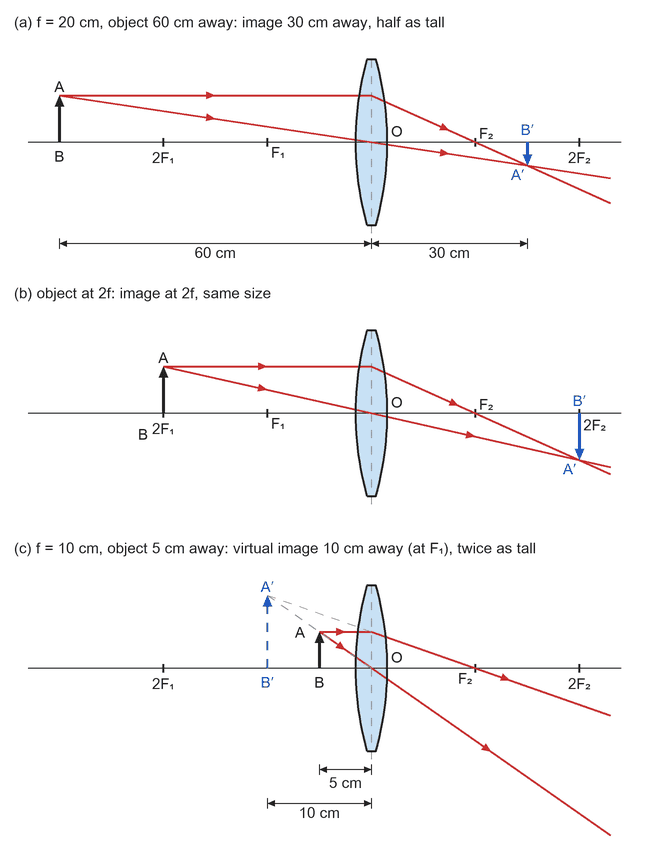
Therefore, the blanks are (a) diminished, (b) equal to, and (c) magnified.
- 612 marks
Question 61
State whether the following statements are 'true' or 'false' by writing T/F against them.
(a) A convex lens has a divergent action and a concave lens has a convergent action.
(b) A concave lens, if kept at a proper distance from an object, can form its real image.
(c) A ray of light incident parallel to the principal axis of a lens, passes undeviated after refraction.
(d) A ray of light incident at the optical centre of a lens, passes undeviated after refraction.
(e) A concave lens forms a magnified or diminished image depending on the distance of an object from it.
Solve with AIWritten solution
Solution:
Concept: Check each statement against the action of each kind of lens and the rules for the principal rays.
Step 1 — (a) F.
A convex lens has a convergent action and a concave lens a divergent action; the statement has them the wrong way round.
Step 2 — (b) F.
A concave lens always forms a virtual image of a real object, wherever the object is placed, because the refracted rays always diverge.
Step 3 — (c) F.
A ray incident parallel to the principal axis passes through (convex lens) or appears to come from (concave lens); it is the ray through the optical centre that goes undeviated.
Step 4 — (d) T.
Near the optical centre the two faces of a thin lens are almost parallel, like a thin glass slab, so the ray goes straight through.
Step 5 — (e) F.
A concave lens always forms a diminished image; only how much smaller it is changes with the distance of the object.
Therefore, (a) F, (b) F, (c) F, (d) T, (e) F.
- 621 mark
Question 62
Where must a point source of light be placed in front of a convex lens so as to obtain a parallel beam of light ?
Solve with AIWritten solution
Solution:
Concept: A ray through the first focus of a convex lens emerges parallel to the principal axis.
Step 1 — Use the rule.
Every ray from a point source at the first focus passes through , so every ray emerges parallel to the principal axis after refraction.
Step 2 — Result.
The emergent rays form a parallel beam. This is how the collimator of a spectrometer gives a parallel beam of light.
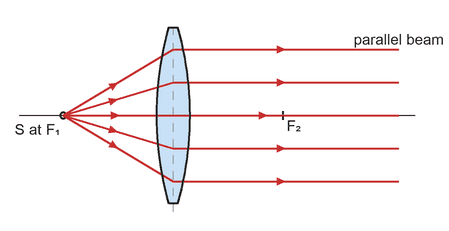
Therefore, the point source must be placed at the first focus of the convex lens.
- 633 marks
Question 63
What are the three principal rays that are drawn to construct a ray diagram for the image formed by a lens ? Draw diagrams to support your answer.
Solve with AIWritten solution
Solution:
Concept: Light goes out from each point of an object in all directions. Any two rays whose paths through the lens we know are enough to locate the image, so we choose three easy ones.
Step 1 — Ray parallel to the principal axis.
After refraction it passes through the second focus (convex lens), or appears to come from (concave lens).
Step 2 — Ray through the optical centre O.
It passes undeviated, straight on, because near O the two faces of the lens are almost parallel.
Step 3 — Ray through (or towards) the first focus.
A ray through (convex lens), or directed towards (concave lens), emerges parallel to the principal axis after refraction.
Step 4 — Locate the image.
The point where any two of these refracted rays meet (or appear to meet) is the image of the top of the object. The diagrams show all three rays for (i) a convex and (ii) a concave lens.

Therefore, the three principal rays are the ray parallel to the axis, the ray through the optical centre, and the ray through (or towards) the first focus.
- 643 marks
Question 64
In the diagrams below, XX′ represents the principal axis, O the optical centre and F the focus of the lens. Complete the path of the rays A and B as they emerge out of the lens.
 Solve with AI
Written solution
Solution:
Concept: Three principal rays fix any image: (1) a ray parallel to the axis passes through (convex) or appears to come from (concave); (2) a ray through the optical centre O goes straight on; (3) a ray through (convex) or aimed at (concave) emerges parallel to the axis.
Step 1 — (a) Convex lens.
Ray B is aimed at the optical centre O, so it passes undeviated, along the same straight line. Ray A passes through the focus F on the incident side (the first focus), so after refraction it emerges parallel to the principal axis.
Step 2 — (b) Concave lens.
Ray B passes through O undeviated. Ray A is directed towards the focus F on the far side (the first focus of a concave lens), so after refraction it emerges parallel to the principal axis.
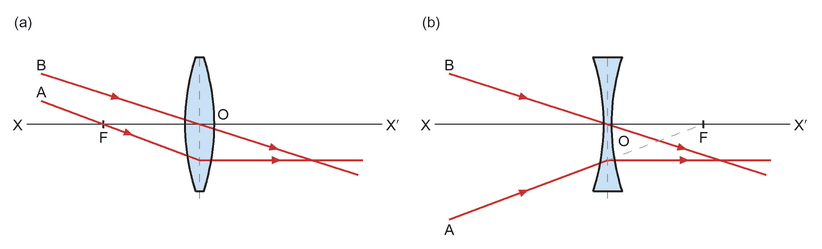
Watch out: For the concave lens, F is on the far side, so ray A is only aimed at it; draw that part dashed.
Therefore, in both lenses ray B goes straight through O and ray A emerges parallel to XX′, as drawn.
- 653 marks
Question 65
Distinguish between a real and a virtual image.
Solve with AIWritten solution
Solution:
Concept: A real image is formed where refracted rays actually meet, so it can be caught on a screen; a virtual image is where they only appear to meet when produced backwards.
Step 1 — Compare the two kinds of image.
The table lists the differences point by point.
Real image Virtual image Formed when refracted rays actually meet. Formed when refracted rays only appear to meet when produced backward. It can be obtained on a screen. It cannot be obtained on a screen; it is seen by looking through the lens. For a single lens it is inverted. For a single lens it is erect. Formed only by a convex lens. Formed by a concave lens always, and by a convex lens when the object is within its focus. Step 2 — Give examples.
The image of a distant object formed on a screen by a convex lens is real; the image of an object seen through a concave lens is virtual.
Therefore, a real image is formed by the actual meeting of rays and can be caught on a screen, while a virtual image is formed where rays only appear to meet and cannot be caught on a screen.
- 663 marks
Question 66
A lens forms an upright and magnified image of an object.
(a) Name the lens.
(b) Draw a labelled ray diagram to show the image formation.
Solve with AIWritten solution
Solution:
Concept: Only a convex lens can form a magnified image, and its image is upright only when it is virtual, that is, when the object lies within the focus.
Step 1 — (a) Name the lens.
The lens is a convex lens, with the object placed between its first focus and the optical centre O.
Step 2 — (b) Draw the rays.
The ray from A parallel to the principal axis passes through after refraction, and the ray from A through the optical centre O goes straight on.
Step 3 — Locate the image.
The two refracted rays diverge. Produced backwards (dashed), they meet at A′; draw A′B′ perpendicular to the axis. A′B′ is virtual, erect and magnified, on the same side as the object.
Therefore, (a) the lens is convex, and (b) the ray diagram shows a virtual, erect, magnified image A′B′.
- 672 marks
Question 67
In each of the following cases, where must an object be placed in front of a convex lens so that the image formed is
(a) at infinity,
(b) of the same size as the object,
(c) inverted and enlarged,
(d) upright and enlarged ?
Solve with AIWritten solution
Solution:
Concept: For a convex lens the image depends on where the object is compared with (one focal length away) and (two focal lengths away): beyond diminished, at same size, between and magnified (all real and inverted); at the image is at infinity; between and O it is virtual, erect and magnified.
Step 1 — (a) Image at infinity.
Place the object at the first focus . The refracted rays come out parallel, so they meet only at infinity.
Step 2 — (b) Image of the same size.
Place the object at , twice the focal length from the lens; the image forms at .
Step 3 — (c) Inverted and enlarged image.
Place the object between and ; the real image forms beyond .
Step 4 — (d) Upright and enlarged image.
Place the object between and the optical centre O; the image is virtual, on the same side as the object.
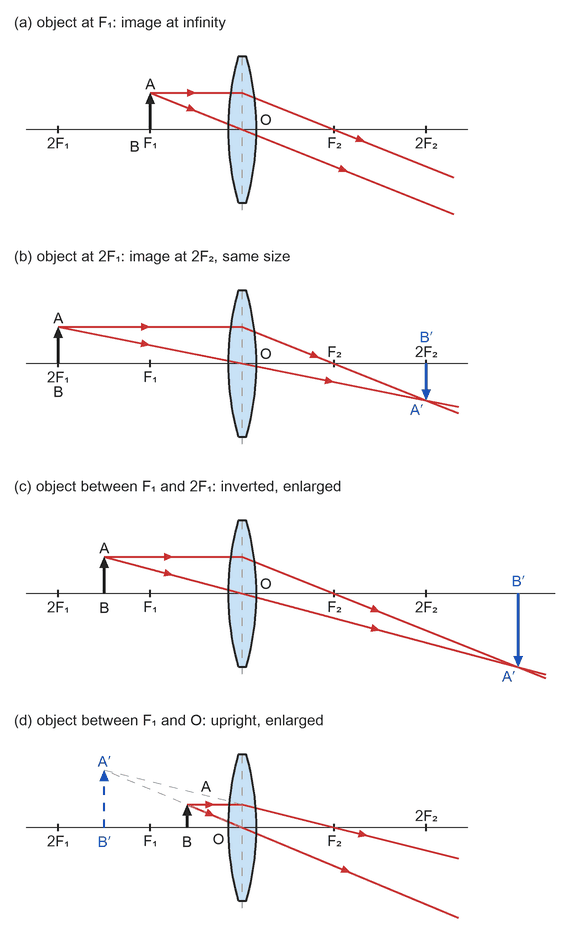
Therefore, (a) at , (b) at , (c) between and , and (d) between and O.
- 683 marks
Question 68
Complete the following table :
Type of lens Position of object Nature of image Size of image Convex Between optical centre and focus Convex At focus Concave At infinity Concave At any distance Solve with AIWritten solution
Solution:
Concept: A convex lens gives a virtual image only for an object within its focus, and parallel rays (image at infinity) for an object at its focus. A concave lens always diverges light, so for a real object its image is always virtual, erect and diminished, formed between and O on the same side as the object.
Step 1 — Complete the table.
Each row is worked out from the rules above.
Type of lens Position of object Nature of image Size of image Convex Between optical centre and focus Virtual and erect Magnified Convex At focus Real and inverted (at infinity) Highly magnified Concave At infinity Virtual and erect (at ) Highly diminished (point-sized) Concave At any distance Virtual and erect (between and O) Diminished Step 2 — Reasons.
For a convex lens with the object between O and the focus, the refracted rays diverge and appear to meet behind the object. With the object at the focus, the refracted rays emerge parallel, so the image is at infinity. For a concave lens, parallel rays from an object at infinity appear to come from , giving a point-sized image there; for any other distance the image lies between and O and is smaller than the object.
Therefore, the table is completed as shown above.
- 695 marks
Question 69
Study the diagram (Fig. 5.48) given below.

(a) Name the lens LL′.
(b) What are the points O and O′ called ?
(c) Complete the diagram to form the image of the object AB.
(d) State the three characteristics of the image.
(e) Name a device in which this action of lens is used.
Solve with AIWritten solution
Solution:
Concept: The given ray from B is parallel to the axis and, after refraction, passes through O′ on the far side. A lens that bends such a ray towards the axis is converging, and the point the ray passes through is its second focus.
Step 1 — (a) Name the lens.
LL′ is a convex (converging) lens, because the ray from B, parallel to the axis, converges to O′ after refraction.
Step 2 — (b) Points O and O′.
O′ is the second focus : rays parallel to the axis meet there after refraction. O, at the same distance on the other side, is the first focus .
Step 3 — (c) Complete the diagram.
Draw a second ray from B through the optical centre of the lens, undeviated. The object AB is between O and the lens, so the two refracted rays diverge. Produced backwards (dashed), they meet at B′ on the same side as the object; draw B′A′ perpendicular to the axis.
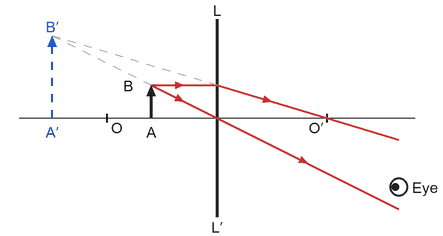
Step 4 — (d) Three characteristics.
The image is virtual, erect and magnified; it is farther from the lens than the object, on the same side.
Step 5 — (e) Device.
This action is used in a magnifying glass (simple microscope), to see small print or small objects enlarged.
Therefore, (a) convex lens; (b) O is the first focus and O′ the second focus; (c) the image A′B′ is as drawn; (d) virtual, erect, magnified; (e) a magnifying glass.
- 705 marks
Question 70
Study the diagram (Fig. 5.49) below.
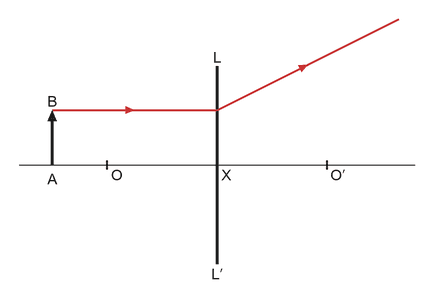
(i) Name the lens LL′.
(ii) What are the points O and O′ called ?
(iii) Complete the diagram to form the image of the object AB.
(iv) State three characteristics of the image.
Solve with AIWritten solution
Solution:
Concept: A ray parallel to the axis that bends away from the axis after refraction shows a diverging lens. For a concave lens, the focus on the incident side is the second focus : the refracted ray appears to come from it.
Step 1 — (i) Name the lens.
LL′ is a concave (diverging) lens, because the ray from B parallel to the axis bends away from the axis after refraction.
Step 2 — (ii) Points O and O′.
O and O′ are the two principal foci. O, on the incident side, is the second focus : the refracted ray, produced backwards, passes through it. O′, on the far side, is the first focus .
Step 3 — (iii) Complete the diagram.
Produce the refracted ray backwards (dashed); it passes through O. Draw a second ray from B straight through the optical centre X, undeviated. The dashed line and this ray meet at B′, between O and the lens; draw B′A′ perpendicular to the axis.

Step 4 — (iv) Three characteristics.
The image is virtual, erect and diminished; it is formed between the focus O and the lens, on the same side as the object.
Therefore, (i) concave lens; (ii) O is the second focus and O′ the first focus; (iii) the image A′B′ is as drawn; (iv) virtual, erect, diminished.
- 715 marks
Question 71
The diagram in Fig. 5.50 shows an object AB and a converging lens L with foci and .
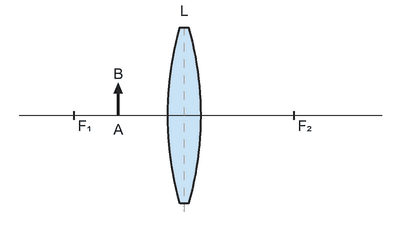
(a) Draw two rays from the object AB and complete the diagram to locate the position of the image CD. Also mark on the diagram the position of eye from where the image can be viewed.
(b) State three characteristics of the image in relation to the object.
Solve with AIWritten solution
Solution:
Concept: The object AB lies between and the lens (within the focal length), so the lens works as a magnifying glass: the refracted rays diverge, and the image is found by producing them backwards.
Step 1 — (a) Draw two rays.
Ray 1 goes from B parallel to the principal axis and, after refraction, passes through . Ray 2 goes from B through the optical centre of the lens, undeviated.
Step 2 — (a) Locate the image CD.
The two refracted rays diverge. Produced backwards (dashed), they meet at D on the object's side; draw DC perpendicular to the axis. CD is the image.
Step 3 — (a) Position of the eye.
The eye is placed on the other side of the lens (the side of ), looking through the lens towards the object. The diverging rays enter the eye and appear to come from D.
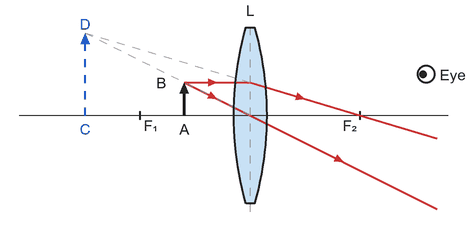
Step 4 — (b) Three characteristics.
The image is virtual, erect and magnified; it lies farther from the lens than the object, on the same side.
Therefore, (a) the image CD and the eye are as drawn, and (b) the image is virtual, erect and magnified.
- 725 marks
Question 72
The diagram in Fig. 5.51 shows the position of an object OA in relation to a converging lens L whose foci are at and .
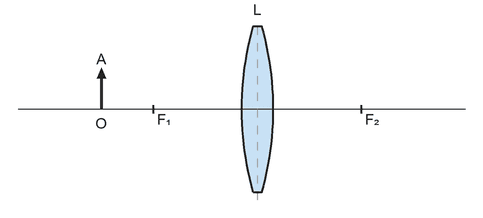
(i) Draw two rays to locate the position of the image.
(ii) State the position of the image with reference to the lens.
(iii) Describe three characteristics of the image.
(iv) Describe how the distance of the image from the lens and its size change as the object is moved towards .
Solve with AIWritten solution
Solution:
Concept: For a convex lens the image depends on where the object is compared with (one focal length away) and (two focal lengths away): beyond diminished, at same size, between and magnified (all real and inverted); at the image is at infinity; between and O it is virtual, erect and magnified.
Step 1 — (i) Draw two rays.
Ray 1 goes from A parallel to the principal axis and, after refraction, passes through . Ray 2 goes from A through the optical centre of the lens, undeviated. The two refracted rays actually meet at A′, below the axis, beyond ; draw A′O′ perpendicular to the axis.

Step 2 — (ii) Position of the image.
The object OA is beyond but nearer than , so the image is on the other side of the lens, beyond .
Step 3 — (iii) Three characteristics.
The image is real, inverted and magnified.
Step 4 — (iv) Object moved towards .
The image moves farther away from the lens and becomes larger and larger. When the object reaches , the refracted rays become parallel and the image is at infinity, highly magnified.
Therefore, the image O′A′ is beyond on the other side, real, inverted and magnified, and it moves away and grows as the object moves towards .
- 735 marks
Question 73
A converging lens forms the image of an object placed in front of it, beyond of the lens. (a) Where is the object placed ? (b) Draw a ray diagram to show the formation of the image. (c) State three characteristics of the image.
- 744 marks
Question 74
A convex lens forms an image of an object equal to the size of the object. (a) Where is the object placed in front of the lens ? (b) Draw a diagram to illustrate it. (c) State two more characterstics of the image.
- 755 marks
Question 75
A lens forms an erect, magnified, and virtual image of an object. (a) Name the kind of lens. (b) Where is the object placed in relation to the lens ? (c) Draw a ray diagram to show the formation of image. (d) Name the device which uses this principle.
- 765 marks
Question 76
A lens forms an image between the object and the lens. (a) Name the lens. (b) Draw a ray diagram to show the formation of such an image. (c) State three characteristics of the image.
- 774 marks
Question 77
Classify as real or virtual, the image of a candle flame formed on a screen by a convex lens. Draw a ray diagram to illustrate how an image is formed.
- 784 marks
Question 78
Show by a ray diagram that a diverging lens cannot form a real image of an object placed anywhere on its principal axis.
- 793 marks
Question 79
Draw a ray diagram to show how a converging lens can form a real and enlarged image of an object.
- 804 marks
Question 80
A lens forms an upright and diminished image of an object placed at its focal point. Name the lens and draw a ray diagram to show the formation of the image.
- 814 marks
Question 81
Draw a ray diagram to show how a converging lens is used as a magnifying glass to observe a small object. Mark on your diagram the foci of the lens and the position of the eye.
- 824 marks
Question 82
Draw a ray diagram to show how a converging lens can form an image of the sun. Hence give a reason for the term 'burning glass' for a converging lens used in this manner.
- 835 marks
Question 83
State the changes in the position, size and nature of the image when the object is brought from infinity up to the convex lens. Illustrate your answer by drawing ray diagrams.
- 845 marks
Question 84
State the changes in the position, size and nature of the image when the object is brought from infinity up to the concave lens. Illustrate your answer by drawing ray diagrams.
- 851 mark
Question 85
The correct lens formula is :
- 861 mark
Question 86
Identify the wrong statement.
- 871 mark
Question 87
For a convex lens, the value of magnification m is :
- 881 mark
Question 88
If the magnification produced by a lens is – 0·5, the correct statement is :
- 891 mark
Question 89
The numerical value of magnification m is always ......... for a concave lens.
- 901 mark
Question 90
If a lens deviates a ray towards its centre, its power is ........... and if it deviates the ray away from its centre, its power is .........
- 911 mark
Question 91
On reducing the focal length of a lens, its power :
- 921 mark
Question 92
The lens of power + 1·0 D is :
- 931 mark
Question 93
Linear magnification m is given by :
- 941 mark
Question 94
If a lens is placed in water instead of air, its power :
- 951 mark
Question 95
The focal length of a lens is (i) positive, (ii) negative. In each case, state the kind of lens.
- 962 marks
Question 96
What information about the nature of image (i) real or virtual, (ii) erect or inverted, do you get from the sign of magnification + or – ?
- 971 mark
Question 97
How is the power of a lens related to its focal length ?
- 981 mark
Question 98
How does the power of a lens change if its focal length is doubled ?
- 991 mark
Question 99
How is the sign (+ or –) of power of a lens related to its divergent or convergent action ?
- 1001 mark
Question 100
The power of a lens is negative. State whether it is convex or concave ?
- 1011 mark
Question 101
Which lens has more power : a thick lens or a thin lens ?
- 1023 marks
Question 102
State the sign convention to measure distances for a lens.
- 1032 marks
Question 103
Write the lens formula explaining the meaning of the symbols used.
- 1043 marks
Question 104
What do you understand by the term magnification ? Write an expression for it for a lens, explaining the meaning of the symbols used.
- 1052 marks
Question 105
Define the term power of a lens. In what unit is it expressed ?
- 1062 marks
Question 106
A lens of power +2·5D is kept in contact with another lens of power –2·5D. What will be the power of the combination of the two lenses ? How will the combination behave ?
- 1074 marks
Question 107
(a) At what position a candle of length 3 cm be placed in front of a convex lens so that its image of length 6 cm be obtained on a screen placed at a distance 30 cm behind the lens ?
(b) What is the focal length of the lens in part (a)?
- 1083 marks
Question 108
A concave lens forms the image of an object kept at a distance 20 cm in front of it, at a distance 10 cm on the side of the object. (a) What is the nature of the image ? (b) Find the focal length of the lens.
- 1093 marks
Question 109
The focal length of a convex lens is 25 cm. At what distance from the optical centre of the lens an object be placed to obtain a virtual image of twice the size ?
- 1103 marks
Question 110
Where should an object be placed in front of a convex lens of focal length 0·12 m to obtain a real image of size three times the size of the object, on the screen ?
- 1114 marks
Question 111
An illuminated object lies at a distance 1·0 m from a screen. A convex lens is used to form an image of the object on the screen placed at a distance of 75 cm from the lens.
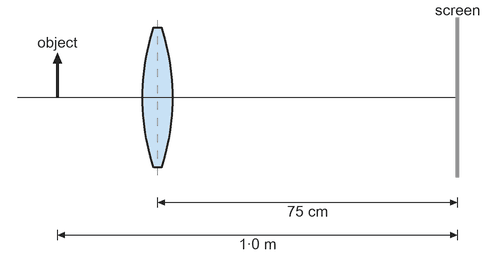
Find : (i) the focal length of the lens, and (ii) the magnfication.
- 1124 marks
Question 112
A lens forms the image of an object placed at a distance of 15 cm from it, at a distance of 60 cm in front of it. Find : (i) the focal length, (ii) the magnification, and (iii) the nature of image.
- 1133 marks
Question 113
A lens forms the image of an object placed at a distance of 45 cm from it on a screen placed at a distance 90 cm on the other side of it. (a) Name the kind of lens. (b) Find : (i) the focal length of the lens, and (ii) the magnification of the image.
- 1143 marks
Question 114
A convex lens forms an inverted image of size same as that of the object which is placed at a distance 60 cm in front of the lens. Find :
(a) the position of the image, and
(b) the focal length of the lens
- 1153 marks
Question 115
A concave lens forms an erect image of rd the size of the object which is placed at a distance 30 cm in front of the lens. Find :
(a) the position of the image, and
(b) the focal length of the lens.
- 1163 marks
Question 116
The power of a lens is + 2·0 D. Find its focal length and state the kind of the lens.
- 1173 marks
Question 117
Express the power (with sign) of a concave lens of focal length 20 cm.
- 1183 marks
Question 118
The focal length of a convex lens is 25 cm. Express its power with sign.
- 1193 marks
Question 119
The power of a lens is – 2·0 D. Find its focal length and its kind.
- 1203 marks
Question 120
The magnification by a lens is –3. Name the lens and state how are and related ?
- 1213 marks
Question 121
The magnification by a lens is +0·5. Name the lens and state how are and related ?
- 1223 marks
Question 122
A photographer needs a lens with focal length of 0.2 m for close up shots. What is the power of the lens required ? How does a lens with higher power affect the focussing capability of a camera ?
- 1233 marks
Question 123
A concave lens has a focal length of 30 cm. Find the position and magnification () of the image for an object placed in front of it at a distance of 30 cm. State whether the image is real or virtual ?
- 1243 marks
Question 124
Find the position and magnification of the image of an object placed at a distance of 8·0 cm in front of a convex lens of focal length 10·0 cm. Is the image erect or inverted ?
- 1251 mark
Question 125
The least distance of distinct vision of normal eye is:
- 1261 mark
Question 126
A magnifying glass forms :
- 1271 mark
Question 127
The maximum magnifying power of a convex lens of focal length 5 cm can be :
- 1281 mark
Question 128
The human eye is not able to see an object distinctly if it subtends an angle :
- 1291 mark
Question 129
A simple microscope uses a :
- 1301 mark
Question 130
Magnifying power of a microscope is given as :
- 1311 mark
Question 131
A person suffering from long sightedness wears spectacles having a ........... lens and a person suffering from short signtedness wears spectacles having .......... lens.
- 1321 mark
Question 132
A boy has two lenses A and B. When lens A is kept near a printed page, letters appear magnified. When lens B is used to see a distant object, an upright image is seen. The lenses A and B are :
- 1332 marks
Question 133
What is a magnifying glass ? State its two uses.
- 1342 marks
Question 134
Where is the object placed with respect to the principal focus of a magnifying glass, so as to see its enlarged image ? Where is the image obtained ?
- 1352 marks
Question 135
Write an expression for the magnifying power of a simple microscope. How can it be increased ?
- 1362 marks
Question 136
State two applications each of a convex and a concave lens.
- 1372 marks
Question 137
How will you differentiate between a convex and a concave lens by looking at (i) a distant object, (ii) a printed page ?
- 1382 marks
Question 138
What would be the effect of a change in the colour of incident light from violet to red on the focal length of the lens ? Also what is the name given to this kind of a defect of lens ?
- 1394 marks
Question 139
Draw a neat labelled ray diagram to show the formation of an image by a magnifying glass. State three characteristics of the image.
- 1404 marks
Question 140
Describe in brief how would you determine the approximate focal length of a convex lens.
- 1415 marks
Question 141
The diagram in Fig. 5.62 shows the experimental set up for determination of focal length of a lens using a plane mirror.
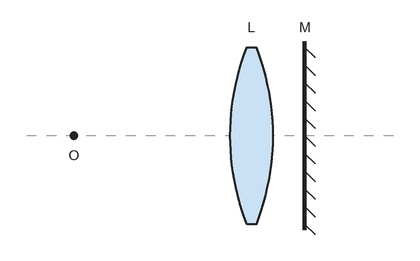
(i) Draw two rays from the point O of the object to show the formation of image I at O itself.
(ii) What is the size of the image I ?
(iii) State two more characteristics of the image I.
(iv) Name the distance of the object O from the optical centre of the lens.
(v) To what point will the rays return if the mirror is moved away from the lens by a distance equal to the focal length of the lens ?
- 1425 marks
Question 142
Describe how you would determine the focal length of a converging lens, using a plane mirror and one pin. Draw a ray diagram to illustrate your answer.
What Class 10 Physics Ch 5 covers
The sections of the chapter, in the order the book takes them. Every question above comes from one of these.
- 01Lens
- 02Technical Terms Related to a Lens
- 03Principal (or Construction) Rays for Ray Diagrams
- 04Characteristics and Location of Images for a Convex Lens
- 05Characteristics and Location of Images for a Concave Lens
- 06Sign Convention and Lens Formula
More ways to study this chapter
The same chapter asked three other ways. Practise it, revise it, and see what the board has set on Ch 5 before.
- Competency-Based Questions (CBQ)Case study questions: a situation, and the part of the chapter that answers it.40questionsOpen
- Previous Year QuestionsQuestions that have actually appeared in board papers, each tagged with its year.30questionsOpen
- Practice QuestionsExtra questions per chapter, for when one attempt at a method is not enough.41questionsOpen
Ch 5 in past ICSE papers
The same chapter as the board has actually asked it. These are worded differently from the textbook exercise, which is the point of reading them.
- 13 marks
Board paper question 1
A lens produces a virtual image between the object and the lens.
(i) Name the lens.
(ii) Draw a ray diagram to show the formation of this image.
Solve with AIWritten solution
Solution:
Concept: A concave (diverging) lens spreads light out. A ray parallel to the principal axis bends away from the axis, as if it came from the focus on the object's side, and a ray aimed at the optical centre O goes straight through. The refracted rays never meet; produced backwards they appear to meet between and O. So a concave lens always forms a virtual, erect and diminished image, between the object and the lens, wherever the object stands.
Given: A lens forms a virtual image between the object and the lens.
Step 1 — Part (i): decide which lens it is.
A convex lens forms a virtual image only when the object is inside its focus, and that image is always farther from the lens than the object (it is magnified). An image lying between the object and the lens must therefore come from a concave (diverging) lens, which always forms a virtual, erect, diminished image on the object's side.
Step 2 — Part (ii): draw the ray parallel to the axis.
Draw the object AB on the principal axis. From A, draw a ray parallel to the axis. After refraction it bends away from the axis; produce it backwards as a dashed line, which passes through the focus on the object's side.
Step 3 — Part (ii): draw the ray through the optical centre.
From A, draw a ray towards the optical centre O. It passes through the lens without bending.
Step 4 — Part (ii): locate the image.
The two refracted rays spread apart and never meet. Their backward extensions (the dashed line and the ray AO) cross at A′. Drop a dashed perpendicular A′B′ onto the axis: A′B′ is the image.
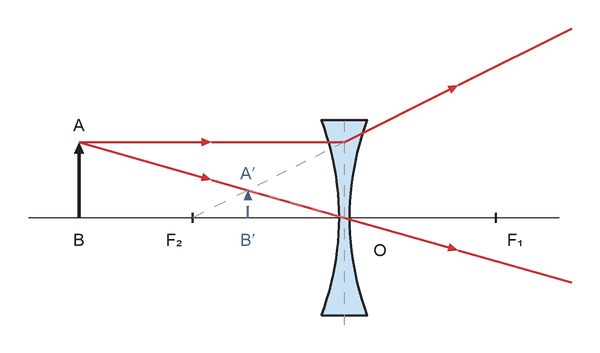
Watch out: Draw the refracted rays as solid lines and their backward extensions as dashed lines; a virtual image is drawn dashed.
Therefore, (i) the lens is a concave (diverging) lens; (ii) the image A′B′ is virtual, erect and diminished, between the object and the lens.
- 23 marks
Board paper question 2
A lens forms an upright and diminished image of an object when the object is placed at the focal point of the given lens.
(i) Name the lens.
(ii) Draw a ray diagram to show the image formation.
Solve with AIWritten solution
Solution:
Concept: A concave (diverging) lens spreads light out. A ray parallel to the principal axis bends away from the axis, as if it came from the focus on the object's side, and a ray aimed at the optical centre O goes straight through. The refracted rays never meet; produced backwards they appear to meet between and O. So a concave lens always forms a virtual, erect and diminished image, between the object and the lens, wherever the object stands.
Given: The image is upright and diminished with the object at the focus.
Step 1 — Part (i): decide which lens it is.
For a convex lens an object at the focus sends out parallel rays, so its image is at infinity and highly magnified, never diminished. An upright, diminished image therefore comes from a concave (diverging) lens, which gives such an image for every position of the object.
Step 2 — Part (ii): draw the two rays.
Place the object AB at the focus on the object's side. From A, draw a ray parallel to the axis: after refraction it bends away from the axis, and its backward extension (dashed) passes through . From A, draw a second ray towards O: it goes straight through.
Step 3 — Part (ii): locate the image.
The backward extension and the ray AO cross at A′. Drop the dashed perpendicular A′B′: the image is virtual, erect and diminished, midway between and O.

Step 4 — Check with the lens formula.
For a concave lens of focal length f, put u = −f and focal length −f in the lens formula:
So the image is at half the focal length from the lens and half as tall as the object, as drawn.
Watch out: For a concave lens the focus on the object's side is (parallel rays appear to come from it); is on the far side.
Therefore, (i) the lens is a concave (diverging) lens; (ii) the image is virtual, erect, half the size of the object, at f/2 from the lens.
- 32 marks
Board paper question 3
The power of a lens is –5D.
(i) Find its focal length.
(ii) Name the type of lens.
Solve with AIWritten solution
Solution:
Concept: Power of a lens: with f in metres; its unit is the dioptre (D). Power is positive for a convex lens and negative for a concave lens.
Given: P = −5 D.
Step 1 — Part (i): write the formula.
Power is the reciprocal of the focal length in metres, so the focal length is the reciprocal of the power:
Step 2 — Part (i): put in the value.
We substitute P = −5 D:
Step 3 — Part (ii): read the sign.
The power (and so the focal length) is negative. A negative focal length belongs to a concave (diverging) lens: parallel rays spread out after passing through it and appear to come from its focus, 20 cm in front of it.

Watch out: Keep the minus sign: it is what tells you the lens is concave.
Therefore, (i) f = −0.2 m (−20 cm), a focal length of 20 cm; (ii) the lens is a concave (diverging) lens.
- 42 marks
Board paper question 4
State the position of the object in front of a converging lens if:
(i) It produces a real and same size image of the object.
(ii) It is used as a magnifying lens.
Solve with AIWritten solution
Solution:
Concept: A convex lens forms these images as the object comes closer: object beyond → real, inverted, diminished, between and ; at → real, inverted, same size, at ; between and → real, inverted, magnified, beyond ; at → at infinity; between and O → virtual, erect, magnified, on the object's side.
Step 1 — Part (i): real image of the same size.
A convex lens gives a real image of the same size only when the object is at , at twice the focal length (2f) from the lens. The rays then meet at on the other side, giving a real, inverted image of the same size.
Step 2 — Part (ii): used as a magnifying lens.
A magnifying lens must give an erect, enlarged image. This happens only when the object is between the focus and the optical centre O, that is, within the focal length. The image is then virtual, erect and magnified, on the same side as the object, and is seen by looking through the lens.
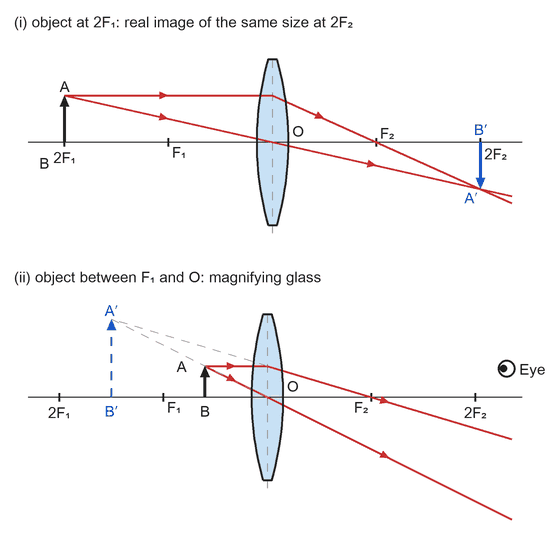
Watch out: A "same size" image needs the object at 2F₁, not at F₁; an object at F₁ sends its image to infinity.
Therefore, (i) at (a distance 2f from the lens); (ii) between and O (within the focal length).
- 53 marks
Board paper question 5
An object AB is placed between O and on the principal axis of a converging lens as shown in the diagram.
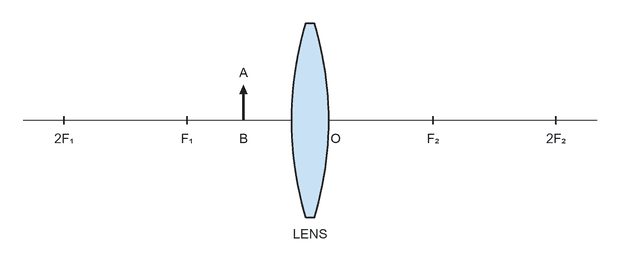
Copy the diagram and by using three standard rays starting from point A, obtain an image of the object AB.
Solve with AIWritten solution
Solution:
Concept: For a convex (converging) lens three standard rays locate an image: (1) a ray parallel to the principal axis passes through the second focus ; (2) a ray through the optical centre O goes straight on; (3) a ray through, or in line with, the first focus emerges parallel to the axis.
Given: Object AB between O and of a converging lens.
Step 1 — Ray 1: parallel to the axis.
From A, draw a ray parallel to the principal axis. After refraction it passes through the second focus .
Step 2 — Ray 2: through the optical centre.
From A, draw a ray towards the optical centre O. It passes through the lens without bending.
Step 3 — Ray 3: in line with the first focus.
Join to A and extend this line (dashed from to A) until it meets the lens. This ray travels as if it came from , so after refraction it emerges parallel to the principal axis.
Step 4 — Locate the image.
The three refracted rays spread apart, so they never meet on the far side. Produce them backwards as dashed lines: they meet at A′. Draw the dashed perpendicular A′B′ to the axis. A′B′ is the image: virtual, erect and magnified, on the same side as the object and farther from the lens. It is seen by looking into the lens from the other side.
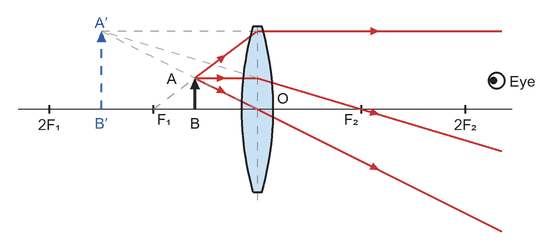
Watch out: With the object inside the third ray does not pass through ; it only lies on the line from through A. draw the refracted rays as solid lines and their backward extensions as dashed lines; a virtual image is drawn dashed.
Therefore, the image A′B′ is virtual, erect and magnified, on the same side of the lens as the object.
- 64 marks
Board paper question 6
An object is placed at a distance of 12 cm from a convex lens of focal length 8 cm.
Find:
(i) the position of the image
(ii) nature of the image
Solve with AIWritten solution
Solution:
Concept: Sign convention (new Cartesian): every distance is measured from the optical centre O. Distances in the direction of the incident light are positive and distances against it are negative. So the object distance u is negative; the image distance v is positive for a real image (on the far side) and negative for a virtual image (on the object's side); f is positive for a convex lens and negative for a concave lens.
Lens formula: .
Magnification: ; it is also the image height divided by the object height. A negative m means a real, inverted image; a positive m means a virtual, erect image.
Given: Object distance u = −12 cm, focal length f = +8 cm (convex lens).
Step 1 — Write the data with signs.
The object is in front of the lens, so u is negative; the lens is convex, so f is positive:
Step 2 — Find the image distance.
From the lens formula, . We substitute the values:
Step 3 — Find the magnification.
The magnification tells us whether the image is erect or inverted, and its size:
Step 4 — State the nature.
The image distance v is positive, so the image is on the far side where the rays really meet: it is real. m is negative, so it is inverted; its size is 2, so it is magnified (twice as tall). This fits the rule: the object (12 cm) lies between (8 cm) and (16 cm), so the image lies beyond .

Watch out: The object distance u is always negative; forgetting its minus sign turns a real image into a virtual one.
Therefore, (i) the image is 24 cm behind the lens (v = +24 cm); (ii) it is real, inverted and magnified (m = −2).
All 30 board paper questions for this chapter, solved the same way.
Class 10 Physics Ch 5 questions students ask
How many questions are there in Class 10 Physics Ch 5?
142 questions. Every one is solved step by step on this page.
Are these Class 10 Physics solutions free?
Yes. Every question and its full working is free to read, with no account needed.
Can I download the Class 10 Physics Ch 5 solutions as a PDF?
There is no PDF to download. Every solution is on this page instead, which means it is searchable, always the current syllabus, and readable on a phone. Use your browser's print option if you want it on paper.